


Contents: Oil change ⬇ Filter replacement ⬇ Filling with fresh engine oil ⬇ Measuring engine oil temperature ⬇ Measuring engine oil pressure ⬇
Oil change
Note: When operating the vehicle under severe conditions, the intervals between engine oil/oil filter changes should be reduced (see Section 1).
1. Regular and frequent replacement of engine oil is one of the basic procedures of preventive maintenance of the car, lying within the qualifications of the average amateur mechanic. Over time, engine oil is subject to aging, which is manifested in its gradual dilution and contamination, leading to premature wear of the internal components of the engine. In addition, some amount of oil burns in the engine cylinders, and also evaporates from the crankcase under the influence of high temperature and pressure. The oil filter must be replaced every time the engine oil is changed.
2. Make sure you have all the materials and tools needed to perform the oil and oil filter change on hand (see accompanying illustration). Also prepare a sufficient amount of rags and old newspapers to collect traces of spilled oil. Before changing the oil, the engine should be warmed up to operating temperature - hot oil has greater fluidity and better washes out sludge and sediment.
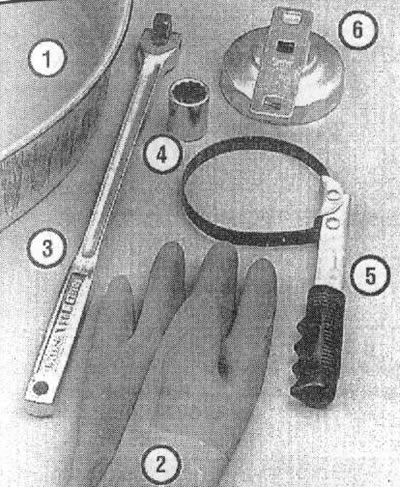
6.2. Basic tools required to change engine oil and oil filter:
1. Drainage container - should be shallow and wide enough to minimize the chance of oil spilling on the ground
2. Rubber gloves - will help protect your hands from burns when oil inevitably gets on them while unscrewing the oil pan drain plug
3. Gate - sometimes the drain plug is tightened so tightly that it requires considerable force to unscrew it
4. Replaceable socket head - used in combination with a wrench or ratchet drive when unscrewing the drain plug, must match the latter in size
5. Strap wrench - allows you to unscrew a full-flow oil filter in conditions of limited access to it
6. A special open-end wrench - is placed on the end of the filter and can then be rotated using a gate or ratchet drive, must match the size of the filter housing
3. Oil can be removed from the engine in two ways: by pumping it out using a special probe (hose with pumping device) through the engine oil dipstick tube (the hose diameter should be no more than 7 mm), or drained through the drain hole in the engine oil pan. Depending on the availability of the appropriate equipment, you can choose either of them - the first is more preferable for private garage conditions, since it does not require special lifting equipment or an inspection pit. Park the car on a flat horizontal surface, apply the parking brake lever and turn off the engine.
4. Remove the oil filler cap (see Section 4).
(Material copied from this website: www.opelbook.ru)
5. On the Z13DT engine, first unscrew the 2 mounting bolts and the hex nut and remove the protective cap of the oil filter. To loosen the bolts, considerable force may be required - if necessary, use a special device for unscrewing the Torx bolts with an extension and a ratchet mechanism.
6. On petrol engines with a working volume of 1.2 l and on diesel engines, using a head (27 mm) or a special key Hazet-2169-27, remove the oil filter cover (see accompanying illustration). When you unscrew the filter cap, the oil will start to drain into the engine oil pan, wait until all the oil has drained from the filter, and then remove the filter element.
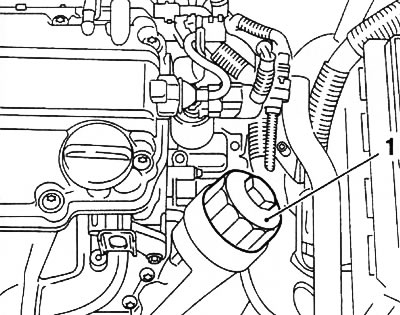
6.6. Oil filter cover (1)
7. Remove the dipstick from the tube (see section 4) and pump out the oil using a special device.
8. If there is no special probe/device, the engine oil can be drained from the crankcase by raising the car with a lift, driving it onto a ramp, or jacking it up and placing it on supports. Make sure that the car is securely fixed in the raised position.
Warning: Never perform any work under a vehicle supported only by the bumper or held in a raised position only by a jack!
9. Get under the vehicle and familiarize yourself with the location of the oil pan drain plug (see accompanying illustration). Remember that the power unit and exhaust system components will remain quite hot during the entire procedure - think of a safe hand manipulation scheme to avoid accidental contact with hot surfaces.
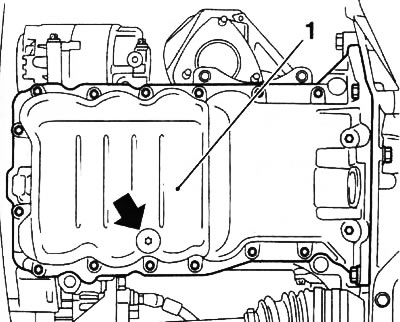
6.9. Drain plug (arrow) of the engine oil pan (1)
10. On Corsa Eco models, it is necessary to first unscrew the 4 mounting bolts and remove the service cover on the engine crankcase guard (see Chapter 2).
11. Place a drain pan capable of holding up to 5 liters of oil under the oil pan, so that at first the stream will flow out through the hole with a decent pressure. Trying not to touch the heated surfaces of the power unit and exhaust system components, unscrew the drain plug from the bottom of the oil pan. When performing this operation, it is recommended to wear protective rubber gloves. Allow the oil to flow freely into the pan, adjusting the position of the latter accordingly as the pressure of the stream weakens.
12. After the oil stops flowing out of the engine crankcase, carefully wipe the drain plug with a clean rag - small metal filings may stick to it, which will immediately lead to contamination of the fresh oil. Check the drained oil for the presence of metal filings. If the engine oil contains a large amount of metal shavings or wear products, this creates a risk of clogging the oil channels and damaging the crank mechanism parts, such as the main or connecting rod bearings of the crankshaft. To eliminate possible consequences, it is necessary to thoroughly clean the oil channels and hoses, if necessary, replace the oil cooler.
13. Wipe the surface of the tray around the drain hole, screw the plug back into place and tighten it to the required torque (see Specifications). Don't forget to replace the copper/aluminum sealing washer on the drain plug thread.
Note: A gasket is sometimes included with a new replacement oil filter.
14. If equipped, reinstall the service cover of the crankcase protection. Collect any spilled oil, remove the drain pan and tools from under the vehicle. Lower the vehicle to the ground. Reinstall the oil filter cover and tighten it to the appropriate torque (see below); on the Z13DT engine, reinstall the oil filter protective cap.
Filter replacement
15. Most of the models considered in this Manual use oil filters with replaceable paper filter elements. Depending on the engine brand, these filters can be of one of two design options (see accompanying illustrations).
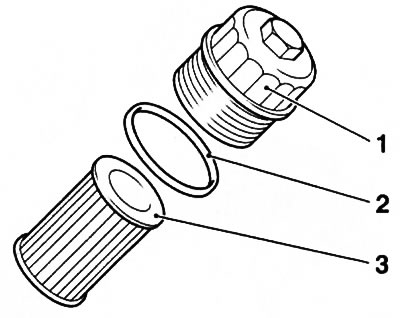
6.15a. Oil filter with replaceable paper element (3) - option A: 1. Oil filter cover 2. Sealing gasket |
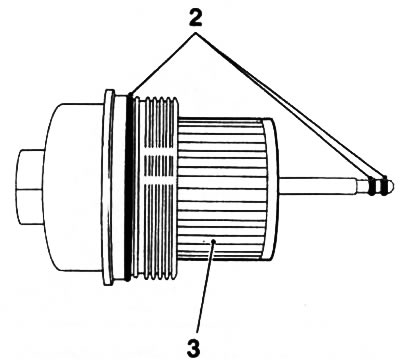
6.15b. Oil filter with replaceable paper element (3) - option B: 2. Sealing gaskets |
16. To unscrew the filter cover with a replaceable paper element, use a socket head (27 mm) or a special Hazet-2169-27 device. After removing the cover, replace the replaceable element and sealing gaskets (see illustrations 6.15). Replace the cover, tightening it to the required torque (see Specifications).
17. Z14XE/Z16SE/Z16XE engines are equipped with a non-separable, fully replaceable filter. Their dismantling at the service station is carried out using a special device Hazet-2172 (see accompanying illustration). In a garage, you can simply pierce the side of the filter housing with the sharp edge of a screwdriver and use the screwdriver as a lever when unscrewing the filter. After unscrewing the filter, to avoid spilling oil, let it drain into a container prepared in advance.
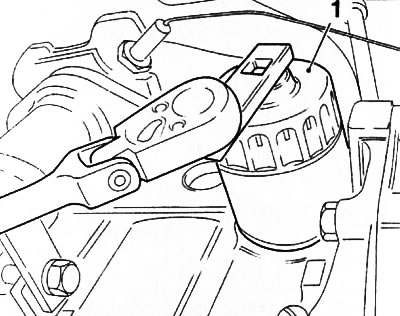
6.17. Removing the replaceable oil filter (1) using a special tool (using the Z16XE engine as an example)
18. Instead of a one-piece replaceable oil filter, you can use a special disassemblable cartridge (see accompanying illustration), allowing replacement of only the filter element.
Note: Regardless of the filter design, replaceable paper elements of the same size are interchangeable.
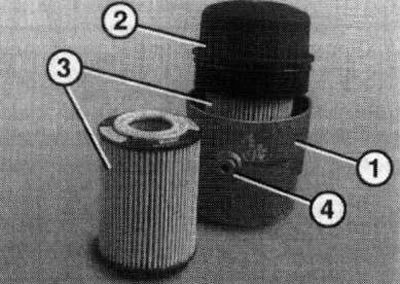
6.18. Disassemblable cartridge with replaceable filter element: 1. Filter housing; 2. Filter cover; 3. Replaceable filter element; 4. Drain hole
19. Before installing the one-piece filter/cartridge, wipe the place where it is mounted on the engine block with a clean rag, remove any remaining old sealing gasket if necessary, lubricate the sealing gasket of the new filter with clean engine oil. Manually screw in the new oil filter until slight resistance appears (the gasket is pressed against the engine flange), then tighten the filter another half turn (tightening force - 15 Nm).
Note: Additional installation information may be provided on the filter housing.
20. The oil filter/replacement element is usually changed when the oil is changed. If necessary, it can be replaced separately, without changing the oil in the engine.
Note: When replacing the filter element/filter, the sealing gaskets must be replaced without fail. As a rule, they are included in the replacement element/filter kit - check their availability when purchasing. If they are not included in the kit, do not forget to purchase them additionally.
Filling with fresh engine oil
Note: The oil filling capacity indicated in the Specifications or the vehicle registration document is approximate. Each time after changing the oil, it is necessary to check its level using the dipstick - if necessary, make the appropriate adjustment.
21. Pour fresh oil into the engine intake pipe - use a funnel to minimize losses. Fill with oil approximately one-quarter less than the volume specified in the Specifications. Wait a few minutes to allow the oil to drain into the pan, then check its level on the dipstick (see Section 4). If the level is above the lower mark, start the engine, ensuring circulation of fresh oil (the oil pressure warning light may go out with a certain delay during the first start-up, due to the need to fill the filter element volume).
Note: Approximately 1 liter of oil is required to raise the oil level from the lower (MIN) to the upper (MAX) mark on the dipstick.
22. After letting the engine run for about one minute, turn it off again and immediately look under the car to check for leaks through the drain plug and oil filter seals. If necessary, tighten any leaking components slightly (observing the tightening forces).
23. During oil circulation in the engine (within 1 minute), the new oil filter is filled. Now it is necessary to check the oil level again and, if necessary, add some more of it, slightly not bringing the level to the upper mark on the dipstick blade (check approximately 5 minutes after turning off the engine - the oil should have time to completely drain into the oil pan). If the oil level is too high, it needs to be pumped out. After a test drive, check the drain plug and oil filter seals again for leaks.
24. During the first few trips after changing the engine oil, try to check its level as often as possible.
25. Used oil drained from the engine cannot be reused and must be handed over to a special collection point. Never pour used oil onto the ground or into the sewer - pour it into a hermetically sealed container and hand it over at the first opportunity.
Measuring engine oil temperature
26. When carrying out various adjustments, it may be necessary to know the exact temperature of the engine oil.
27. The oil temperature must be measured in the engine crankcase at a level of approximately 1 cm from the bottom of the crankcase. The measurement is performed with a special device (see accompanying illustration), for which it is necessary to insert the measuring probe of the device into the guide tube of the dipstick for measuring the engine oil level and push it until it touches the bottom of the crankcase, and then pull it out by about 1 cm.
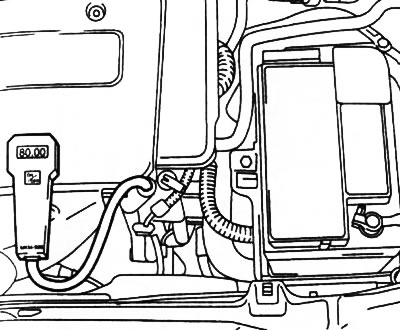
6.27. Engine oil temperature measuring device
28. To prevent air from being sucked in through the guide tube, the hole must be closed with a rubber stopper.
29. Oil temperature depends on engine load. 80°C corresponds to normal engine operating temperature. Under extreme load, oil temperature can reach 150°C.
Measuring engine oil pressure
30. To diagnose the condition of the oil pump and the degree of wear of the crankshaft bearings, the exact value of the oil pressure in the engine lubrication system can be measured. The procedure is described in Chapter 2.
Visitor comments