


Contents: Gear selector lever positions P, R…⬇ Riding position "D4" ⬇ Riding position "D3" ⬇ Riding position "2" ⬇ Riding position "1" ⬇ Device "kickdown" ⬇ Engine braking ⬇ Stop ⬇ "Building a " car ⬇ Precise maneuvering ⬇
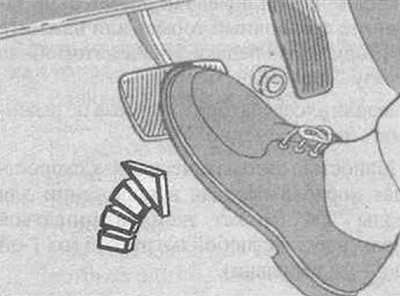
After starting the engine and before engaging any gear, be sure to apply the parking brake or press the brake pedal. Otherwise, the car will immediately "take off".
Do not press the accelerator and brake pedals at the same time.
The fully automatic 4-speed gearbox in the "D4" driving position can be operated with almost any load (from 1st to 4th gear).
After starting the engine and selecting the "D" mode for long-distance driving, the "D4" position is always automatically engaged.
With a soft, even increase in gas, the next, more economical gear is engaged earlier than with a sharp, abrupt press on the pedal. This is one of the ways to correctly switch without loading the gearbox to the mode of optimal fuel consumption.
Manual gear shifting is only permitted in exceptional cases. The driving positions "D3" (press the key - the control lamp No. No. No. lights up), "2" and "1" are only switched on when automatic upshifting is particularly undesirable or when additional engine braking is required.
As soon as the traffic situation allows, switch back to "D4".
Gear selector lever positions P, R and N
- P - stop, parking. The rear wheels are locked. It is installed on a stationary vehicle with the parking brake applied.
- R - reverse. Engages only when the vehicle is stopped.
- N - neutral gear or idle gear.
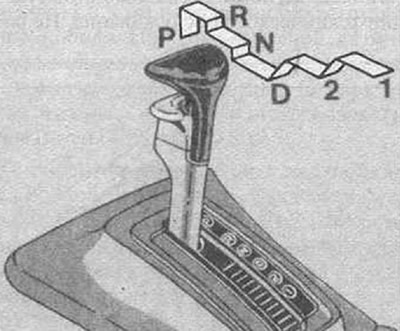
In the "P" or "N" position, the engine starts. Do not add gas when changing gears.
Riding position "D4"
D4 - position for driving in normal conditions in 1st - 4th gears. 4th gear is the most economical. Sets optimal speed, reduces fuel consumption, noise intensity.
To save fuel, the torque converter is additionally equipped with a clutch, which automatically disengages the converter slippage in 4th gear when a certain speed is reached.
After starting the engine and selecting the "D" position, the long-distance driving position D4 is almost always automatically engaged.
If the vehicle's power in position D4 is not sufficient to continue driving, you can switch to D3.
Riding position "D3"
Press the key.
D3 - position for road conditions when driving in 1st, 2nd and 3rd gears (the control lamp 0 lights up).
In position D3 - 4th gear is not engaged.
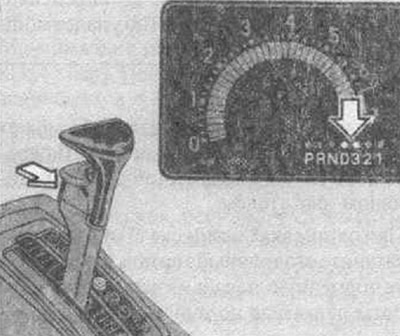
If position D3 is selected at a sufficiently high speed, the automatic will still leave 4th gear engaged until conditions for shifting to 3rd gear are created, for example when braking.
As soon as the road conditions change and allow switching to D4, press the key.
Riding position "2"
2 - position for driving in difficult conditions in 1st and 2nd front, 3rd and 4th are not included.
As soon as road conditions allow, immediately switch to position D4.
Riding position "1"
1 - position for driving in extremely difficult road conditions in 1st gear, for example when driving on a steep descent, only 1st gear is engaged.
As soon as the road conditions change and the necessary conditions are created, immediately switch to gear D4.
Device "kickdown"
When the speed drops to a certain limit, when the engine power drops noticeably, when the accelerator pedal is pressed all the way, the device will automatically engage a lower gear.
The engine power can be fully utilized to increase speed.
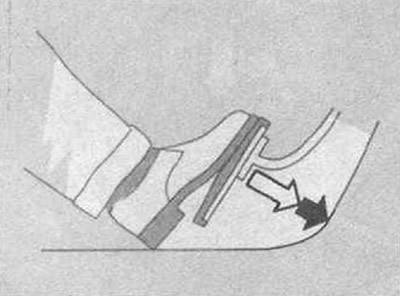
Note: If the vehicle suddenly slows down and cannot accelerate, and the kickdown device does not work, immediately turn off the engine and stop, otherwise the automatic transmission may be seriously damaged. The help of service station specialists is required. Without understanding the cause of the malfunction, you cannot continue driving.
Engine braking
To use engine braking, for example on a descent, engage gear D3, D2 or, if the situation requires, D1 in a timely manner.
The maximum engine braking effect is possible in the D1 driving position. If this gear is selected at high speed, the automatic transmission will remain in 2nd gear until the conditions for switching to 1st gear are created, for example by braking.
Stop
The selected driving position can remain engaged when the vehicle is stopped briefly with the engine running.
When stopping on downhill slopes, be sure to tighten the parking brake or press the brake pedal. It is not advisable to increase engine speed.
In case of prolonged stoppage, the engine must be turned off. When leaving the stopped car, do not forget to tighten the parking brake, set the gear selector lever to the "P" position and remove the key from the ignition switch.
"Building a " car
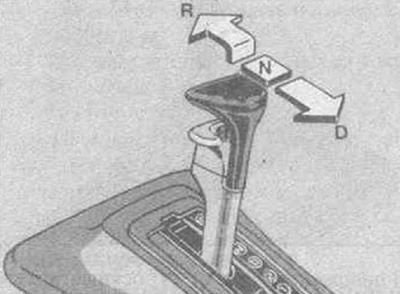
To free a car stuck in sand, mud, snow or a hole by "rocking" it is necessary to alternately change the position of the selector lever from "D" to "R" and vice versa. Gas - medium, engine speed - as low as possible, accelerator pedal movement - smooth.
Precise maneuvering
To perform a precise maneuver when parking a car in a strictly defined place or when entering a garage, etc., use the slow gradual movement method.
Maintain the vehicle's speed and control it with the brake pedal.
Never apply gas while the brake pedal is depressed.
Text copied from this portal: OpelBook.ru
Visitor comments