


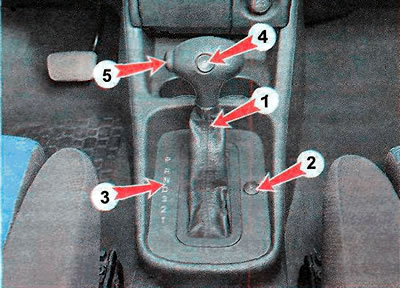
1 - selector lever;
2 - Automatic transmission winter mode switch. When winter mode is turned on, the control lamp lights up in the switch. This mode is intended for starting off on slippery surfaces; starting off in third gear in this case. The mode is turned off by pressing the switch again, turning off the ignition, setting the selector to positions 2 or 1, or when the transmission oil temperature is too high.
3 - scale of the main operating modes of the automatic transmission:
- p — "parking". Designed for long-term parking of the car, the engine and chassis are disconnected, the output shaft of the gearbox is blocked (the car cannot move on its own). Turn on the mode only when the vehicle is completely stopped.
Warning! When parking the vehicle on uphill or downhill slopes, additionally apply the parking brake.
- R - "reverse". Designed to move the car backwards. Turn on the mode only when the car is completely stopped.
- N - "neutral". Designed for short-term parking of the car and towing, the engine and chassis are disconnected.
- D - "drive". Designed for moving the car forward, including for short-term parking under all standard road conditions.
Note. In many materials devoted to the operation of automatic transmissions, there is a very common recommendation to engage "neutral" during stops while driving for more than 1-2 minutes. On these cars, during stops (and holding the brake pedal) for more than two seconds, the engine is automatically disconnected from the transmission (the "neutral" is engaged), so in this case the above recommendation does not make sense. When the brake pedal is released, the "neutral" is disengaged.
3, 2, 1 - additional forward driving modes, in which gear shifting is limited to third, second or first, respectively. They can be useful in certain road conditions: towing a trailer, driving in dense city traffic at low speed, driving on rough terrain. These modes can also be used for engine braking.
4 - switch for the sport mode of the automatic transmission. When switched on, the corresponding indicator lamp lights up on the instrument panel (see "Instrument panel"). The mode is designed for dynamic movement of the car using the maximum power and traction capabilities of the engine. Fuel consumption increases. The mode is switched off by pressing the switch again or by turning off the ignition.
5 - selector lock switch to prevent accidental movement.
The operating modes are switched by moving the selector handle forward and backward, while the control lamp lights up opposite the symbol of the selected mode. The engine can only be started with the selector in positions P and N. To switch from P to R and back, from N to R, from D to 3 and from 2 to 1, you should additionally press switch 5. In addition, to switch from P to R, you must press the brake pedal. When switching modes, do not press the gas pedal.
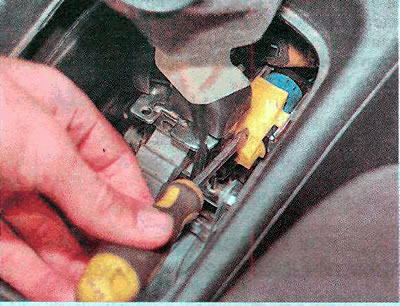
Note: If the battery is disconnected or dead, to move the selector from position P, do the following:
- 1. Lift up the selector trim (see "Parking brake actuator lever - replacement").
- 2. Using a slotted screwdriver, move the solenoid forward a little and move the selector.
Visitor comments