
The transmission range selector lever can be in one of seven fixed positions «R», «R», «N», «D», «3», «2» or «1». The engine can only be started in positions «R» or «N» lever. To switch AT, move the lever along the guide groove.
A panel is mounted to the left of the selector lever on the center console (see illustration 23.1) with the designation of AT modes. When switching the AT mode, the LED next to the corresponding designation lights up.
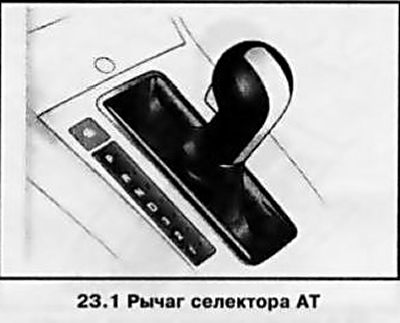
The selector lever is equipped with a release button. The lock release button must be pressed when the lever is moved to the positions «R» And «R», when switching to positions «3» or «1», as well as when removing the lever from the position «R». The lever can be moved to other positions without pressing a button.
Attention: Do not increase the engine speed with the selected forward or reverse driving mode and the brake pedal depressed! Switching the transmission from position to working position must be carried out at idle engine speed - keep the foot brake pedal depressed!
The procedure for starting the engine is described in the above (see Section 21).
When starting off, in order to disable the blocking of the AT selector lever, depress the foot brake pedal. Press the lock release button and move the lever to the position» D», «3», «2» or «1» to move forward or «R» for reversing.
Release the parking brake - brake warning light on the instrument cluster (see Section 16) should go out.
Release the foot brake pedal and gently depress the gas.
Take your foot off the gas pedal when shifting gears.
Attention: When the gear is engaged and the brake pedal is released, the car starts to move slowly, even if the gas pedal is released! In no case do not press the gas and brake pedal at the same time - otherwise it may lead to failure of the AT!
Standard selector lever positions
Position «R». In this position, when the key is removed from the ignition lock, the transmission is locked, providing additional protection for the parked car. In this case, the withdrawal of the lever from the position «R» impossible even when depressing the brake pedal. A description of the lever lock emergency disengagement procedure is given below.
Note: The key can only be removed from the ignition switch after the selector lever has been moved to the «R» and releasing the foot brake pedal. To avoid damage to the AT, move the lever to the position «R» only after the vehicle has come to a complete stop.
Position «R».Setting the selector lever to this position allows the vehicle to move in reverse. Switching the lever to position «R» out of position «N» (neutral) do it only after the car has come to a complete stop - in case of an unsuccessful attempt, depress the foot brake pedal and slowly move the lever first back to the position «N», then to position «R». Don't forget to press the unlock button.
Position «N». In this position, none of the AT gears will be engaged. Position «N» (neutral) used to start a stalled engine while driving or when stopping a car with a running engine. If for any reason you need to move away from the vehicle, first move the range selector lever to the position «R». When pulling the lever out of position «N» depress the foot brake pedal.
Attention: Putting the transmission into position «N» while driving, there is a risk of serious internal damage to the gearbox!
Position «D». In this position, the range selector lever must be constantly when the car is moving in normal road conditions, this ensures automatic switching of the AT between forward gears in accordance with changes in speed mode and the degree of depressing the gas pedal from first gear to the highest. The corresponding display will show «D» and the currently enabled transmission.
For a sharp acceleration of the car when the transmission is operating in the range «D» squeeze the gas pedal to the stop. The transmission will then automatically shift to the next lower gear (kickdown mode), which will provide more power when accelerating. When the pedal is released, the transmission returns to the original, higher gear that meets the characteristics of the current speed mode.
Selector lever positions for driving in special conditions
AT modes «3», «2» or «1» are designed to limit automatic gear shifting above the specified step and are used when driving in special conditions.
Position «3». In this position, the transmission shift stroke is limited to third gear. The mode can be used to implement engine braking. Turning on the range «3» also useful for avoiding unnecessary automatic transmission cycling between third and fourth gears - such cyclic transmission shifts can be observed, for example, when driving in heavy traffic with frequent slowdowns and stops.
Position «2».When the range is turned on «2» the automatic transmission will always operate in second gear. It is recommended to use this limitation when towing a trailer, when driving on hilly terrain, or when applying engine braking on a steep downhill. Position «2» can also be used when starting off on slippery road surfaces, or when driving on snow, helping to prevent severe slipping of the vehicle's drive wheels.
Note: If the mode «2» switched on at too high a speed, the transmission will continue to operate in the previous gear until the shift point to 2nd gear is reached.
Position «1».When the range is turned on «1» automatic transmission will constantly work on the first (inferior) transmission. The mode can be used when driving with a trailer on particularly steep descents and long passes, when driving in deep snow, sand and mud.
Note: If the mode «1» switched on at too high a speed, the transmission will continue to function in 2nd gear until the shift point to 1st gear is reached - for example, by braking.
AT emergency operation mode
A malfunction of the AT is warned by the corresponding control lamp on the instrument cluster (see Section 16). If the lamp does not go out after starting the engine or lights up while driving, the automatic transmission mode is disabled. To continue driving, you can change gears manually using the selector lever. In this case, the inclusion of 2nd gear is completely blocked and the switching is carried out according to the scheme «1-3-4». In this case, the following scheme of the ratio of the positions of the lever takes place:
- 1 1st gear
- 2 3rd gear
- 3 4th gear
- D 4th gear
- N Neutral
- R Reverse
- P Parking position
To eliminate the causes of AT failures, contact the specialists of the Opel service station.
Emergency disengagement of the selector lever lock in position «R»
The need for emergency disengagement of the AT selector lever lock in position «R» occurs in the event of a breakdown of the locking mechanism, as well as when it is required to tow a faulty vehicle. In addition, the selector lever may not move out of the locked position if the battery has an insufficient charge level.
If the cause of the malfunction is a discharged battery, start the engine from an auxiliary source (see chapter «Introduction»).
If you refuse to disable the lock for other reasons, perform the following operations:
- Engage the parking brake;
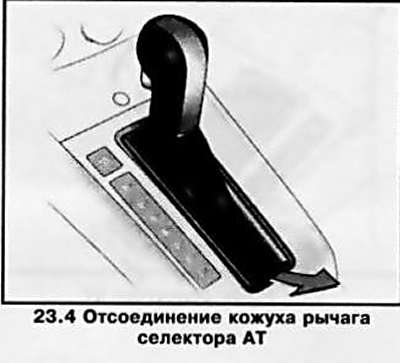
- Release the back of the casing from the panel latches (see illustration 23.4) selector lever on the center console and move the cover up and to the side (see illustration 23.5);
- Using a screwdriver, push the yellow stopper forward and remove the lever from the P position;
- Return the selector cover to its original position and make sure it is securely fixed.
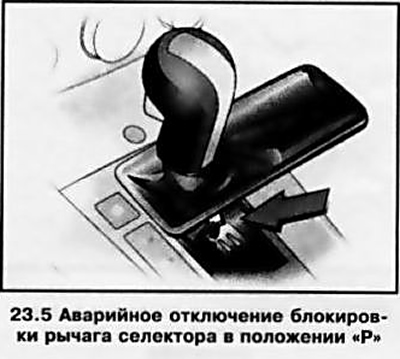
When switching the selector lever back to the position «R» blocking occurs again.
At the first opportunity, contact an Opel workshop to eliminate the cause of the malfunction, or / and recharge the battery.
Some methods of driving a car with AT
- When stopped with the engine running, the gear can be left in, but the vehicle must be held from shifting by the parking brake or by using the foot brake pedal. When stopping on inclines, be sure to apply the parking brake or depress the brake pedal.
- For precise maneuvering, for example, when installing in a parking lot, driving into a garage, etc., you can use the property «sliding». To do this, with the gear engaged, without depressing the gas pedal, control the movement of the car by releasing the brake pedal.
- If the car gets stuck in sand, mud, snow or in a ditch, with the gas pedal lightly pressed, alternately move the selector lever back and forth between positions «D» And «R». Keep the engine speed as low as possible, avoid pressing the gas pedal sharply.
- Before leaving the car when parking, you must first apply the parking brake, then set the gear lever to position P and remove the key from the ignition or, if the Open&Start system is equipped, remove the smart key from the car. Be sure to lock the car, otherwise the battery may be discharged during a long period of parking.
Attention: Do not keep the car in gear by increasing the engine speed, in order to avoid overheating of the gearbox! For longer stops, such as in a traffic jam or at a crossing, it is recommended to turn off the engine.
Attention: The method described above can only be used in exceptional cases.
Note: On models equipped with the Open&Start system, when the ignition is switched off, the indication display of the selected AT mode (see Section 16) indicator will flash for 10 seconds «R», if position P was not engaged before parking or the parking brake was not applied.
Visitor comments