


Models with mechanical ignition key
- a) Set the parking brake;
- b) Engage neutral gear (manual transmission)/move the selector lever to position "P" or "N" (automatic).
- c) Turn the ignition key to position 2 and wait until the pre-glow indicator lamp goes out (see Section 16) (diesel models);
- d) Press the clutch pedal to facilitate engine starting (manual transmission);
- e) Depress the foot brake pedal (AT models);
- f) Without pressing the gas pedal, turn the key in the ignition switch to the right until it stops. As soon as the engine starts, immediately release the key;
- g) If starting fails within 10 seconds or if the engine stalls again, wait at least 30 seconds with the key removed from the ignition switch and try starting again as described above;
- h) On petrol models with unstable speeds (for example, when misfiring) to avoid failure of the catalytic converter (see Section 28) try to run the engine only for a short time and do not allow heavy loads - immediately drive the car to the Opel service station;
- i) On diesel models, if the mixture does not ignite regularly, hold the starter key until the engine runs at a steady speed, but not more than 20 seconds. If the engine does not start during this time, remove the key from the ignition switch, then repeat the warm-up and starting procedure (see above).
- j) Do not turn the engine with the starter for more than 30 seconds at a time, otherwise the starter may be damaged;
- k) If starting the engine is difficult at very low or very high ambient temperatures, use the accelerator pedal to make starting easier;
- l) In summer, in hot weather, when starting the engine within 30 minutes after it has stopped, starting must be done with the gas pedal fully depressed;
- m) Let the engine idle for at least 30 seconds before driving off. To gradually warm up the engine, start driving at moderate speeds, especially in cold weather.
Note: On models equipped with the Easytronic robotic gearbox, even if a gear is engaged, the gearbox automatically switches to neutral before starting the engine.
Note: If the fuel in the tank is completely used up, the starting process after refueling takes significantly longer (up to 1 minute) — in this case, air is removed from the fuel system (see Chapter 1, Section 8).
The article was published on the website: OpelBook.ru
Features of engine starting on models with an electronic key of the Open system&Start
On models with the corresponding configuration, instead of the ignition switch, a "Start/Stop" button is mounted in the console part of the instrument panel (see illustration 21.1), by means of which the engine is started and stopped.
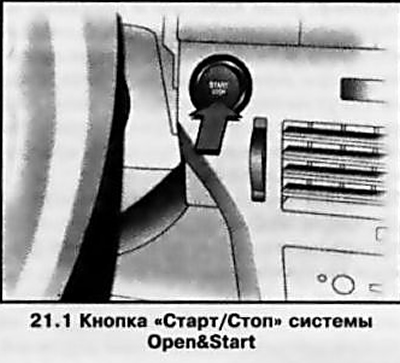
To start the engine, follow the same procedures (see above) as on vehicles with a mechanical ignition key, but instead of turning the key, use the Start/Stop button (see below).
When you press the button, the system checks the access permission of the given key - in this case, the electronic key (see Section 2) must be recognized inside the vehicle (it should be with the driver, for example, in the pocket of his jacket).
Caution: Do not leave the electronic key in the trunk or directly in front of the information display!
After the key is recognized, the ignition is switched on and the electronic engine start lock and the electromechanical steering wheel lock are simultaneously switched off.
The next time you press the "Start/Stop" button with the clutch pedal (manual transmission)/brake depressed and the AT selector lever in position P or N, the engine starts. The button must be held until the engine starts, but for at least 1 second. When you release the button, the engine starting process is interrupted.
Note: When the clutch/brake pedal is depressed, the engine can be started by pressing the "Start/Stop" button for the first time.
If the button is pressed while the engine is running or with the ignition on without depressing the clutch/brake pedal, the ignition is switched off and the engine is stopped. At the same time, the engine start interlock is activated.
Attention: When starting/stopping the engine, the vehicle must be stationary!
If the vehicle is stationary, opening and then slamming the driver's door activates the steering wheel lock.
If a fault occurs in the electronic key system, the corresponding indicator lamp on the instrument cluster should light up (see section 16) in constant or flashing mode - the engine may not start the next time you try to start it. If the lamp is activated while the engine is running, you must hold the "Start/Stop" button down a little longer than usual to turn off the ignition. Follow all the recommendations in Section 16 and contact an Opel service station to fix the problem. If necessary, the engine can be started in emergency mode (unlocking/locking doors in emergency mode see Section 8).
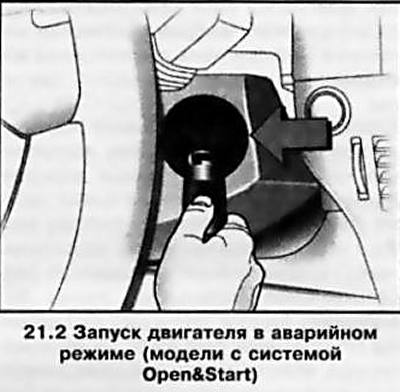
To start the engine in emergency mode, a special device is mounted on the right side of the steering column, marked with a pictogram) (see illustration 21.2). It is necessary to hold the electronic key at the designated place for some time, press the brake/clutch pedal, and in AT, press the brake pedal and set the selector lever to position P or N and press the "Start/Stop" button again.
Please note: This option is only available in case of emergency - please fix the problem as soon as possible or contact an Opel service station!
Visitor comments