
Engine start
The engine can only be started when the brake pedal is depressed. On the display of the selected transmission mode (see Section 16) indicator lights up «N». When the brake pedal is not pressed, the indicator is activated in flashing mode. Switching the selector lever to neutral before starting the engine is not necessary - the gearbox automatically switches to neutral.
Note: In this case, the engine starts after a short delay.
Gearshift control with gearshift lever
The scheme of switching gears and modes of the Easytronic system is shown in illustration 24.1. The shift lever must always move in each direction as far as it will go. After each operation, it automatically returns to the middle position, so you must constantly monitor the indication on the transmission mode selection display (see Section 16).
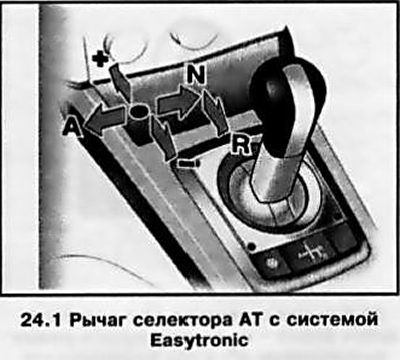
When moving the gear lever to the position «N» neutral gear will be engaged.
To move away, press the foot brake pedal, release the parking brake and move the gear lever to the position «A», «+» or «-» - Easytronic will turn on automatic mode, first gear (with winter mode activated (see below) - second gear). The appropriate indicator will light up on the transmission mode select display (see Section 16). After releasing the brake, the vehicle starts to move slowly. If you need to start in reverse, select the appropriate gear (see below).
It is also possible to move off without pressing the brake pedal, if you press the gas pedal while moving the lever. If the accelerator or brake pedal is not pressed, the gear will not engage - the indicator flashes on the display «A». After a few seconds, the indicator will reappear on the display «N» - Repeat the starting procedure as described above.
Automatic shift mode
In automatic mode, gear shifting is performed automatically depending on road conditions and the degree of pressure on the gas pedal.
Automatic mode is activated by moving the gear lever to the position «A». With each subsequent pressing of the lever to the position «A» will shift between automatic and manual transmission.
Manual shift mode
In manual mode, the gears are switched manually - with a short movement of the lever in the direction «+» a higher gear will be engaged, and with a short movement in the direction «-» - lower - the indicator lights up on the transmission mode selection display «M» and included transmission.
Note: If the engine speed is too low, the Easytronic transmission will automatically downshift even in manual mode.
If a higher gear is selected when the speed is insufficient or a lower gear is selected if the speed is too high, the shift will not take place. By repeatedly moving the shift lever at short intervals, it is possible to skip gears.
When the automatic mode is on, moving the gear lever to the position «+» or «-» will switch to manual mode, this will shift to a higher or, respectively, to a lower gear - the indicator will light up on the display of the selected transmission mode «M» and the currently enabled transmission.
Engaging reverse gear (R)
Attention: Reverse gear can only be engaged after the vehicle has come to a complete stop!
To engage reverse gear, press the brake pedal (when starting, release the parking brake) push the gear lever to the position «N» and then, without releasing the lever, to the position «R» - the indicator will light up on the transmission mode selection display «R». After releasing the brake, the vehicle starts to move slowly.
It is also possible to start in reverse without depressing the brake pedal by depressing the accelerator pedal while moving the shift lever. If the accelerator or brake pedal is not pressed, the gear will not engage, the indicator flashes on the display «R». After a few seconds, the indicator will reappear «N» - Repeat the starting procedure as described above.
Some driving techniques with the Easytronic system
For a sharp acceleration of the car when the transmission is operating in automatic mode, depress the gas pedal, overcoming the point of resistance until it stops. At the same time, if the engine worked in the speed range close to the lower threshold value for the current gear, the gearbox will automatically switch to an adjacent lower gear, which will provide more power when accelerating; if the engine speed was close to the upper threshold value of the current gear, more high gear. When depressing the gas pedal, overcoming the point of resistance, shifting to a higher gear will occur automatically and in manual mode.
Note: When the gas pedal is fully depressed, manual gear shifting is not available.
When pulling away in SPORT mode (see below) when the gas pedal is fully depressed, the drive wheels may slip slightly - this ensures maximum acceleration of the car.
When driving downhill in automatic mode, Easytronic will only shift up if the engine speed is increased by depressing the accelerator pedal, allowing engine braking with the pedal released. When braking, the Easytronic transmission downshifts normally.
For engine braking on slopes when driving in manual control mode, shift to a lower gear in a timely manner.
The vehicle is stopped using the brake pedal. At the same time, 1st gear is automatically engaged in both automatic and manual modes (with winter mode activated (see below) - 2nd gear) or reverse gear (if it was previously driven in reverse) and the clutch disengages. If the driver's door is opened while the engine is running and the brake pedal is not depressed, a warning horn sounds - move the gear lever to the position «N» and apply the parking brake.
When stopping on an incline, be sure to hold the vehicle with the parking brake or the main brake pedal.
Attention: Never keep the car in gear by increasing the engine speed, otherwise the clutch will automatically engage if it overheats!
For longer stops, such as in a traffic jam or at a level crossing, turn off the engine.
For precise maneuvering, for example, when parking, driving into a garage, etc., you can use the property «sliding». To do this, when the gear is on, without depressing the gas pedal, control the movement of the car by releasing the brake pedal.
Note: To protect against damage to the Easytronic transmission if the clutch becomes too hot, the «sliding» turns off automatically.
Attention: Never depress the gas and brake pedals at the same time!
If the car gets stuck in sand, mud, snow or in a ditch, with the gas pedal lightly pressed, alternately move the selector lever back and forth between positions «A» And «R» or «+» And «-». Keep the engine speed as low as possible, avoid pressing the gas pedal sharply.
Attention: The method described above can only be used in exceptional cases.
Before leaving the car when parking, it is necessary to apply the parking brake and remove the key from the ignition or, in the presence of the Open&Start system, remove the electronic key from the car - while the last current gear remains engaged (see transmission mode selection display).
Note: If before switching off the ignition the lever was pressed to the position «N» - transmission is not included.
After the ignition is switched off, Easytronic stops responding to shift lever movements. Be sure to lock the car, otherwise the battery may be discharged during a long period of parking.
If the parking brake is not engaged, the corresponding control lamp will flash for a few seconds after the ignition is turned off (see Section 16), and if the driver's door is opened, an audible warning chime will also sound. It is necessary to turn on the ignition, shift into gear, turn off the ignition and apply the parking brake.
Easytronic emergency operation
In the event of a malfunction in the Easytronic gearbox, the corresponding warning lamp in the instrument cluster lights up (see Section 16) - You can continue driving, but the manual shift becomes unavailable.
In case of serious malfunctions, the indicator F is additionally displayed on the transmission mode selection display - you must not continue driving! To eliminate the causes of failures, contact the specialists of the Opel workshop.
Clutch release
In the event of an interruption in the power supply, if the gear was engaged, the clutch does not disengage - the car cannot be moved.
If necessary, remove the car from the flow of moving traffic, the clutch can be disengaged as follows:
- Apply the parking brake and turn off the ignition;
- open the hood (see Section 4);
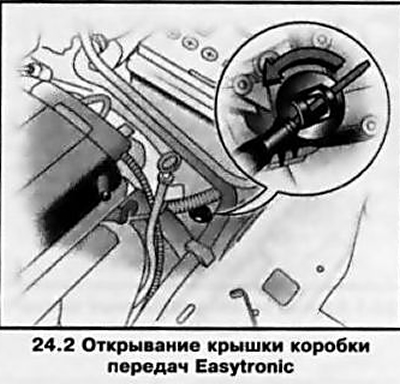
- Clean the cover of the Easytronic gearbox and its adjacent surfaces (see illustration 24.2) from dust and dirt.
- Use a screwdriver to turn the cover and pull it up as shown in the illustration;
- Using a flat-blade screwdriver, turn the set screw located under the cover to the right until you feel resistance - the clutch is disengaged.
- Replace the cleaned cover. Be careful not to get dirt inside the box. The lid must be fully attached to the body.
Attention: To avoid damage to the gearbox, do not apply excessive force to overcome the resistance of the screw from turning!
Attention: Towing a car and starting the engine with the clutch disengaged in this way is prohibited!
If the cause of the malfunction is a discharged battery, start the engine from an auxiliary source (see Introduction) and recharge the battery.
If the cause of the power failure is not in a discharged battery, contact the Opel campaign service station.
Visitor comments