


Contents: Selector lever ⬇ Forced reverse gear shifting ⬇ Engine braking ⬇ Checking the oil level ⬇ Automatic transmission oil change ⬇
Selector lever
The automatic transmission selector lever is located on the body floor tunnel and has the following positions:
- "P" — Parking. The selector lever is set to this position only after the car has come to a complete stop and the parking brake has been applied. The front wheels of the car are locked in this position (transmission brake is on);
- "R" — reverse. Engage reverse only after the car has come to a complete stop;
- "N" — neutral (initial) position;
- "D" — sequential automatic switching mode from I to II and III gears and back;
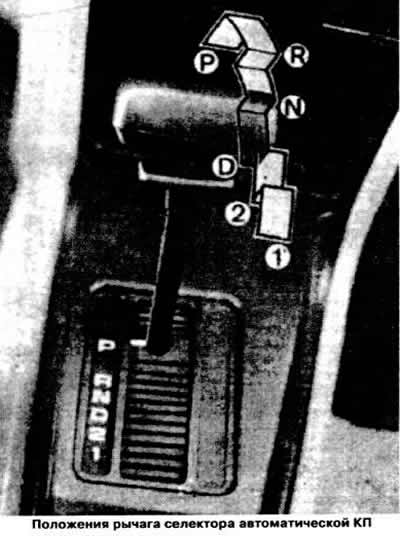
- "2" — automatic switching mode from 1st to 2nd gear and back depending on the engine load and crankshaft speed, used when driving in the mountains on steep climbs and descents;
- "1" — driving mode only in 1st gear, regardless of the accelerator pedal position and engine load; used when driving in particularly difficult road conditions.
In order to prevent accidental switching of automatic transmission operation modes, the selector lever is blocked in the following positions "P", "R", "2" and "1". The lever moves freely only from position "N" to position "D" and back.
Unlocking the selector lever for moving to position "2" is performed by raising the lower movable part of the lever handle by one tooth, to position "R" - by the 1st tooth, to positions "P" and "1" - until it stops.
Note: When moving the selector lever to a position at the same level or lower, it is not necessary to lift the movable part of the handle.
(Text was copied from the portal: www.opelbook.ru)
Forced reverse gear shifting
The automatic transmission is equipped with a mechanism for forced reverse gear shifting ("kick-down") to the nearest lower gear, designed for the most efficient use of acceleration when accelerating the car. The "kick-down" mechanism is activated when the accelerator pedal is pressed all the way down, when the car speed is less than the maximum permissible speed in a given gear, depending on the position of the selector lever.
Engine braking
When driving down steep slopes with a full load or trailer, for effective engine braking, reduce the speed to 30 km/h and move the selector lever to position "1". If the selector lever is mistakenly moved to position "1" at a speed above a certain value depending on the vehicle model, the locking device will hold the automatic transmission in 2nd gear until the vehicle speed decreases to the required value.
Checking the oil level
Checking the oil level in the automatic transmission should be performed every 15,000 km or twice a year, or more often if the vehicle is operated in particularly difficult road conditions.
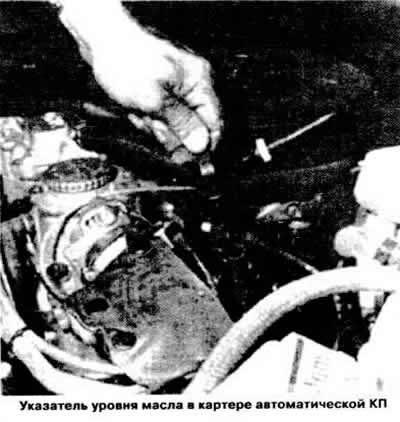
The check is carried out using the oil level indicator located on the right at the rear of the engine, in the following order:
on a cold automatic transmission.
- set the selector lever to position "P":
- start the engine and let it run for one, maximum two minutes, at idle speed;
- remove the oil level indicator, wipe it with a lint-free cloth, reinsert it into the socket until it stops and remove it;
- check the oil level on the side of the indicator where the mark "+20°C" is stamped: the oil level should be at the "MAX" mark;
Note: If the oil level is 5 mm below the "MAX" mark, then add 0.25 l.
on a warmed-up automatic transmission (after running about 20 km):
- remove the oil level indicator, wipe it with a lint-free cloth, reinsert it into the socket until it stops and remove it;
- check the oil level on the side of the gauge where the mark "+94°C" is stamped: the oil level should be between the marks "MAX" and "MIN";
- add oil if necessary, taking precautions to prevent dirt from entering the gearbox.
Note: The difference between the "MIN" and "MAX" marks is 0.5 l.
If you need to top up the oil frequently, you need to find out the reason for its increased consumption at a service station.
Automatic transmission oil change
Every four years of operation or every 60,000 km of run it is necessary to change the oil in the automatic transmission. The frequency of oil changes is reduced under difficult operating conditions (city driving, towing a caravan, driving with a load on mountain roads, etc.).
The oil is changed when the gearbox is not warmed up and the oil temperature is below +35°C. To do this, unscrew the gearbox oil pan mounting bolts, tilt it and drain the oil. Replace the pan gasket and mesh filter with new ones, install the pan and fill with 7 liters of fresh oil.
Visitor comments