


Contents: AR25 Transmission - General…⬇ AR25 Transmission - Maintenance ⬇ AR25 Transmission - Removal and…⬇ Kickdown system (aR25 transmission)…⬇ Selector lever rod (aR25…⬇ Selection lever (aR25 transmission)…⬇ Inhibitor switch (aR25 transmission)…⬇ Electronic transmission control unit…⬇ Sports mode switch (aR25…⬇ Winter Mode Switch (AR25…⬇ Transmission fluid filter…⬇
AR25 Transmission - General Description
1. Beginning in 1990, 2.0 liter models with automatic transmission were equipped with a new four-speed automatic transmission with electronic control. This new AR25 transmission unit has three driving modes: economy, sport and winter. Economy mode offers a mode for normal driving, in which the car is driven at relatively low engine speeds, combining an acceptable driving speed with economical fuel consumption. The transmission is automatically set to economy mode when the ignition is turned on.
2. For high-speed driving, there is a sport mode, which is selected by pressing the button on top of the gear selector lever. When the transmission is in sport mode, an indicator lamp on the left side of the instrument cluster lights up. In this mode, the transmission is connected to higher gear ratios, with higher engine speeds, to provide maximum acceleration. Returning to economy mode is done by simply pressing the selector button again.
3. Winter mode is selected using the button on the central console. When winter mode is set, the LED indicator lights up. The car is then driven in third gear. This limits the torque on the drive wheels and allows the car to move safely on slippery roads. Winter mode can only be set when the selector lever is in the "D" position. Returning to the economy mode is done by simply pressing the button on the lever again, or by moving the selector lever through "3" or "R". Note that the transmission will automatically exit winter mode and return to economy mode if the vehicle speed exceeds 80 km/h or if the downshift mechanism is pressed for more than 2 seconds.
AR25 Transmission - Maintenance
Checking the transmission fluid level
4. When checking the transmission fluid level, first drive the vehicle for approximately 20 km to warm up the transmission to normal operating temperature. Place the vehicle on a flat surface. With the engine running and the brakes pressed, slowly move the selector lever from "P" to "1", and then back to "P".
5. With the engine idling and the selector lever in the "P" position, remove the transmission fluid dipstick, wipe it clean, then reinsert it completely into the tube. Remove the dipstick and note the fluid level. Repeat this procedure three times and take the average number, which is the true transmission fluid level.
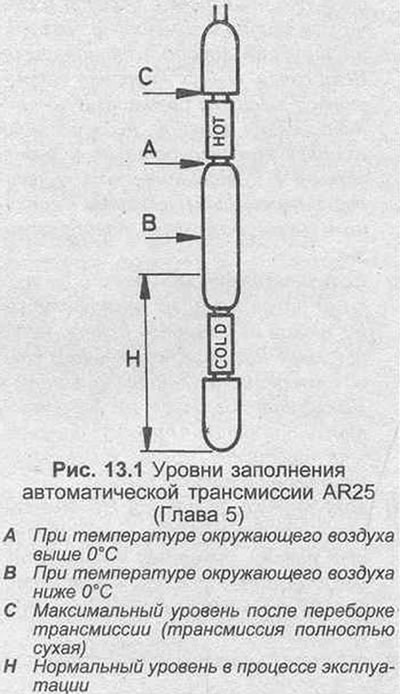
6. If the engine and transmission are at normal operating temperature, with the ambient temperature above 0°C, the fluid level should be within the "HOT" mark on the dipstick (approximately 42 mm from the lower end of the dipstick). At ambient temperatures below 0°C, the fluid level should be halfway between the "HOT" and "COLD" marks on the dipstick (approximately 32 mm from the lower end of the level measuring probe).
7. If necessary, top up the level with the specified fluid through the dipstick tube and recheck the fluid level as described above.
8. If the level is correct, install the dipstick and stop the engine.
Transmission fluid replacement
9. On the AR25 transmission, the fluid should be changed every 60,000 km or every 4 years, whichever comes first. It is also recommended to remove the large transmission pan and clean the transmission fluid filter. This will drain more transmission fluid and replace it accordingly (approximately only half of the transmission fluid drains when only the drain plug is removed from the pan), and all the dirt will be removed from the filter and pan.
10. If you wish to replace only the transmission fluid, this can be done as described in Chapter 2 of Section 6, referring to the Specifications at the beginning of this Section for approximate fluid amounts. Finally, fill the transmission with the specified fluid type to the proper level on the dipstick (see Figure 13.1), then start the vehicle and check the level as described earlier in this Chapter. To also clean the filter element, continue as follows.
11. Apply the handbrake, then jack up the front of the car and secure it on axle stands.
12. Place a container under the transmission pan, then remove the drain plug and allow the fluid to drain into the container.
Warning: If the vehicle has recently been driven, the fluid will be extremely hot.
13. Check the drain plug seal and replace if necessary. After all fluid has drained, wipe the threads clean and install the drain plug into the pan, tightening it to the torque specified in the Specification.
14. Loosen and remove all pan mounting bolts, then carefully lower the pan away from the transmission. Be prepared for some fluid to leak. Note that the pan still contains a significant amount of transmission fluid. Drain the fluid from the pan into a container, then remove the gasket and discard it.
15. Remove the three mounting bolts, then remove the filter from the back of the transmission along with the sealing gasket. Discard the gaskets; a new one must be used during installation.
16. Clean the filter element in a solvent bath, then examine the element for signs of clogging or damage. If the filter element is leaky or clogged, the filter must be replaced. Remove the magnet inside the pan and clean it for traces of metal particles; any large or small piece of metal indicates wear on transmission components.
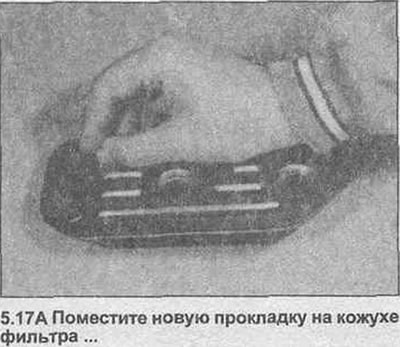
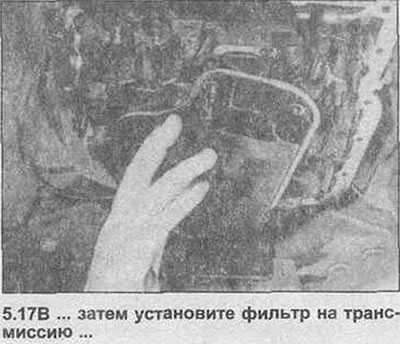
17. Check that the filter element is dry, then install a new gasket on the filter housing and attach the filter to the transmission. Check that the gasket is correctly installed, install the mounting bolts and tighten them to the specified torque Specification (photo).
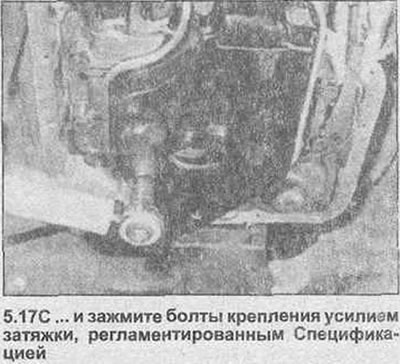
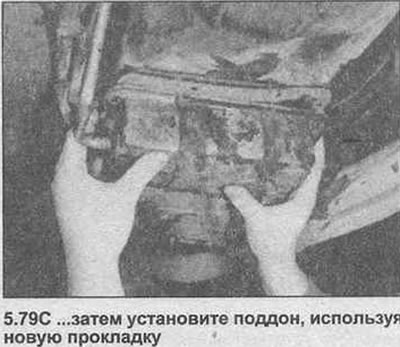
18. Check that the oil pan and transmission sealing surfaces are clean and dry, then place a new gasket on the oil pan and install the magnet. Install the oil pan on the transmission and tighten the mounting bolts to the specified torque Specification (photo).
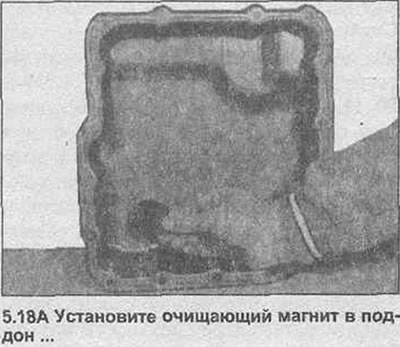
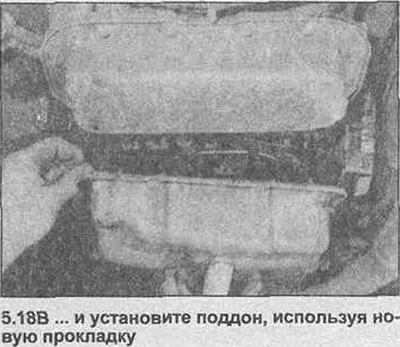
19. Lower the vehicle to the ground, then fill the transmission with the specified fluid type to the proper level on the dipstick (see fig 13.1); approximate amounts are given in the Specifications at the beginning of this Section. Finally, start the vehicle and check the fluid level as described earlier in this Chapter.
AR25 Transmission - Removal and Installation
Removal
20. Apply the handbrake and place the selector lever in the "N" position. Disconnect the negative battery terminal.
21. Remove the dipstick from the filler pipe, then remove the dipstick pipe mounting bolt and gasket and remove the pipe from the transmission.
22. Locate the transmission inhibitor switch wiring back to the wiring connector (which is fixed in the center of the engine compartment bulkhead). Disconnect the connector and release the switch wiring harness from all associated mounting brackets and ties.
23. From inside the engine compartment, release the transmission breather hose from all mounting brackets and connections.
24. Block the rear wheels, then jack up the front of the car and secure it on axle stands.
25. From underneath the vehicle, release the inhibitor switch wiring and breather hose from any remaining brackets.
26. On models without a catalytic converter, remove the exhaust system distributor pipe as described in Section 3, then unscrew the pipe mounting bracket and heat shield. On models with a catalytic converter, remove the distributor pipe and converter using the information provided in Chapter 3 from this Section, then remove the catalytic converter mounting bracket and heat shields.
27. Disconnect the two wiring connectors on the left side of the transmission case and separate the wiring from the transmission.
Note: When disconnecting the wiring connectors, support the bottom of each connector to prevent separation from the transmission.
28. Disconnect the speed sensor wiring from the mounting bracket and from the wiring connector.
29. Loosen and remove the four mounting bolts and remove the front crossmember from under the vehicle.
30. Perform the actions described in points 9-17 Chapter 14 in Section 6.
31. Place a jack with a block under the transmission and raise it until the weight of the transmission is removed.
32. Loosen and remove the nuts and bolts securing the rear crossmember to the transmission and the four bolts securing the crossmember to the underbody, then remove the crossmember from underneath the vehicle.
33. With a jack positioned under the transmission, loosen and remove the remaining bolts securing the transmission case to the engine. Note the correct bolt positions and verify that all necessary components have been separated.
34. With the bolts removed, move the jack and transmission to the rear, freeing it from the pins. When the transmission is free, lower the jack and pull the unit out from under the car, ensuring the torque converter is properly positioned on the transfer shaft. Remove the pins from the transmission or engine.
Installation
35. The transmission is installed in the reverse order, taking into account the following points.
- a) Apply a small amount of heat resistant lubricant to the transmission input shaft grooves. Do not apply too much as this may contaminate the torque converter.
- b) Make sure the pins are correctly positioned on the transmission before installation.
- c) Tighten all nuts and bolts to the torque specified in the Installation Specification.
- d) Before installation, coat the threads of the rear of the crossmember-to-bottom mounting bolts with locking compound.
- e) Check that the breather hose and electrical wiring harness are correctly installed and secured with all necessary clamps.
- f) Finally, fill the transmission with the specified type and quantity of fluid and check the selector mechanism adjustment as described later in this Chapter.
Kickdown system (aR25 transmission) — general description and replacement of the switch
36. Unlike the earlier AW 03-71 L transmission, the AR25 transmission downshift system is fully electronically controlled and has no drive cable. The system is activated by a switch located under the accelerator pedal.
37. To remove the switch, disconnect the wiring harness, then carefully pry the switch out of the retainer. When installing, make sure the switch is correctly positioned on the retainer, then reconnect the wiring harness connector.
Selector lever rod (aR25 transmission) - adjustment
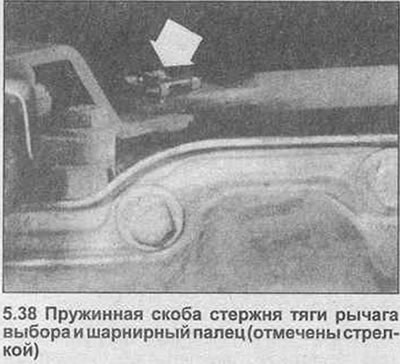
38. The selector lever rod can be adjusted using the information given in Section 6, Chapter 17 (photo) Finally, check the operation of the inhibitor switch and, if necessary, adjust it as described later in this Chapter.
Selection lever (aR25 transmission) - removal and installation
Removal
39. Remove the central console assembly as described in Section 11.
40. Apply the handbrake, then jack up the front of the car and secure it on axle stands.
41. From underneath the vehicle, release the spring clip, then remove the pivot pin and disconnect the tie rod at the bottom of the selector lever.
42. From inside the vehicle, carefully drill out the five rivets securing the selector lever housing to the body. Remove the selector lever and housing from the vehicle.
Installation
43. Remove all traces of sealant from the base of the selector lever housing and the vehicle body.
44. Coat the back of the selector lever housing with a suitable sealant, then install the housing on the vehicle.
45. Secure the selector lever housing using new rivets.
46. From underneath the vehicle, reconnect the tie rod to the selector lever base, securing the pivot pin with the spring clip.
47. Install the central control as described in Section 11.
48. Check the adjustment of the selector mechanism and the operation of the switch, inhibitor as described elsewhere in this Chapter.
Inhibitor switch (aR25 transmission) - removal, installation and adjustment
Removal
49. Apply the handbrake and move the selector lever to the "N" position.
50. Locate the transmission inhibitor switch wiring back to the wiring connector (which is fixed in the center of the engine compartment bulkhead). Disconnect the connector and release the switch wiring harness from all associated mounting brackets and ties.
51. Block the rear wheels, then jack up the front of the car and secure it on axle stands.
52. From underneath the vehicle, release the inhibitor switch wiring from any mounting brackets (photo).
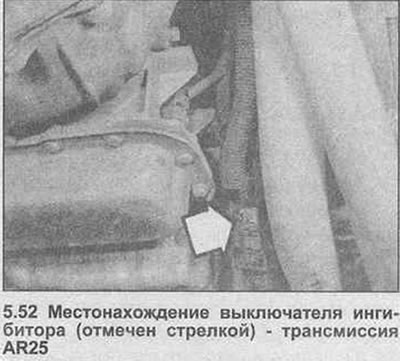
53. Unfasten the inhibitor switch trim, then loosen and remove the nut securing the selector lever to the transmission and separate the lever from the shaft.
54. Unscrew the two mounting bolts and pull off the inhibitor.
Installation and adjustment
55. Before installing the switch, inspect the shaft seal for signs of damage or oil leakage and replace if necessary. To replace the seal, gently pry the seal out with a small flat-head screwdriver. Coat the projections of the new seal with a thin layer of lubricant, then carefully push it onto the end of the shaft and press it into place in the transmission. If necessary, use a pipe of suitable diameter to seat the seal in place, which fits only on the outer edge of the seal.
56. Position the inhibitor, connect the shaft, then install the two mounting bolts, pinching them with your fingers at this stage. Adjust the switch as follows. Before continuing, temporarily install the selector lever on the shaft and check that the transmission is still in neutral ("N").
57. There are two ways to adjust the switch: mechanical and electrical. The electrical method is a much more accurate method, but requires the use of a multimeter.
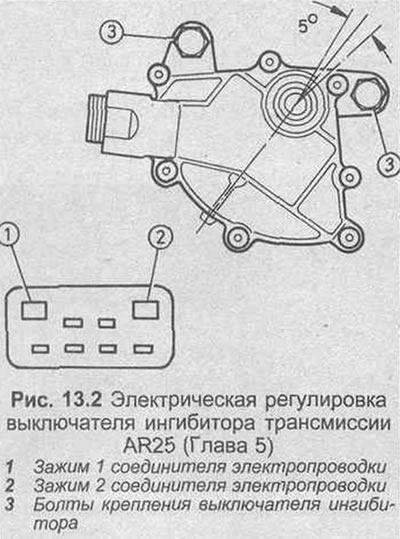
58. To adjust the switch electrically, connect the multimeter, set to the resistance measurement function, across terminals 1 and 2 of the switch wiring connector (see Figure 13.2). The transmission must be in neutral to ensure a closed circuit. Slowly rotate the switch to determine the switch actuation area. It should be within an arc of approximately 5°. Place the switch in the center of this area, then tighten the mounting bolts to the torque specified in the Specification.
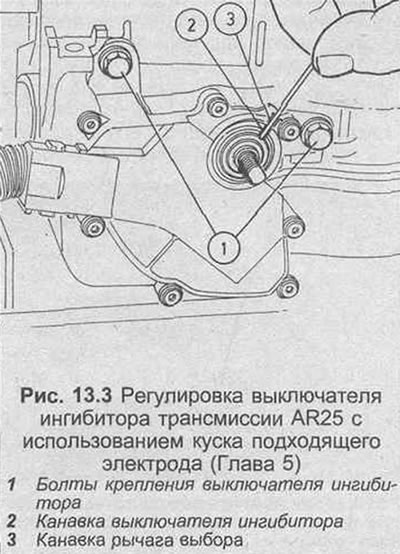
59. For mechanical adjustment of the switch, use a rod with a diameter of 2.0-2.3 mm. Set the transmission to neutral, turn the switch until the grooves on the switch and the transmission selector lever are aligned and the rod can be inserted freely (see Figure 13.3). Clamp the switch in this position and tighten the mounting bolts to the torque specified in the Specification. Check that the grooves are still correctly aligned, then remove the rod.
60. When the inhibitor switch is correctly adjusted, install the selector lever onto the transmission shaft and tighten the lock nut to the tightening torque specified in the Specification.
61. Route the switch wiring into the engine compartment.
62. From inside the engine compartment, reconnect the inhibitor switch wiring connector and secure the wiring with new clamps.
63. Check the adjustment of the selector mechanism as described in Section 6, Chapter 17, then check that the inhibitor switch is working properly.
64. Install the inhibitor switch trim and lower the vehicle to the ground.
Electronic transmission control unit (AR25 transmission) - removal and installation
Removal
65. The electronic control unit is located under the hood (behind the left end of the plastic water reflector).
66. To remove the unit, open the hood, then remove the seal from the left end of the water deflector. Carefully lift the water deflector to gain access to the control unit (photo).
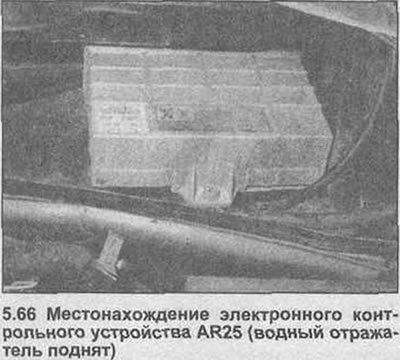
67. Unscrew the mounting bolt and remove the control unit, disconnecting the electrical wiring connector.
Installation
68. Installation is the reverse procedure of removal.
Sports mode switch (aR25 transmission) - removal and installation
Removal
69. Using a small flat-head screwdriver, carefully pry the gear indicator panel trim off the selector lever.
70. Remove the single mounting screw, then separate the panel from the central console. Remove the lamp socket from the panel and lift the panel away from the selector lever.
71. Route the sport mode switch wiring through the selector lever base.
72. Carefully unsolder the two wires and remove the switch.
Installation
73. Installation is the reverse procedure of removal. Make sure the wires are securely soldered to the switch. Test the switch before installing the panel.
Winter Mode Switch (AR25 transmission) - removal and installation
Removal
74. Unclip the center console trim and remove it from the center console, disconnecting the switch wiring connector(s).
75. Press the switch retaining rods and pull the switch out of the trim.
Installation
76. Installation is carried out in reverse order.
Transmission fluid filter (transmission AW 03-71L) - cleaning
77. When changing the transmission fluid at the specified interval, it is also recommended to remove the pan and clean the transmission filter. This will also allow you to drain and replace more fluid and examine the composition of the used fluid.
78. To clean the filter, first follow the steps in points 13-15 Chapter 2 of Section 6.
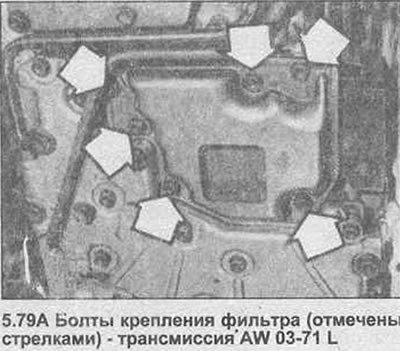
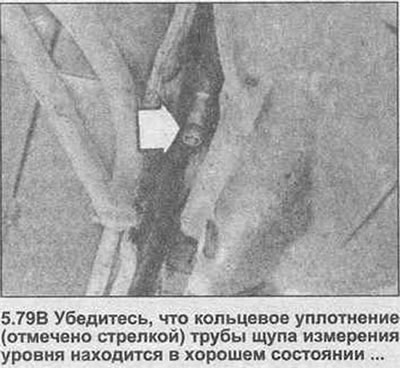
79. Remove the pan and clean the transmission fluid filter as described in paragraphs 14-18 of this Chapter, taking into account that the filter is secured with six bolts and that there are two magnets in the pan. Also, before installing the pan, inspect the O-ring of the dipstick tube for signs of damage and replace if necessary (photo).
80. Finally, fill the transmission and check the fluid level as described in Section 6, Chapter 2.
Visitor comments