


Contents: General description ⬇ Checking and adjusting the mixture…⬇ Throttle Potentiometer - Removal and…⬇ Lambda sensor (models with catalytic…⬇ Exhaust manifold (models with…⬇ Exhaust system (models with…⬇ Catalyst - General Description and…⬇ Carbon filter (models with catalytic…⬇ Cleaning valve (models with…⬇
General description
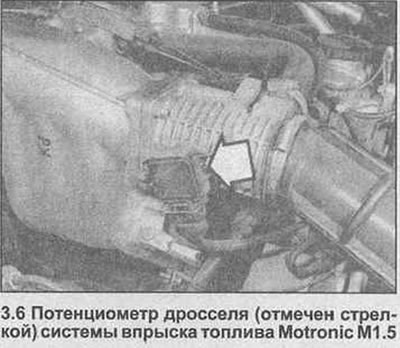
1. From 1990 onwards, all 2.0 litre models are fitted with the Motronic M1.5 fuel injection system, replacing the ML4 system fitted to earlier models. Both systems are very similar in principle of operation, the only significant change in the M1.5 system being the installation of a throttle potentiometer, replacing the throttle switch used in the early ML4 system. The advantage of the potentiometer is that it provides information to the control unit about the exact position of the throttle valve, and not just whether the valve is open or closed. This allows for more precise control of the quality of the fuel/air mixture at different engine operating conditions.
2. From 1990 onwards, the 2.0 litre models were also equipped with a catalytic converter. These models have the C20NE engine code and are equipped with a closed three-way system with a catalytic converter to reduce the amount of harmful emissions into the atmosphere in the exhaust gases. The system is controlled by a Lambda sensor, which is screwed into the exhaust manifold. The tip of the Lambda sensor is sensitive to oxygen and provides the fuel injection system control unit with constant feedback on the state of the exhaust gases. This allows the control unit to precisely adjust the amount of fuel supplied to the engine, calculate the required fuel/air ratio and thus ensure maximum efficiency. The tip of the Lambda sensor also has a built-in heating element, which is controlled by the control unit. When the engine is cold, the control unit supplies electricity to the heating element of the Lambda sensor, which in turn heats the exhaust gases passing through the sensor. The heated exhaust gases quickly bring the catalytic converter to normal operating temperature, where it operates efficiently.
3. On models with a catalytic converter, a fuel vapor management system is installed. This prevents the release of fuel vapor into the atmosphere. When the ignition is off, vapors from the fuel tank are fed to the carbon filter, where they are absorbed. When the engine is started, the electronic control unit opens the purge solenoid valve, and fuel vapors are fed into the intake manifold and mixed with fresh air. This cleans the carbon filter.
4. Unless otherwise noted, the procedures performed on these later models are the same as for the 2.0L models in Section 3.
Checking and adjusting the mixture composition - models with a catalyst
On models with a catalytic converter, the fuel/air mixture is controlled by the Lambda sensor and therefore does not require any adjustment. However, the operation of the catalytic converter system should be checked periodically using a calibrated exhaust gas analyzer. If the CO level in the tailpipe is too high, the entire fuel injection system and ignition system should be completely checked using diagnostic equipment.
Throttle Potentiometer - Removal and Installation
6. The throttle potentiometer can be removed and replaced using the throttle switch information given in Section 3, Chapter 25, ignoring the note regarding switch adjustment (photo). Adjustment of the throttle potentiometer is not necessary.
Lambda sensor (models with catalytic converter) - removal and installation
Note: The lambda sensor must be removed from the exhaust manifold when the engine is at normal operating temperature. The sensor is very sensitive and will not function if damaged, if the power supply is interrupted, or if any cleaning materials or solvents are used on it.
Removal
7. Warm up the engine to normal operating temperature, then turn it off. Apply the handbrake, jack up the front of the car and secure it with axle stands.
8. Be careful not to burn yourself on the hot exhaust pipe when disconnecting the sensor wiring connector and releasing the wiring from the mounting brackets.
9. Carefully unscrew the Lambda sensor and remove it from the exhaust system together with the sealing gasket.
Installation
10. If you are installing the original Lambda sensor, remove all traces of anti-lock compound from the threads and coat with a special lubricant (part number 19 48 602) the sensor thread. If the specified lubricant is not available, lubricate with a high-temperature anti-seize compound of good quality, (type Duckhanis Copper 10). Please note that new Lambda sensors already have a coating of lubricant on the threads. Check the sealing gasket for signs of damage and replace if necessary.
11. Install the sealing gasket on the end of the lambda sensor, then screw the sensor into the distribution pipe and tighten it with the specified tightening torque Specification.
12. Check that the wiring is correctly routed and reconnect the wiring connector and secure the wiring with all necessary mounting brackets.
13. Finally, check that the electrical wiring is not in danger of contact with the exhaust system, then lower the vehicle to the ground.
Exhaust manifold (models with catalytic converter) - removal and installation
14. On these models, the exhaust manifold can be removed and reinstalled as described in Chapter 29 of Section 3, noting that it is necessary to disconnect the lambda sensor wiring connector and remove the wiring from the mounting brackets before disconnecting the distribution pipe. When installing, reconnect the wiring connector and check that the wiring is correctly positioned and secured with all necessary mounting brackets.
Exhaust system (models with catalytic converter) — general description, removal and installation
Note: The catalytic converter is a fragile component and can be easily damaged - all parts of the system are removed, taking care not to hit the parts with tools when handling.
15. On these models, the exhaust system is very similar to the equipment of the 2.0 liter model, except that it consists of four parts - the fourth part is the catalytic converter itself, installed between the distribution and intermediate pipes.
16. The system can be removed and reinstalled using the information given in Chapter 30 of Section 3, noting that before removing the entire system or the distribution pipe, it is necessary to disconnect the Lambda sensor wiring connector and release the wiring from the mounting brackets, or directly remove the sensor as described earlier in this Chapter. When installing, install the sensor as described earlier in this Chapter, and/or check that the wiring is securely fastened with all necessary mounting brackets and is not in danger of contacting the exhaust system (where it is applied).
Catalyst - General Description and Precautions
17. The catalytic converter is a reliable and simple device that does not require any maintenance, but there are some facts that the car owner must be aware of in order for the converter to function properly throughout its entire service life.
- a) Do not use leaded gasoline in a vehicle with a catalytic converter - the lead coats the precious metals, reduces the efficiency of the conversion, and eventually destroys the converter.
- b) Always maintain the ignition and fuel system in good condition - especially check the air cleaner element, fuel filter and spark plugs and replace according to the manufacturer's instructions. If the air/fuel mixture becomes too rich due to neglect, unburned excess fuel will enter and burn in the catalytic converter, overheating the element and eventually destroying the converter.
- c) If the engine misfires, do not operate the vehicle (or at least as little as possible), until the damage is repaired. Misfiring allows unburned fuel to enter the converter, causing overheating as noted in (b) above.
- d) When starting the engine, do not push - or tow - the vehicle - this also causes unburned fuel to enter the catalytic converter and cause overheating, see (b).
- e) Do not turn off the ignition at high engine speed. If the ignition is turned off at high idle speed, unburned fuel will enter the catalytic converter (very hot), with a possible risk of ignition on the element and damage to the converter.
- j) DO NOT use fuel with engine oil additives - they may contain substances harmful to the catalytic converter.
- g) DO NOT continue to operate the vehicle if the engine is consuming oil. Blue smoke is a telltale sign of oil in the fuel - unburned carbon particles clog the converter passages and reduce efficiency; during prolonged use the element will overheat.
- h) Remember that the catalytic converter operates at very high temperatures, therefore the heat shields on the underbody and body of the vehicle will become hot enough to ignite any flammable materials that may come into contact with them. Therefore, do not park the vehicle on dry, long grass or piles of leaves.
- i) Remember that the catalytic converter is fragile - do not hit it with tools during work. When driving from, do not drive the car in ruts, road humps, etc., so as not to damage the exhaust system.
- j) In some cases, especially when the car is new, a sulfurous smell may be felt (rotten eggs) from the exhaust. This is the case with most catalytic converters fitted to cars, and due to the small amount of sulphur contained in some petrols reacting with the hydrogen in the exhaust to produce hydrogen sulphide gas (H2S); this gas is poisonous, but it is not produced in sufficient quantities to cause a problem. If the car has traveled several thousand miles, the problem should disappear, k) The catalytic converter, if well maintained, should work effectively for 90,000-160,000 km. The CO level should not exceed the norm, if it is not, the converter must be replaced.
Carbon filter (models with catalytic converter) - removal and installation
Removal
18. The carbon filter is mounted on the engine compartment bulkhead. To remove it, loosen the hose clamps and disconnect the hoses from the casing, noting their correct position. Loosen and remove the upper casing hanger clamp bolt, then remove the clamp and remove the casing from the engine compartment.
Installation
19. Installation is carried out in reverse order.
Cleaning valve (models with catalytic converter) - removal and installation
Removal
20. Locate the outlet hose from the carbon filter (mounted on the engine compartment bulkhead) to the cleaning valve. Mark their correct installation position, loosen the fastening brackets and disconnect the hoses from the valve.
21. Disconnect the valve wiring connector, then unscrew the mounting bolt and remove the valve from the engine compartment.
Installation
22. Installation is the reverse procedure of removal. Check that the vacuum hoses are correctly installed and securely fastened with the mounting brackets.
Visitor comments