


Contents: General description ⬇ Front brake pads (aTE support) -…⬇ Front brake caliper (aTE support) -…⬇ Front Brake Caliper Mounting Bracket…⬇ Handbrake lever and cable (models…⬇ Electronic ABS control device (since…⬇
Note: Hydraulic fluid is poisonous; if fluid gets on the trim, rinse immediately with plenty of water. Some types of hydraulic fluid are flammable and may ignite when in contact with very hot components. Brake fluid also absorbs moisture from the air - old fluid may be contaminated and unsuitable for further use. Always use the recommended type of fluid from a sealed container.
General description
1. On later models, a new type front brake caliper is installed.
Front brake pads (aTE support) - inspection and replacement
Warning: Replace both sets of front brake pads at the same time - never replace the pads on just one wheel, as this may cause uneven braking. Note that dust generated by worn pads may contain asbestos, which is harmful to health. Never blow it out with compressed air. Do not use petroleum-based solvents to clean brake system parts. Use only methylated spirits.
2. Apply the handbrake, then jack up the front of the car and secure it on axle stands. Remove both front wheels.
3. Thickness of brake pads (friction material and support plate) can be measured through a gap in the caliper. If any of the pads are worn less than the specified minimum thickness (See Section 9 of the Specifications), all pads should be replaced as a set on that axle. However, a much more complete check can be made if the caliper is first removed, as follows.
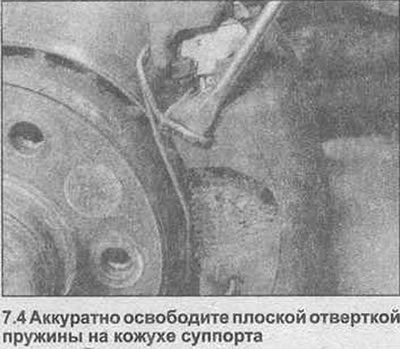
4. Carefully release the springs and remove them from the outside of the caliper body (photo).
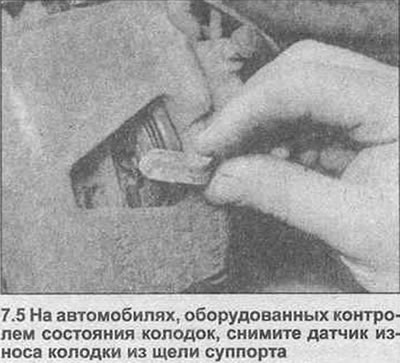
5. On vehicles equipped with a monitoring device, unfasten the pad wear sensor through the slot in the caliper (photo).
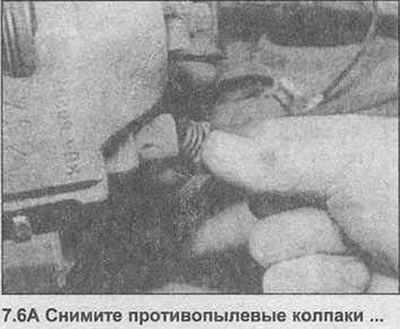
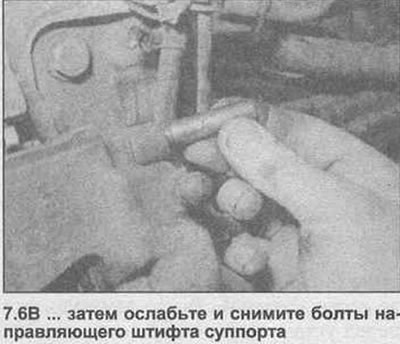
6. Remove the dust caps from the caliper guide pin bolt holes, then loosen and remove the two guide pin bolts and remove them from the caliper (photo).
7. Pull the caliper off the brake disc and unclip the inner pad from the caliper piston. Tie the caliper to the suspension strut using a suitable piece of wire, without kinking the flexible tube of the high-pressure brake system line.
8. Remove the outer shoe from the caliper mounting bracket.
9. First, measure the thickness of each brake pad (friction material and support plate). If any pad is worn at any point to the specified minimum thickness (see Section 9 of the Specifications), all four pads must be replaced. Pads must also be replaced if any are contaminated with oil or grease; there is no satisfactory way to degrease the friction material if it is contaminated. If any of the brake pads are worn unevenly or are contaminated with oil or grease, investigate and correct the cause before reassembling. On vehicles equipped with brake pad condition monitoring, if the pad wear sensor has been in contact with the brake disc, it should also be replaced.
10. If the brake pads are still serviceable, carefully clean them using a clean, wire brush. Clean the grooves in the friction material of sand and pick out any large embedded particles of dirt or mud. Carefully clean the pad location in the caliper body and mounting bracket. Check that the guide pins are free and easily pull the upper bushings into the caliper. Inspect the dust seal around the piston and the piston for signs of leaks, corrosion or damage.
11. If new brake pads are being installed, the caliper piston should be pushed back into the cylinder to create space. Either use a G-clamp or similar tool, or use suitable pieces of wood as levers. If the master cylinder fluid reservoir has not been emptied, there should be no leaks, but watch the fluid level carefully as you retract the piston. If the fluid level rises above the maximum level mark, the excess should be sucked out with a syringe.
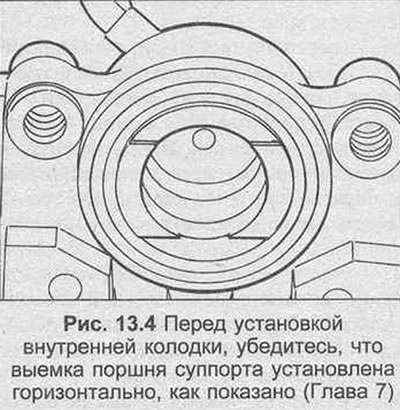
12. Before installing the inner pad, check that the recess on the caliper piston is installed horizontally relative to the caliper body (see Figure 13.4). If necessary, turn the piston until the notch is positioned correctly.
13. When the piston is correctly positioned, place the inner pad in place and install the outer pad in the caliper mounting bracket. Make sure the friction material faces the brake disc (photo).
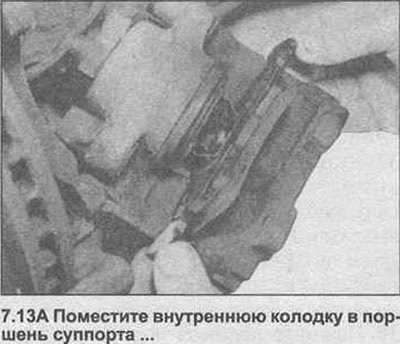
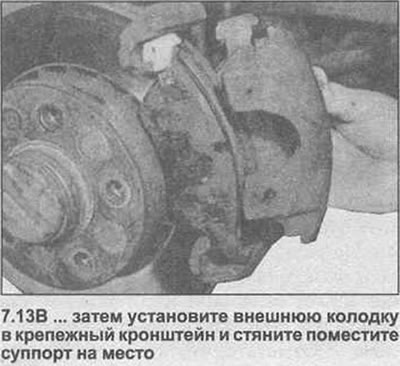
14. Place the caliper in place on the brake disc with the outer pad facing up.
15. Clean the guide pin bolt threads completely, then coat with a suitable locking compound. Install the bolts into the caliper bores, then tighten them to the specified torque Specification and install dust caps.
16. On vehicles equipped with the monitoring system, clip the pad wear sensor into place on the pad. If a new sensor is being installed, take the wiring from the original sensor.
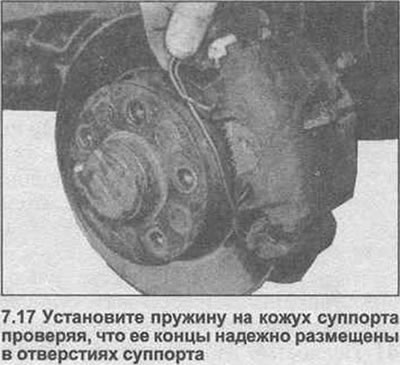
17. Install the caliper spring, making sure that its ends are securely placed in the holes in the caliper body (photo).
18. Check that the caliper body moves smoothly on the guide pins, then press the brake pedal several times until the pads make contact with the brake disc and normal pedal pressure is restored.
19. Repeat the above procedure on the remaining front brake caliper.
20. Install the wheels, then lower the vehicle to the ground and tighten the wheel bolts to the specified torque Specification installations.
21. Check the hydraulic fluid level.
Front brake caliper (aTE support) - removal, overhaul and installation
Note: Before starting work, see the note at the beginning of this Chapter regarding the hazards of hydraulic fluid and asbestos dust.
Removal
22. Block the rear wheels, apply the handbrake, then jack up the front of the car and secure it on axle stands. Remove the corresponding front wheel.
23. To reduce fluid loss, remove the master cylinder reservoir cap and plug the holes with a piece of polyethylene, or, using a G-clamp or similar tool, pinch the flexible hose of the high-pressure brake system line.
24. Clean the area around the connection, then unscrew the high-pressure brake line pipe connection bolt and disconnect the hose from the caliper. Plug the end of the hose and the holes in the caliper to prevent dirt from entering the hydraulic system. Discard the sealing gaskets; they should always be replaced after the caliper is removed.
25. On vehicles equipped with a monitoring system, unfasten the pad wear sensor from the caliper slot.
26. Carefully unclip the large spring and remove it from the outside of the caliper body.
27. Remove the dust caps from the caliper guide pin bolt holes, then loosen and remove the two bolts and remove them from the caliper.
28. Carefully lift the caliper assembly away from the brake rotor and remove the inner pad from the caliper piston. Note that the outer pad does not have to be removed and can be left in the caliper mounting bracket.
Bulkhead
29. Place the caliper on the bench, wipe off all traces of dust and dirt.
30. Partially pull the piston out of the caliper body and remove the dust seal. The piston can be pulled out manually, or if necessary, pushed out by applying compressed air to the hole under the connecting bolt. This requires low pressure, such as that generated by a foot pump.
31. Using a small screwdriver, remove the piston hydraulic seal, being careful not to damage the caliper bore.
32. Knock out the guide bushings from the caliper body using a suitable socket.
33. Clean all components thoroughly using only methylated spirits or clean brake fluid. Never use mineral solvents such as gasoline or paraffin, as they attack the rubber components of the hydraulic system. Dry the components immediately using compressed air or a clean, lint-free cloth. Use compressed air to blow out the flush grooves.
34. Check all components and replace any that are worn or damaged. Pay particular attention to the cylinder bore and piston; they need to be replaced (please note that this means replacing the entire case assembly), if they are nicked, worn or corroded. Similarly, check the condition of the guide pins and their bushings; both guide pins should be undamaged. If there is any doubt about the condition of any component, replace it.
35. If the assembly is suitable for further use, take a new piston and dust seal and a tube of brake cylinder paste (number 90 295 751).
36. Apply a small amount of brake cylinder paste to the surfaces of the caliper bore, piston and piston seal.
37. Install the piston seal into the caliper bore using only the force of your fingers. Install the new dust seal onto the piston, then carefully install the piston into the caliper bore, twisting it until it fits straight into the bore.
38. Press the piston completely into the hole, then rotate the piston so that the recess is horizontal relative to the caliper body (see Figure 13.4). Once the piston is properly seated, press the dust seal into the groove on the caliper body.
39. Lightly lubricate the caliper guide bushings with soapy water, then press them into place in the caliper body. Installation
40. Place the pads in place on the caliper piston, then install the caliper onto the brake disc and outer pad.
41. Clean the guide pin bolt threads completely and coat lightly with a suitable locking compound. Install the bolts into the caliper bores, then tighten them to the specified torque Specification and install dust caps.
42. On vehicles with a monitoring system, secure the sensor in place on the block.
43. Install the caliper spring and make sure that its ends are securely placed in the holes in the caliper body.
44. Place a new sealing gasket on each side of the hose coupling and install the brake high-pressure line pipe coupling bolt. Check that the brake high-pressure line pipe coupling is correctly positioned against the lug on the caliper and tighten the coupling bolt to the specified torque Specification.
45. Remove the clamp from the brake high-pressure line pipe, if used, and bleed the hydraulic system as described in Section 9. Note that, providing the precautions described have been taken to minimize brake fluid loss, it should only be necessary to bleed the appropriate front brake.
46. Install the wheel, then lower the vehicle to the ground and tighten the wheel bolts to the specified torque Specification.
Front Brake Caliper Mounting Bracket Bolts (all models) - revised tightening procedure
47. On all front brake calipers, the caliper mounting bracket bolts - steering joint bolts are now first tightened to the specified tightening torque Specification, then rotate at the specified angle (see Specifications at the beginning of this Section). Also note that the bolt threads must be coated with a suitable locking compound before installation.
48. The mounting bracket bolts must be replaced every time they are loosened.
Handbrake lever and cable (models with catalytic converter) - removal and installation
49. On models with a catalytic converter, the handbrake cable and lever can be removed and installed as described in the relevant Chapter Section 9. Note that in both cases, both catalytic converter heat shields must first be removed to gain access to the cable adjustment nut.
Electronic ABS control device (since 1989) - removal and installation
Removal
50. On models from 1989, the electronic ABS control unit is located under the front passenger seat. To remove the unit, first disconnect the negative battery terminal.
51. Move the passenger seat fully forward to access the unit on the rear of the seat.
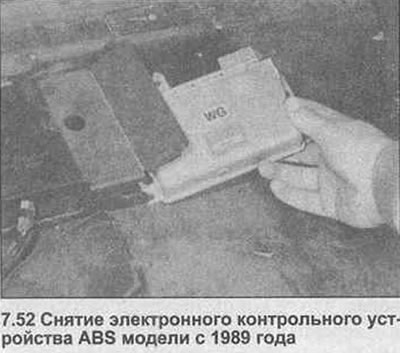
52. Open the plastic cover, then remove the control unit from the rear of the plastic housing (photo). Disconnect the wiring connector and remove the unit from the car.
Installation
53. Installation is the reverse procedure of removal.
Visitor comments