


Contents: External lamp units - removal and…⬇ Lamps - replacement ⬇ Headlamp Washer/Wiper Components -…⬇ Washer jet ⬇ Windscreen wiper motor ⬇ Washer pump ⬇ Headlamp Washer/Wiper Relay ⬇ Central locking system components -…⬇ On-board computer components -…⬇ Speed Controller Components -…⬇ Power Window Components - Removal…⬇ Electric windows (models since 1988)…⬇ Electric Door Exterior Mirror -…⬇ Anti-theft alarm system - general…⬇ Loudspeakers - Removal and…⬇ Windshield Antenna Amplifier -…⬇
External lamp units - removal and installation
Rear combination lights
1. On Sedan models, open the trunk lid, then detach the appropriate trunk trim panel to gain access to the lamp assembly. Press the two retaining clips on the lamp holder and remove the holder from the lamp assembly. Remove the four retaining bolts and remove the lamp assembly from the vehicle.
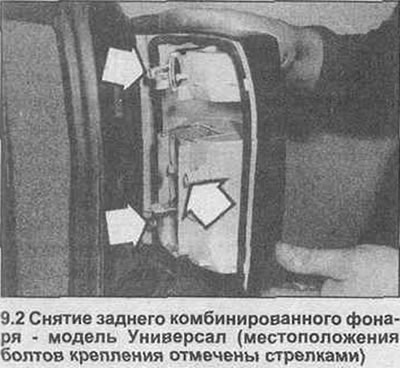
2. On Estate models, from inside the trunk, turn the latch and open the appropriate lamp trim. Press the locking devices and remove the lamp socket assembly. Unscrew the three mounting bolts and remove the lamp unit from the vehicle (photo).
3. Installation is the reverse procedure of removal.
Front fog lights
4. Apply the handbrake, then jack up the front of the car and secure it on axle stands.
5. Disconnect the wiring connector from the corresponding fog lamp, then loosen and remove the mounting bolts and remove the lamp from the rear of the bumper.
6. Installation is the reverse procedure of removal.
Side repeater of parking lights
7. Where necessary, loosen the mudguard mounting screws, then loosen and remove the corresponding front wheel arch liner mounting bolts. Unclip the rear of the liner to gain access to the side repeater lamp wiring connector.
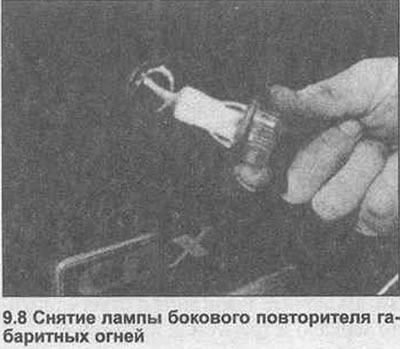
8. Disconnect the wiring connector, then unfasten the fastening latches and remove the lamp from the wing (photo).
9. Installation is carried out in reverse order.
Lamps - replacement
Vanity passenger sun visor mirror lamp
10. Lower the sun visor and use a small flat-head screwdriver to carefully pry off the lamp cover. Remove the lamp.
11. Installation is the reverse procedure of removal.
Headlamp Washer/Wiper Components - Removal and Installation
Windscreen wiper arm
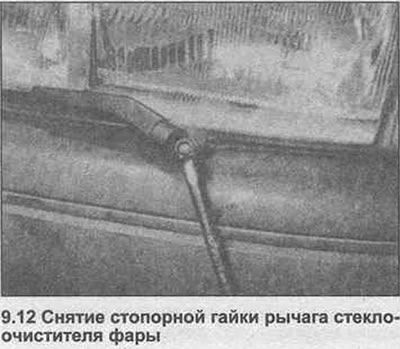
12. Lift the spindle trim, then loosen and remove the wiper arm lock nut (photo). Remove the arm from the spindle grooves and remove from the vehicle.
13. Installation - the reverse procedure to removal. Check that the wiper blade is correctly installed in the spindle grooves and the lock nut is securely tightened.
Washer jet
14. Remove the wiper arm as described above.
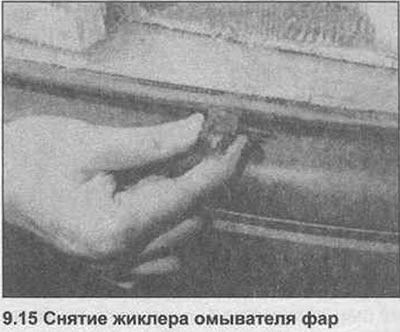
15. Push out the washer nozzle and disconnect it from the washer tube (photo). Tie it to the tube with a piece of twine to prevent it from getting caught behind the bumper.
16. Installation is the reverse procedure of removal.
Windscreen wiper motor
17. The windshield wiper motor can be removed and installed as described in Chapter 32 of Section 12.
Washer pump
18. The pump is identical to the windshield washer pump and can be removed and installed using the information given in Section 12, Chapter 33. Solenoid valve
19. Unscrew the windshield washer reservoir from the wheel arch and empty the contents into a suitable container.
20. Disconnect the valve wiring connector, then remove the valve from the tank.
21. Mark the hoses to avoid confusion during installation, then disconnect them and remove the valve from the vehicle.
22. Installation is carried out in the reverse order. Check that the washer hoses are correctly reconnected. Finally, fill the reservoir with fluid.
Headlamp Washer/Wiper Relay
23. See. Section 12, Chapter 16.
Central locking system components - removal and installation
24. Disconnect the negative battery terminal.
Door Lock Actuator Motor - Pre-1988 Models
25. Remove the inner door trim panel as described in Section 11.
26. Remove the plastic water deflector shield from the door frame to gain access to the drive unit.
27. Loosen and remove the mounting screws from the rod. Disconnect the wiring connector and remove the drive motor from the door.
28. When installing, reconnect the wiring connector to the actuator, then connect the actuator to the rod. Install the servo motor unit mounting screws, tightening them with your fingers at this stage. Adjust the actuator motor as follows.
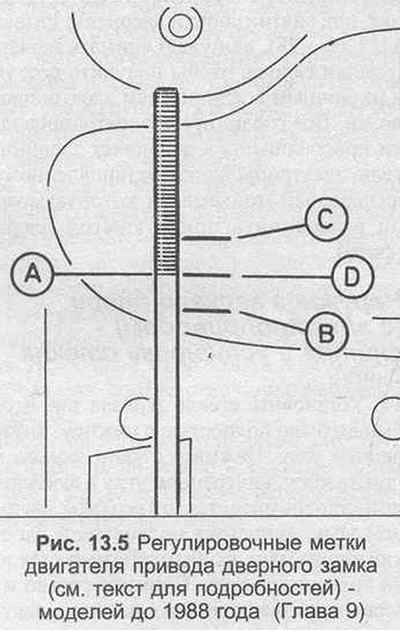
29. Using Figure 13.5, make a mark "A" on the door lock push rod. Push the rod to the closed position and make a mark "B" on the door frame opposite the position of the mark on the rod. Pull the rod to the open position and again make a mark "C" on the door frame opposite the position of the mark on the rod. A third mark "D" on the door frame is made exactly between the marks "B" and "C". Slowly move the rod from the closed position to the open position, listening for the actuator motor switch. The switch should operate, with a characteristic audible click, when the rod is exactly halfway between the closed and open positions - that is, when mark "A" aligns with mark "D". Adjust the position of the actuator motor, then securely tighten the mounting screws.
30. If the drive motor is correctly adjusted, install the plastic water-repellent shield into the door frame and install the door trim panel as described in Section 11.
Door Lock Actuator Motor - Models Since 1988
31. On 1988 and later models, remove the lock assembly as described in Section 11. Remove the two drive motor mounting screws, then disconnect the motor and remove it from the suspension.
32. When installing, reconnect the engine control lever to the rod, then install the mounting screws, tightening them with your fingers only. Before installing the lock assembly, adjust the position of the drive motor as described in the corresponding next paragraph.
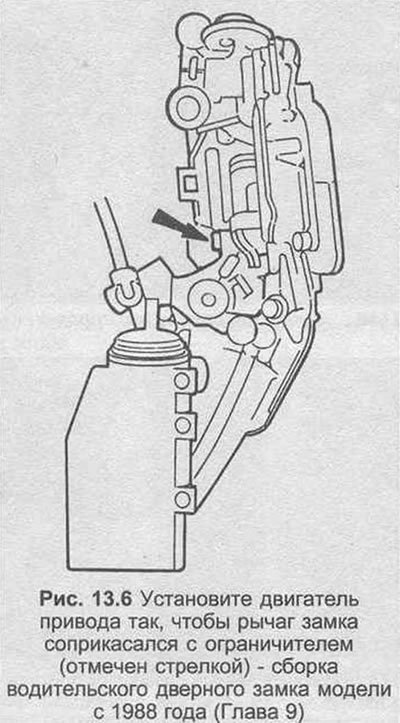
33. Press the driver's door drive control lever to the closed position and adjust the position of the servomotor motor so that the lock lever contacts the limiter (see Figure 13.6). Fix the drive in this position and tighten the mounting screws securely.
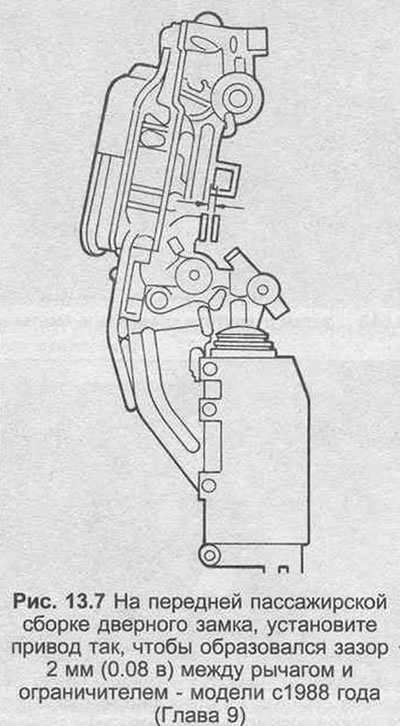
34. Press the control lever into the front passenger door drive motor and adjust the motor position so that there is a 2 mm gap between the lock lever and the limiter (see Figure 13.7). Fix the drive motor in this position and tighten the mounting screws securely.
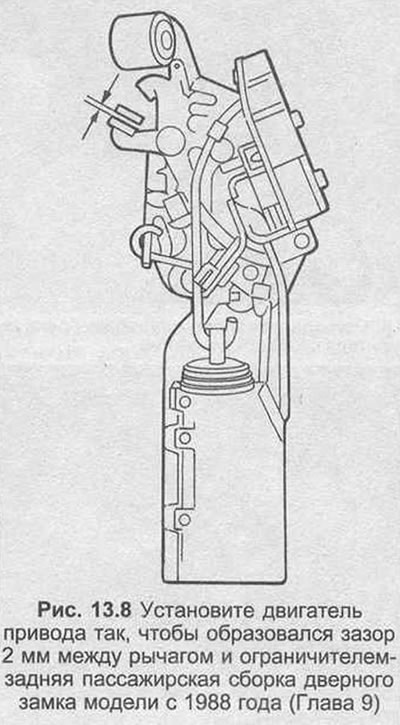
35. Rear passenger doors: press the control lever into the drive motor and in the closed position, adjust the motor position to a gap of 2 mm between the lock and the limiter (see Figure 13.8). Fix the drive motor in this position and tighten the mounting screws securely.
36. If the drive motor is adjusted correctly, install the lock assembly to the door as described in Section 11.
Rear lid/trunk lid drive motor
37. Open the trunk lid or tailgate, then loosen and remove the two drive motor mounting screws. Disconnect the drive from the transmission linkage, then disconnect the wiring connector and remove the drive motor.
38. When installing, connect the wiring connector, then connect the drive control lever to the linkage rod. Install the drive motor mounting screws and tighten them by hand at this stage. Adjust the position of the drive motor as follows.
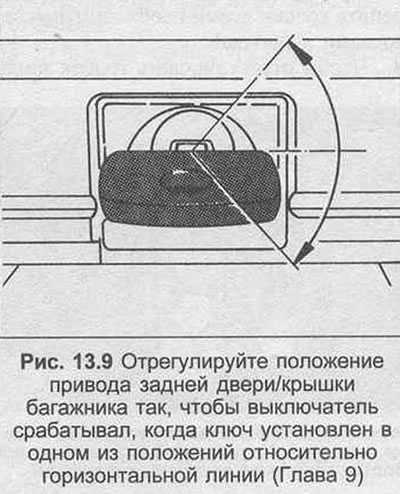
39. Insert the key into the lock and set the lock in a horizontal position. Slowly turn the key up and down, listening to the drive motor. The switch should operate with a characteristic click when the key is set in one of the two positions relative to the horizontal line (see Figure 13.9). Adjust the position of the drive motor in this way, then tighten the mounting screws securely.
Fuel filler cap drive motor
40. From inside the luggage compartment, carefully remove the rear right trim panel until the drive motor is exposed.
41. Disconnect the electrical connector from the rear of the engine, then remove the two mounting screws and remove the engine from the vehicle.
42. Installation is the reverse procedure of removal.
Assembling the control switch
43. The control switch assembly consists of two micro switches mounted on the rear of the lock cylinder. One switch is connected to the central locking system, the other is connected to the electric window system.
44. To remove the switch, first remove the door trim panel as described in Section 11.
45. Pull back the plastic water shield to gain access to the outside door handle.
46. Disconnect the wiring from the microswitch assembly at the connector. Unclip the switch assembly from the handle and remove it from the door.
47. Installation is the reverse procedure of removal.
Electronic control device
48. The electronic control unit for the central lock is located behind the trim panel on the driver's side (see Fig. 12.6, "B", Section 12).
49. To remove the unit, remove the rubber cover and remove the trim panel from the driver's side.
50. Disconnect the electrical wiring connector, then unscrew the two mounting bolts and remove the control unit from the vehicle.
51. Installation is the reverse procedure of removal.
On-board computer components - removal and installation
52. Disconnect the negative battery terminal.
On-board computer
53. Remove the instrument panel as described in Section 12.
54. Slide the trip computer out of the panel and disconnect the electrical wiring connector.
55. If a new trip computer is being installed, remove the program memory unit from the original unit and install it in the new computer. If the computer display lamp has burned out, you must take the computer to the dealer, as a special tool is required to replace the lamp.
56. Installation is the reverse procedure to removal, noting that no pressure should be applied to the front of the computer to avoid damaging the indicators.
Trip computer switch
57. Remove the center trim from the console and disconnect the trip computer switch wiring connector. If the switch connector cannot be accessed through the trim gap, remove the center console mounting screws and lift the console slightly. See. Section 11 for further information.
58. If the switch wiring connector is disconnected, press the switch retaining latches and remove the switch from the trim.
59. Installation is the reverse procedure of removal.
Outdoor air temperature sensor
60. The outside air temperature sensor is attached to the front bumper. To remove the sensor, unfasten it from the bumper and disconnect the electrical connector.
61. Installation is carried out in reverse order.
Speed Controller Components - Removal and Installation
62. Disconnect the negative battery terminal.
Regulator block
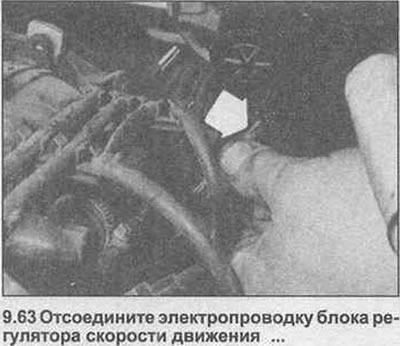
63. The regulator unit is installed on the engine compartment bulkhead. To remove the unit, first disconnect the wiring connector (photo).
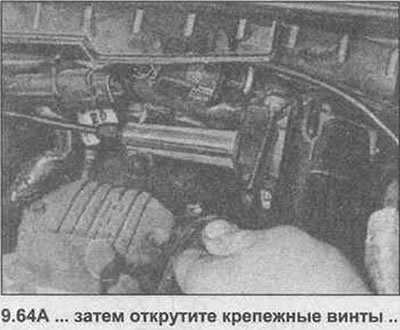
64. Unscrew the three mounting screws and detach the regulator unit from the partition (photo).
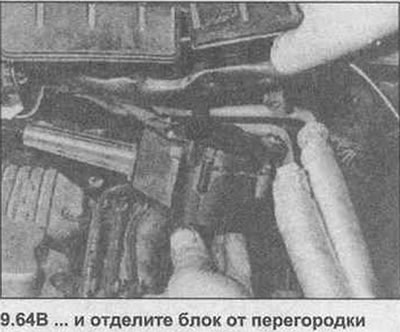
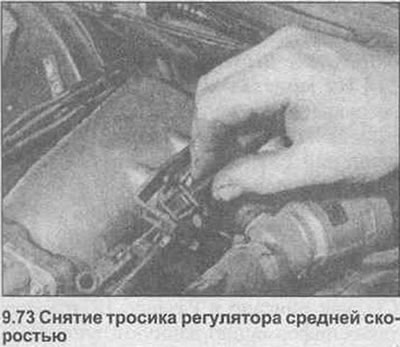
65. Separate the small spring clip and disconnect the spherical sector of the accelerator cable from the throttle rod. Carefully remove the spring clip with a lever and disconnect the medium-speed control cable from the throttle rod (photo). (See photo 9.73 for how to release the cable).
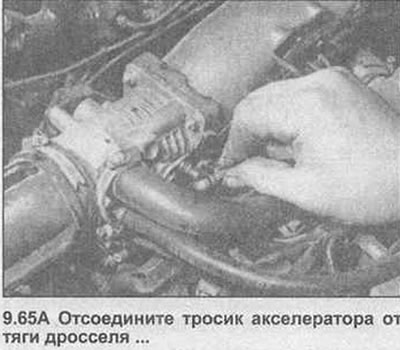
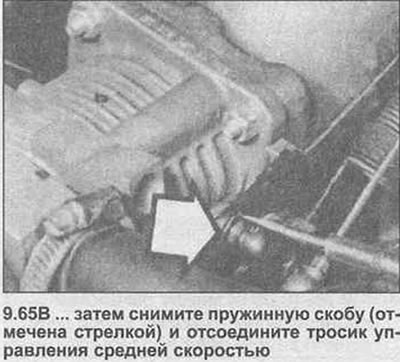
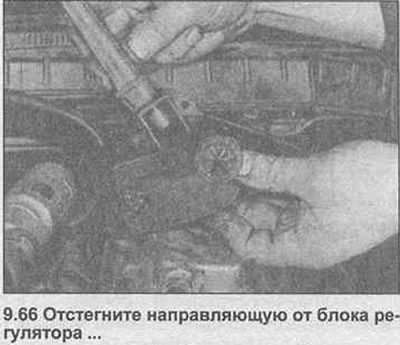
66. Screw the adjustment screw fully into the guide, then unclip the guide from the regulator block (photo).
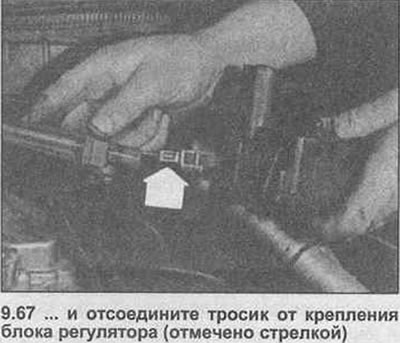
67. Pull the guide out of the regulator unit and disconnect the average speed control cable from the regulator unit (photo). Remove the regulator unit from the vehicle.
68. When installing, attach the cable nipple to the regulator block. Fix the guide in place in the regulator block.
69. Install the mid-speed cable to the throttle linkage and secure with the spring clip. Reconnect the accelerator cable and secure with the spring clip.
Text copied from this portal OpelBook.ru
70. Install the regulator assembly mounting screws and tighten them securely. Reconnect the wiring connector.
71. Adjust the accelerator cable as described in Section 3, then adjust the mid-speed control cable as described in step 77.
Speed control cable
72. Perform the actions described above in points 63 through 67.
73. Release the cable housing retaining clip from the throttle body and remove the cable from the engine compartment (photo).
74. If installing a new cable, unscrew the guide from the mounting nut of the original cable and screw it completely onto the mounting nut of the new cable.
75. When installing, secure the cable housing in place on the throttle body, then follow the steps in steps 68 through 70.
76. Adjust the accelerator cable as described in Section 3, then adjust the speed control cable as follows.
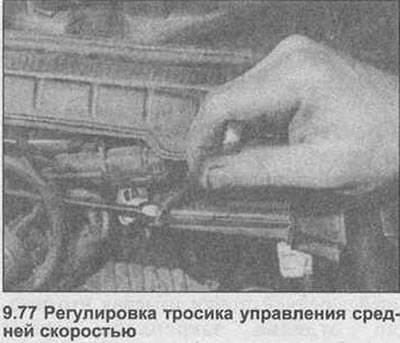
77. Tighten the guide mounting nut until the cable is no longer slack and the rod starts to move only the throttle (photo). From this position, unscrew the guide mounting nut two full turns back along the guide so that a small play is formed in the cable.
Control unit
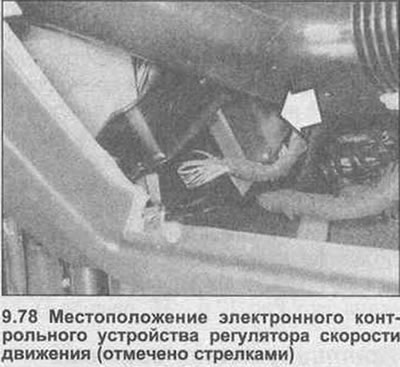
78. The control unit is located behind the glove compartment at the end of the panel (photo) - also see. Figure 12.6, insert "C", in Section 12.
79. To access the unit, open the glove box, then loosen and remove the five glove box mounting bolts. Remove the glove box from the dash, disconnecting the wiring connectors from the light and switch as they become accessible. Note that on models with air conditioning, it will also be necessary to disconnect the cold air hose at the rear of the glove box.
80. Disconnect the electrical wiring connector from the control unit, then unscrew the mounting screw and remove the unit through the glove compartment.
81. Installation is the reverse procedure of removal.
Control switches
82. The cruise control switches are located on the end of the left steering column switch assembly lever. See. Section 12 for removal and installation parts.
Speed controller relay
83. See. Section 12, Chapter 16 (Fig 12.6).
Power Window Components - Removal and Installation
84. Disconnect the negative battery terminal.
Window Motor and Regulator Assemblies
85. See. Section 11, Chapter 20 for front doors and Section 11, Chapter 21 for rear doors.
Central control panel switches
86. Remove the central console as described in Section 11.
87. Press the retaining clips and remove the switch from the console.
88. Installation is the reverse procedure of removal.
Rear Door Switches
89. Carefully pry the switch out of the door trim panel and disconnect the wiring connector.
90. Installation is the reverse procedure of removal.
Door Lock Control Switch
91. See the information given for the central locking system in paragraphs 43 to 47 of this Chapter.
Electric windows (models since 1988) - reprogramming
92. On 1988-models, whenever the battery is disconnected, or if any of the components of the power window have been removed, the power window control device must be reprogrammed as follows.
93. Close all doors, then turn on the ignition.
94. Close one of the windows by pressing the corresponding control switch until the window is completely closed.
With the window closed, hold the switch down for at least two seconds.
95. Repeat the procedure on the remaining window.
Electric Door Exterior Mirror - Removal and Installation of Components
Mirror drive motor
96. Remove the mirror glass as described in Chapter 8 from this Section.
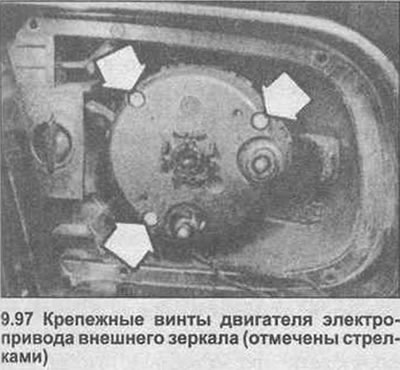
97. Remove the three mounting screws, then remove the motor from the mirror housing, disconnecting the wiring connector as it becomes accessible (photo).
98. Installation is the reverse procedure of removal.
Mirror control switch
99. Remove the door trim panel as described in Section 11.
100. Press the retaining clips and remove the switch from the door panel.
101. Installation is the reverse procedure of removal.
Mirror heating time relay
102. On pre-1989 models, the mirror heating timer relay is located behind the passenger panel (see Figure 12.6, insert "F", in Section 12). To remove the relay, remove the rear rubber cover and remove the trim panel. Disconnect the wiring connector and pull the relay out of the mounting plate.
103. On models from 1989, the mirror heating time relay can be combined with (or instead) rear window washer/wiper timer relay, which is located on the relay holder behind the fuse box. See. Section 12, Chapter 16 for further information (and to Figure 12.6, "H", relay No.4).
Anti-theft alarm system - general description
104. Since 1990, an anti-theft alarm system has been fitted as standard equipment on all Sedan models and offered as an optional extra on most other models. At the time of writing, very little information was available regarding the alarm system, so any problems with the system should be addressed by a dealer.
105. Both a player and a graphic equalizer (where are they used) can be removed using the information given in Section 12, Chapter 40. Before disconnecting, mark the correct position of all electrical wiring connectors.
Loudspeakers - Removal and Installation
Front door speakers
106. See. Section 11, Chapter 13. Dashboard speakers
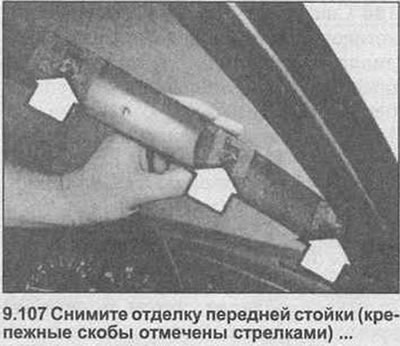
107. Carefully lever the trim panel away from the corresponding A-pillar, noting that the trim panels are secured with three retaining clips (photo).
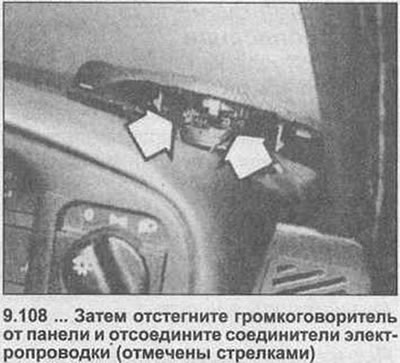
108. Remove the speaker from the instrument panel using a lever, disconnecting the wiring connectors as they become accessible (photo).
109. Installation is the reverse procedure of removal.
Rear Speakers - Sedan Models
110. Unfasten the speaker cover from the rear panel.
111. Remove the four speaker mounting screws, then lift the speaker and disconnect the wiring connectors.
112. Installation is the reverse procedure of removal.
Rear Speakers - Station Wagon Models
113. See. Section 11, Chapter 10.
Windshield Antenna Amplifier - Removal and Installation
114. On models with an antenna that is built into the windshield, an amplifier is included in the antenna cable to increase the signal. The amplifier can be removed as follows.
115. Remove the right front speaker from the instrument panel as described above.
116. Remove the radio or CD player as described in Section 12, also noting the information given in item 105.
117. Trace the radio/CD player wiring back to the amplifier wiring connector, which is approximately 60mm from the main connector. Disconnect the amplifier.
118. Tie the end of the antenna cable to the radio with a piece of twine and disconnect the upper end of the wiring from the windshield.
119. Loosen the mounting bolt, then pull the amplifier out through the speaker slot. If the end of the antenna cable is exposed, untie the twine and leave it behind the panel; twine can be used during installation to pull the antenna cable and amplifier wiring connector into place through the radio opening.
120. Installation is the reverse procedure of removal.
Visitor comments