
OpelBook.ru
Cars AvtoVAZ Cars Mitsubishi Cars BMW Cars Mercedes Cars Nissan Cars Toyota Cars Chevrolet
English Русский
Български
Беларускі
Український
Српски
Hrvatski
Română
Polski
Slovenský
Magyar
 |  Sitemap  |  Contacts  |    


Main Astra Corsa Insignia Kadett Omega Vectra Zafira Others Articles
Omega A (1986-1993) Omega B (1993-1999) Omega B2 (1999-2003)
  • Main
  • Omega
  • Omega A
  • General information
  • User manual
  • Adjusting the vehicle's landing level

Adjusting the vehicle's landing level (Opel Omega A)

            0

Allows you to maintain a constant ride height for the vehicle under varying rear axle loads, such as when towing a trailer, and improves driving performance.

Allows you to maintain a constant ride height for the vehicle under varying rear axle loads, such…


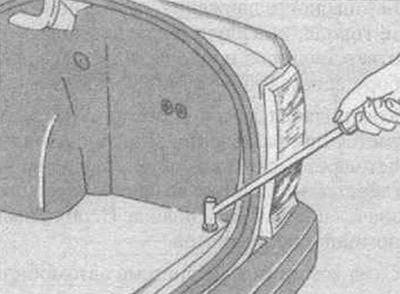
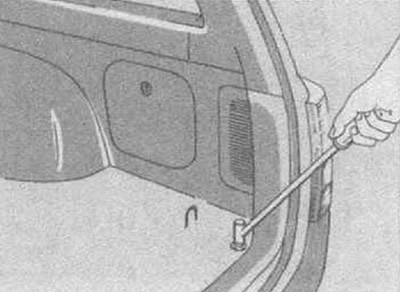
Manual adjustment is carried out using a conventional pump or compressor. The manual adjustment lift filler valve is located in the trunk on the right.

When planning a full load of the car, for safety reasons it is not recommended to inflate the capacity of the regulating device to the maximum in advance and drive in this position without loading the car. When driving with a full load, the minimum pressure in the device should be 300 kPa (3 bar). And never fall below the base value - 80 kPa (0.8 bar).
When planning a full load of the car, for safety reasons it is not recommended to inflate the…


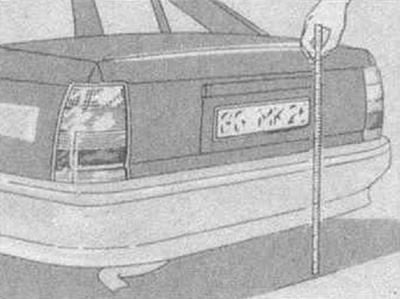
Place the unloaded vehicle on a level surface. Inflate the device with air to 80 kPa. Measure the height of the rear bumper above ground level. Subtract 5 cm from this value and write down the result. If this value decreases when the vehicle is loaded, increase the pressure until you get the specified value.


Place the unloaded vehicle on a level surface. Inflate the device with air to 80 kPa. Measure the…


The maximum permissible pressure is 500 kPa (5 bar). Exceeding this value is prohibited.

Before driving with the vehicle unloaded, the pressure must be reduced again to 80 kPa (0.8 bar).

Automatic adjustment of the vehicle's height while driving is delayed. This is intended to avoid changing the vehicle's landing level with every unevenness in the road.

(Original source is on the website: OPELBOOK)


This article is available at russian, bulgarian, belarusian, ukrainian, serbian, croatian, romanian, polish, slovak, hungarian
Checking the article: Zinoviev Kirill

Share information:

Previous articles
Opel Omega A: User manual
Next articles

Electronically controlled chassis damping
Automatic transmission
Air Conditioning Control
Heating and ventilation control
Windows, retractable sunroof
Lighting fixtures
Manual speed control device
Brake system
Wheels and tires
Additional luggage rack on the roof of the body
Traction device
Fuel system of diesel engine


See similar ones from other Opel car manuals:
▶ Checking and adjusting the fuel level in the float chamber Opel Kadett D (1979-1984)
▶ Characteristics of vehicle components Opel Astra F (1991-1998, petrol)
▶ Vehicle Identification Numbers Opel Corsa B (1993-2000)
▶ Towing another vehicle Opel Insignia A (2008-2017)
▶ Adjusting the rear view mirrors Opel Vectra A (1988-1995, petrol)
Link to this page in different formats

Visitor comments


No comments yet


How much will 11 + 22 =


Omega B2 (1999-2003) 
  • General information
  • User manual
  • Maintenance
  • Troubleshooting
  • Power unit
  • Petrol 4-cylinder
  • Petrol 6-cylinder
  • Engine overhaul
  • Diesel engines 2.0 l
  • Diesel engines 2.5 l
  • Cooling and heating
  • Injection system (gasoline)
  • Fuel system (diesel)
  • Fuel system
  • Exhaust system
  • Ignition system
  • Transmission
  • Clutch
  • Mechanical gearbox
  • Automatic gearbox
  • Main gear and shafts
  • Chassis
  • Brake system
  • Car suspension
  • Steering
  • Body
  • Body elements
  • Electrical equipment
  • Equipment and devices
  • Electrical circuits
Omega B (1993-1999) 
  • General information
  • User manual
  • Tips for the car owner
  • Maintenance (gasoline)
  • Maintenance (diesel)
  • Power unit
  • Petrol engine SOHC 2.0 l
  • Petrol engine DOHC 2.0 l
  • Petrol engines 2.5 and 3.0 l
  • Repair of gasoline engines
  • Diesel engine 2.0 l
  • Diesel engine repair 2.0 l
  • Diesel engine 2.5 l
  • Cooling and heating
  • Power system (petrol)
  • Emission reduction
  • Fuel system (diesel 2.0 l)
  • Fuel system (diesel 2.5 l)
  • Launch system
  • Ignition system
  • Transmission
  • Clutch
  • Mechanical gearbox
  • Automatic gearbox
  • Drive shafts
  • Chassis
  • Brake system
  • Wheel suspension
  • Steering
  • Body
  • Exterior
  • Interior
  • Doors and windows
  • Electrical equipment
  • Equipment and devices
  • Wiring diagrams (early)
  • Wiring diagrams (late)
Omega A (1986-1993) 
  • General information
  • User manual
  • Maintenance
  • Changes and additions
  • Troubleshooting
  • Power unit
  • Gasoline engines
  • Diesel engines
  • Cooling system
  • Fuel system (gasoline)
  • Fuel system (diesel)
  • Ignition system
  • Transmission
  • Clutch
  • Mechanical gearbox
  • Automatic gearbox
  • Cardan shaft
  • Drive shafts
  • Chassis
  • Brake system
  • Car suspension
  • Steering
  • Body
  • Exterior
  • Interior
  • Electrical equipment
  • Power devices
  • Lighting and appliances
  • Electrical circuits
OpelBook.ru © 2017–2026 · Mobile version · · Sitemap: EN BG BY UA RS HR RO PL SK HU · Feedback · Site search
Astra F, petrol · Astra G, petrol · Astra G · Astra H · Astra J, petrol · Corsa B · Corsa C, petrol · Corsa C · Insignia A · Kadett D · Kadett E · Omega A · Omega B · Omega B2 · Vectra A, petrol · Vectra A · Vectra B, petrol · Vectra B · Vectra C · Zafira A, petrol · Frontera A, petrol · Frontera B · Ascona C · Vivaro A ·
We want your visit to be comfortable 🤝! We use cookies 🍪 to make that happen.