


Note: Handle the brake system with care and avoid inhaling dust generated by wear of its components, as it may contain asbestos, which is harmful to health.
Inspection
1. Where applicable, remove the front wheel caps, then loosen the wheel bolts and apply the handbrake. Jack up and support the front of the vehicle on axle stands.
2. Remove the wheels. Turn the steering wheel to the extreme right position and check the right brake pads for wear. Make sure that the brake pad thickness is (including the block) — not less than the minimum value given in the Specifications.
3. Turn the steering wheel to the extreme left position and check the left brake pads in the same way.
4. If the thickness of at least one of the brake pads is less than that specified in Specifications minimum, replace all front pads as a set.
5. If the pads require replacement, proceed as follows.
Models 1.4, 1.6 and 1.8 l
Removal
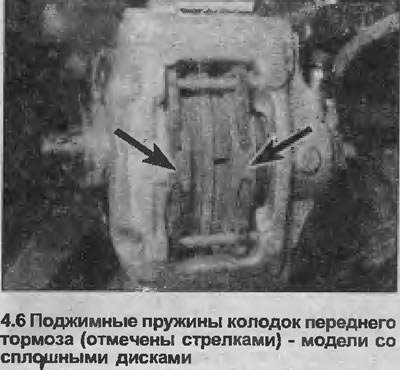
6. Remember how the brake shoe pressure springs are installed (see illustration), then remove the upper and lower brake shoe mounting pins from the caliper using a punch.
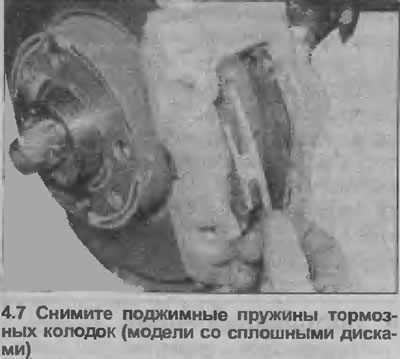
7. Remove the brake shoe pressure springs (see illustration).
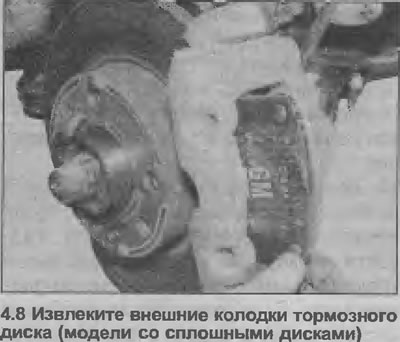
8. Move the pads slightly away from the disc, then use pliers to remove the outer pad (see illustration).
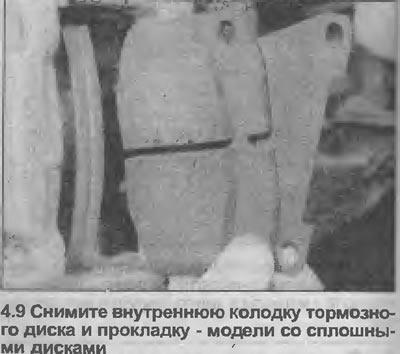
9. Remove the inner pad and the gasket installed between the pad and the caliper piston (see illustration).
Installation
10. Clean off any dust or dirt from the caliper, being careful not to inhale any particles that may become airborne. Carefully scrape off any rust from the edge of the brake disc.
11. To install new (thicker) pads, you need to push the caliper piston all the way into the cylinder bore using a flat metal rod. This action will raise the fluid level in the reservoir, so to avoid losing fluid, suck out some of it using an old hydrometer or pipette. See the note at the beginning Chapters 3. Do not insert a flat rod between the piston and the disc in an attempt to displace the piston.
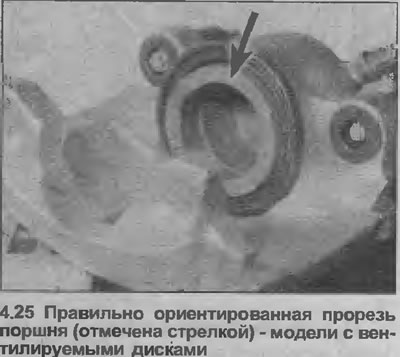
12. Make sure that the slots in the piston are aligned vertically. If necessary, carefully turn the piston to the correct position.
13. Apply a small amount of brake grease to the top and bottom edges of the metal base of the new pads.
14. Install the new pads onto the caliper, placing a shim between the inner pad and the piston. Make sure the brake pads are facing the disc and that the pads move freely.
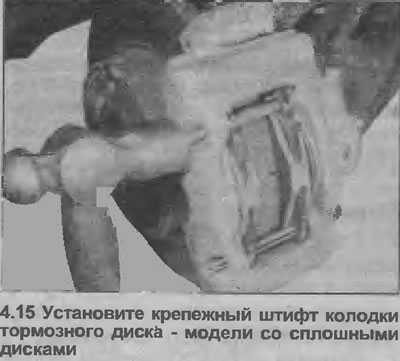
15. Install the pressure springs onto the brake shoes, then insert the mounting pins (from the outside of the caliper), pressing on the springs. Drive the pins into the caliper (see illustration).
16. Repeat the steps on the second wheel.
17. Install the wheels and lower the vehicle to the ground. Do not fully tighten the wheel bolts until the vehicle is lowered to the ground.
18. Press the brake pedal firmly several times to press the pads against the disc.
19. Check and, if necessary, top up the brake fluid level.
20. New brake pads must first be bedded in, so try to avoid sudden braking for the first 160 km after installing new pads.
2.0L models
Removal
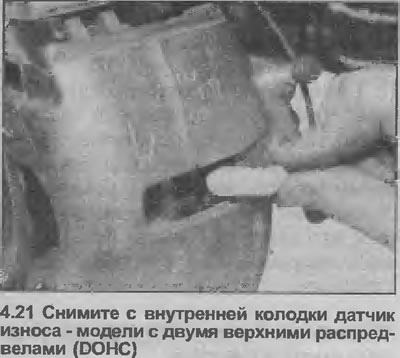
21. Where applicable, move the wear sensor away from the inner pad and disconnect the wiring connector under the wheel arch, near the suspension strut (see illustration). Remember how the wire runs.
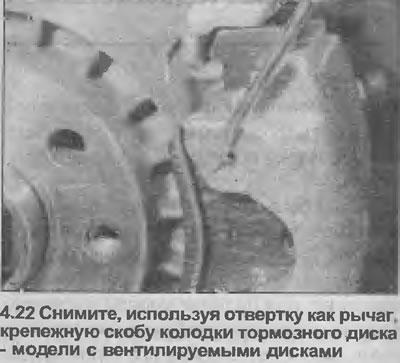
22. Using a screwdriver as a lever, remove the brake pad retaining clip from the outer edge of the caliper (see illustration).
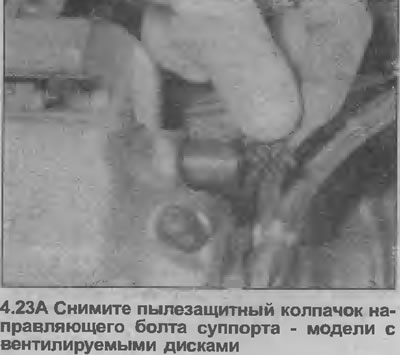
23. Using a screwdriver as a lever, remove the dust caps from the two guide bolts on the inside edge of the caliper, then use a socket wrench to remove the guide bolts and lift the caliper and inner pad off the bracket. Remove the outer brake pad (see illustrations). Tie the caliper to the body with wire or twine to avoid deformation of the brake hoses.
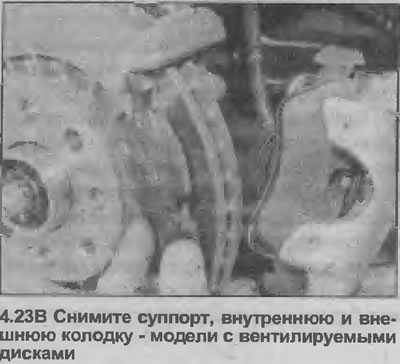
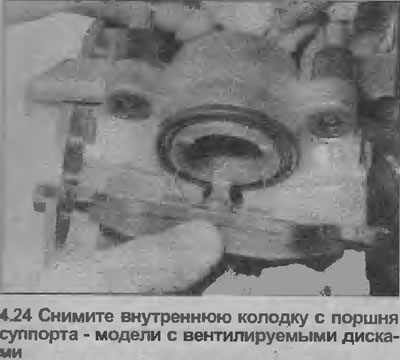
24. Move the inner pad away from the caliper piston (the shoe is secured with a bracket mounted on its metal base) (see illustration).
Installation
25. Proceed as described in points 10-12 (see illustration).
26. Apply a small amount of brake grease to the caliper contact surfaces of the new brake pads.
27. Install the new inner pad onto the caliper piston, making sure the piston is positioned correctly.
28. Install the outer pad onto the caliper bracket with the brake pad facing the disc.
[Original source is on the website: OPELBOOK.ru]
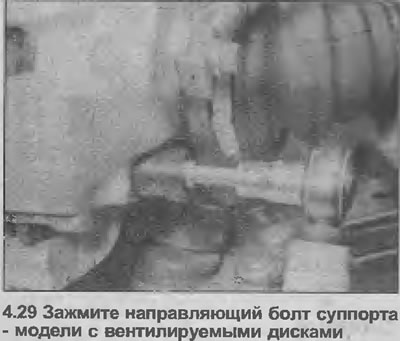
29. Install the caliper on the bracket and tighten the guide bolts to the specified tightening torque Specifications (see illustration).
30. Install the guide bolt dust caps.
31. Install the shoe mounting bracket.
32. Where applicable, install a new wear sensor on the inner shoe and connect its wiring to the connector under the wheel arch. Route the wiring as noted during removal.
33. Repeat the steps on the second wheel.
34 Proceed as described in paragraphs 17-20 inclusive.
Visitor comments