


Inspection
1. It is recommended to remove the drums to inspect the brake shoes. This will also allow you to inspect the working brake cylinders for signs of leaks. However, you can determine the wear of the brake linings without removing the drums through the inspection holes in the support shields, by removing the plugs.
2. Use a flashlight and, if necessary, a mirror and check that the brake pad thickness is greater than that specified in Specifications minimum.
3. If any of the pads is worn beyond the Specification limit, replace all four rear brake pads as a set.
Removal
4. Where applicable, remove the rear wheel caps, then loosen the wheel bolts and block the front wheels. Jack up and support the rear of the vehicle on axle stands. Remove the rear wheels.
5. Release the handbrake completely.
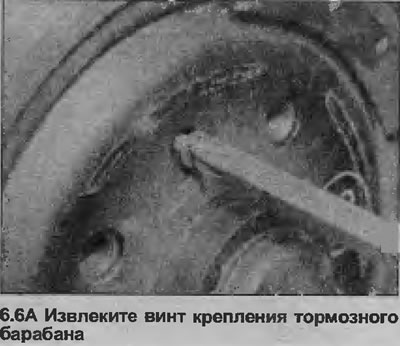
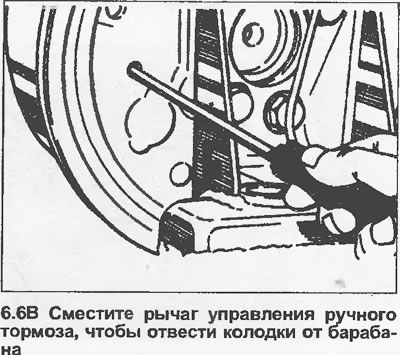
6. Remove the mounting screw and remove the drum. If this is not possible, remove the inspection hole plug in the support shield and move the handbrake control lever toward the brake shoe to move the shoes away from the drum. If necessary, loosen the handbrake cable adjuster (see illustrations).
7. Remember the location and orientation of all components before removing them to simplify subsequent reassembly.
8. Clean dust and dirt from the drum and shoe, being careful not to inhale any airborne particles.
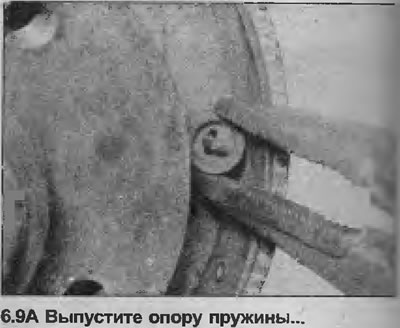
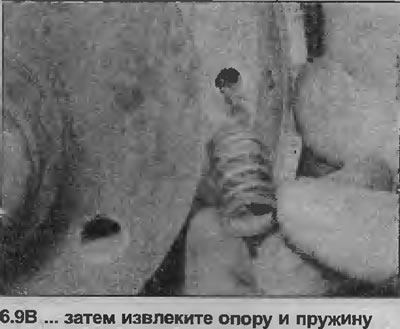
9. Remove the support posts and shoe springs (together with their supports), pressing on the spring supports and turning them 90° with pliers (see illustrations). Note that the shoe support posts are removed through the rear of the backplate.
10. Disconnect the handbrake cable from the control lever.
11. Disconnect the upper and lower return springs and remove the shoes individually or as a set with adjustable expansion bars and springs. Remove the hub (see Section 10). Do not damage the rubber boots of the working brake cylinder. Before removing the return springs, note their correct position and orientation, as well as the position and orientation of the adjustable expansion strips.
12. When removing the pads, place a tight rubber band or spring clip on the wheel cylinder to prevent the pistons from coming out. Never press the brake pedal while the drum is removed.
Installation
13. Clean off any dust or dirt from the drum brake backing plate, being careful not to inhale any airborne particles.
14. Apply a small amount of brake grease to the area of the backing plate that contacts the side surface of the pads.
15. Find the cause of contamination of the linings (wheel cylinder or leaking hub bearing seal) and eliminate it.
16. Although the pads are sold separately (without pads), it is recommended to change the assembly of the pad with the lining, since installing new linings on old pads requires special skills and equipment.
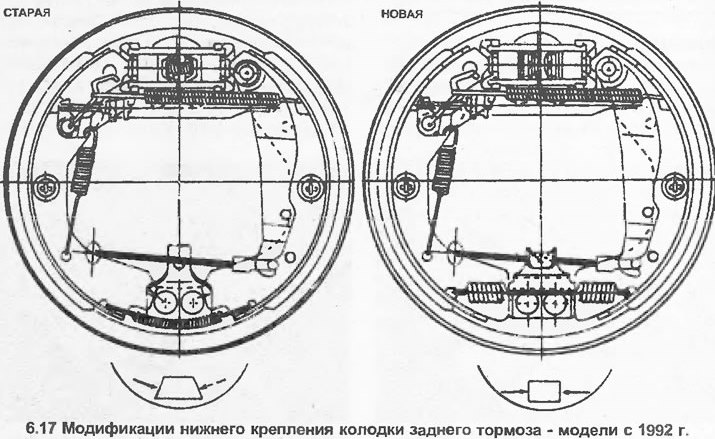
17. If removed as an assembly, disassemble the shoes, adjusting spreader bars and springs. Note the position and orientation of the components. Later models (since 1992) have a modified lower brake shoe mount (rectangular shape), accordingly, the brake pads were also changed along with the lower return spring (see illustration).
18. If both brake assemblies are removed at the same time, do not mix up the components. Note that the left and right brake adjuster bar components are labeled. The threaded rod is marked with an "E" (left) or "R" (right), the other components are marked in black (left brake) or silver (right brake) color.
19. Disassemble and clean the adjustable expansion bar. Apply a small amount of silicone grease to the threads of the adjustable bar.
20. Inspect the return springs. If they are deformed or damaged, replace them. Weak springs can cause braking.
21. If the new pads were not supplied with a new handbrake control lever (where it is applied), move the lever from the old pads. The lever is secured with a pin and a locking ring or a rivet that needs to be drilled out.
22. If the components are installed as an assembly, assemble the new shoes, springs and adjuster bar components. Spread the adjuster bar to facilitate installation (see illustrations).
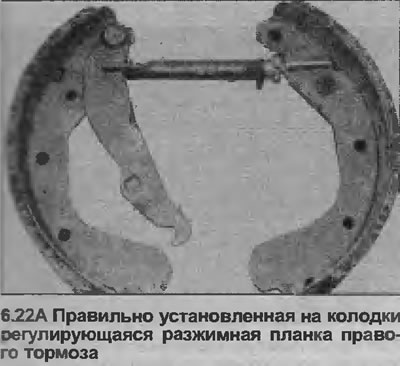
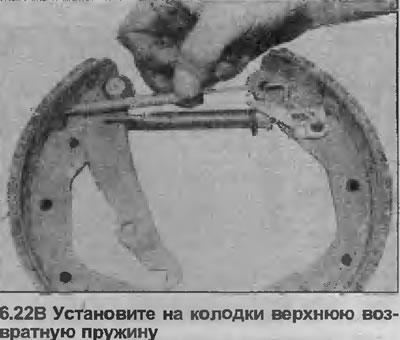
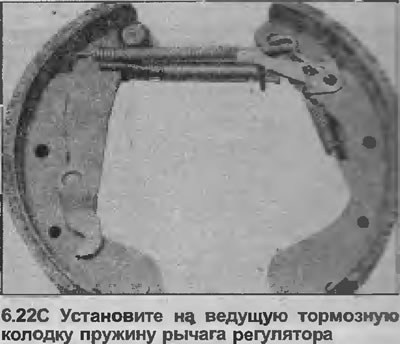
23. Apply the shoes to the drum brake backing plate. Be careful not to damage the boots of the working brake cylinder and not to move the pistons. Do not forget to remove the rubber band or spring clip from the working brake cylinder that was installed when removing the shoes.
24. Insert the brake shoe support posts and secure them with springs.
25. Connect the handbrake cable, then install the hub and adjust its bearing.
26. Installing the shoe and spring assembly can be difficult. You can install the shoes and secure them with the support posts, and then install the adjustable spreader bar, return springs and adjuster.
27. Move the adjuster wheel to reduce the length of the expansion bar and move the shoes away from the brake drum.
28. Make sure that the handbrake control lever is set correctly (pin on the edge of the shoe bridge), then install and attach the brake drum.
[Original posted on the website OPELBOOK]
29. Repeat the steps on the second brake.
30. Adjust the brakes by pressing the brake pedal at least fifteen times. You will hear clicking sounds in the drums when the automatic clearance compensators are activated. When the clicking sounds stop, the adjustment is complete.
31. Check the handbrake adjustment as described in Chapter 26.
32. Install the wheels and lower the vehicle to the ground. Do not fully tighten the wheel bolts until the vehicle is lowered onto the wheels.
33. New drum brake linings must first be bedded in, so try to avoid hard braking during the first 100 miles after replacing the pads.
Visitor comments