


Note: Before disassembling the master cylinder, make sure the correct parts are available and save the old components to use as a reference when purchasing replacements.
1. Remove the master cylinder as described in Chapter 15.
Master cylinder type GMF
2. Clamp the master cylinder in a vice with soft-padded jaws.
3. Where installed, unscrew the pressure control valves from the base of the cylinder.
4. Carefully remove the O-ring from the end of the cylinder using a screwdriver as a lever.
5. Lightly press the primary piston using a wooden or plastic stick. Keep the piston pressed by inserting a smooth pin or rod with a diameter of 3.0 mm through the primary channel of the feed tank into the cylinder (see illustration).
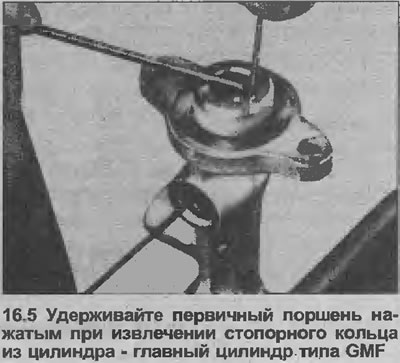
6. Remove the retaining ring from the end of the cylinder with a screwdriver. Be careful not to damage the piston or cylinder walls.
7. Remove the pin or rod that secures the piston.
8. Remove the primary piston assembly from the cylinder by tapping the cylinder against a wooden block if necessary.
9. Supply low pressure air to the cylinder (for example using a foot pump) through the front channel of the feed tank to expel the secondary piston assembly.
10. Clean all components using only clean brake fluid or methylated spirits and inspect them for signs of wear and damage. In particular, check the pistons and cylinder bore for scratches and corrosion. If the cylinder walls are worn, replace the master cylinder assembly (see illustration).
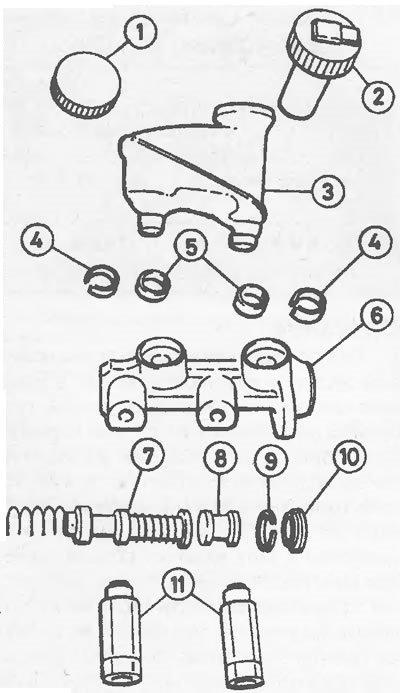
16.10 Components of the GMP type master cylinder
1 Filler cap (standard)
2 Filler cap (with liquid level sensor)
3 Feeding tank
4 Feed tank mounting brackets
5 Feed tank seals
6 Cylinder
7 Secondary piston and springs
8 Primary piston
9 Retaining ring
10 O-ring seal
11 Pressure regulating valves
11. If the cylinder bore is in good condition, purchase a repair kit of parts that will contain all the necessary replacement parts already assembled
12. Lubricate the cylinder bore with clean brake fluid or brake system lubricant, then clamp the cylinder horizontally in a vice with soft-padded jaws.
13. Remove the plug from the end of the auxiliary tube (included in the repair kit) and insert the short part of the tube up to the flange into the cylinder channel.
14. Use a wooden or plastic block to push the components out of the tube and into the cylinder bore. Then insert the pin or rod used during removal into the cylinder through the primary bore of the feed tank to hold the primary piston depressed.
15. Insert the new retaining ring into the end of the cylinder bore, making sure it is seated correctly and that the piston moves freely in the cylinder.
16. Press the primary piston and remove the pin or rod from the feed tank channel.
17. Install a new O-ring onto the end of the cylinder.
18. Where applicable, screw the pressure regulating valves into the base of the cylinder
19. Install the master cylinder as described in Chapter 15.
Master cylinder type ATE
20. Clamp the master cylinder in a vice with soft-padded jaws.
21. Where applicable, unscrew the pressure control valves from the base of the cylinder.
22. Carefully remove the O-ring from the end of the cylinder using a screwdriver as a lever.
23. Lightly press down on the primary piston using a wooden or plastic block, then remove the retaining ring from the end of the cylinder.
24. Remove the primary piston assembly, noting the location of the limiter washers.
25. Press down on the secondary piston, again using a wooden or plastic block, and remove the lock screw from the cylinder body (see illustration).
Text copied from an online resource www.opelbook.ru
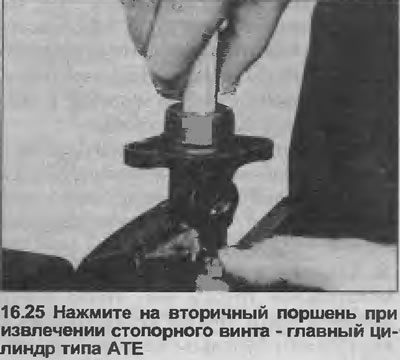
26. Remove the secondary piston assembly from the cylinder, tapping the cylinder against a wooden block if necessary to dislodge the piston from the bore.
27. Clean all components using only clean brake fluid or methylated spirits, and inspect them for signs of wear and damage. In particular, check the pistons and cylinder bores for scratches and corrosion. If the inner cylinder walls are worn, replace the master cylinder assembly (see illustration).
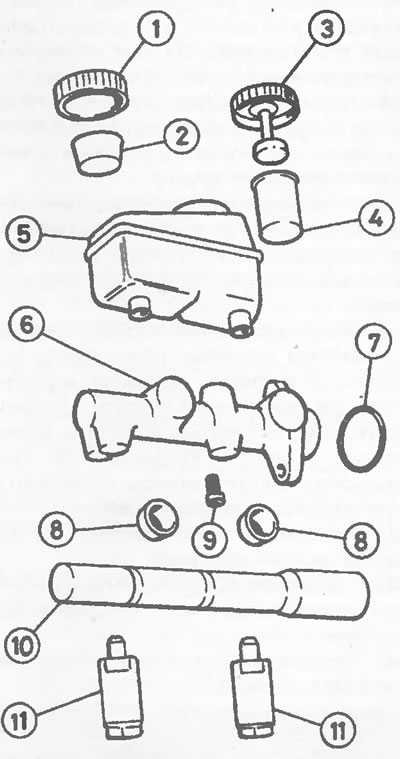
16.27 ATE Master Cylinder Components
1 Filler cap (standard)
2 Mesh filter
3 Filler cap (with liquid level sensor)
4 Guide bushing for float
5 Feeding tank
6 Cylinder
7 O-ring seal
8 Feed tank seals
9 Locking screw
10 Auxiliary tube of repair kit
11 Pressure regulating valves
28. If the cylinder walls are in good condition, purchase a repair kit of parts, which will contain all the necessary replacement parts already assembled.
29. Lubricate the cylinder bore with clean brake fluid or brake system lubricant, then clamp the cylinder horizontally in a vice with soft-padded jaws.
30. Install a new O-ring onto the lock screw, then lightly screw the screw into the cylinder body so that it does not protrude into the bore.
31. Remove the plugs from the ends of the auxiliary tube, then remove all components from the short part of the tube and push it into the long part of the tube until their ends are flush.
32. Insert the auxiliary tube into the cylinder bore up to the rim of the short sleeve. Then use a wooden or plastic block to assemble the secondary piston into the cylinder.
33. Lightly tighten the lock screw, then remove the wooden or plastic block and auxiliary tube and fully tighten the lock screw.
34. Turn the master cylinder in a vice to a vertical position.
35. Lubricate the primary piston skirt and seal grooves with the special grease included in the repair kit. Install the limiter washer on the piston.
36. Move the short part of the auxiliary tube so that the end of the long part of the tube is flush with the inner flange of the short part.
37. Install the front seal onto the primary piston with the open end of the seal facing the front of the master cylinder.
38. Install the auxiliary tube on the cylinder to compress the seal, insert the edge of the piston and tube into the hole and remove the tube.
39. Install the intermediate ring onto the primary piston, then install the remaining seal using the auxiliary tube as described above.
40. Place the stop washer on the primary piston, then press the piston lightly using a wooden or plastic block and install a new snap ring into the end of the cylinder bore. Make sure the snap ring is seated correctly and that the piston moves freely.
41. Install a new O-ring onto the edge of the cylinder.
42. Where applicable, screw the pressure regulating valves into the base of the cylinder.
43. Install the master cylinder as described in Chapter 15.
Visitor comments