


Note: See Note at Beginning Chapters 3 before you begin work. Also note that both valves should be replaced at the same time and that the valves must be identical. Make sure you purchase the correct type of valves(the valve type is indicated on its body).
Valves mounted on the master cylinder
Removal
1. Remove the brake fluid reservoir cap, cover the filler neck with a piece of polyethylene and secure it with a rubber band or reinstall the cap. This will reduce fluid loss during the next procedure.
2. Place a suitable container under the master cylinder to catch any brake fluid that is released.
[Article posted on Internet portal opelbook]
3. Mark the two lower brake pipes, then loosen the union nuts and disconnect the pipes from the pressure regulating valves at the base of the master cylinder. Plug the open ends of the pipes to prevent dirt from entering.
4. Remove the pressure regulating valves from the master cylinder and plug the openings in the cylinder to prevent dirt from entering.
Installation
5. Install in reverse order. Finally, remove the polyethylene from the filler neck of the refill tank and bleed the entire brake system as described in Chapter 3.
Valves mounted on the rear of the bottom
Removal
6. Proceed as described in point 1.
7. Block the front wheels, then jack up and support the rear of the vehicle on axle stands.
8. Working under the rear of the car, loosen the union nut and disconnect the brake pipe from one of the valves. Be prepared for fluid to escape and plug the end of the pipe to prevent dirt from getting in and further fluid loss
9. Disconnect the flexible hose from the valve in the same way.
10. Release the valve retaining clip from the bracket on the underbody, keeping in mind that on some models the retaining clip also secures the ABS sensor wiring. Remove the valve (see illustration).
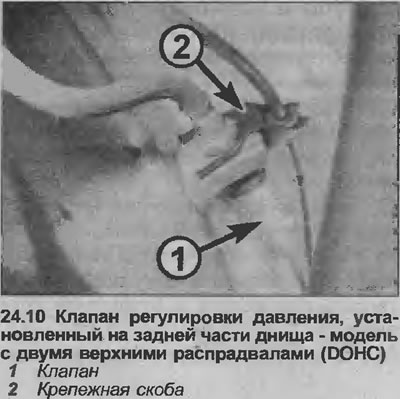
11. Remove the second valve in the same way.
Installation
12. Proceed as described in point 5.
Visitor comments