
OpelBook.ru
Cars AvtoVAZ Cars Mitsubishi Cars BMW Cars Mercedes Cars Nissan Cars Toyota Cars Chevrolet
English Русский
Български
Беларускі
Український
Српски
Hrvatski
Română
Polski
Slovenský
Magyar
 |  Sitemap  |  Contacts  |    


Main Astra Corsa Insignia Kadett Omega Vectra Zafira Others Articles
Vectra A (1988-1995, petrol) Vectra A (1988-1995) Vectra B (1995-2002, petrol) Vectra B (1995-2002) Vectra C (2002-2008)
  • Main
  • Vectra
  • Vectra A
  • Chassis
  • Brake system
  • Vacuum booster — removal and installation

Vacuum booster — removal and installation (Opel Vectra A)

            0

Contents: Removal ⬇ Installation ⬇
Note: During 1989, some vehicles were produced with the brake pedal not correctly installed (approximately 15.0 mm above the clutch pedal instead of the usual 4.0 mm below it). The correct pedal installation height can be achieved by adjusting the working length of the vacuum booster fork as described in points 15 and 16.


Removal


1. Disconnect the negative cable from the battery.

2. Working inside the passenger compartment, remove the lower trim panel from the driver's footwell.

3. Disconnect the wiring connector from the brake light switch, then turn the switch counterclockwise and remove it from the bracket.

4. Pull the spring clip off the right end of the pivot pin that secures the booster fork to the pedal.

5. Using pliers, disconnect the end of the return spring from the pedal and remove the pivot pin that secures the booster fork to the pedal.

6. Remove the windshield fairing as described in Section 11, then remove the motor and wiper link as described in Section 12.

7. Remove the coolant expansion tank as described in Section 3.

8. Disconnect the vacuum line from the brake booster.

9. Remove the two mounting nuts and carefully remove the master cylinder from the mounts on the booster. Move the master cylinder forward slightly, being careful not to deform the brake lines.

10. Remove the two plugs covering the amplifier mounting bolts (see illustrations).
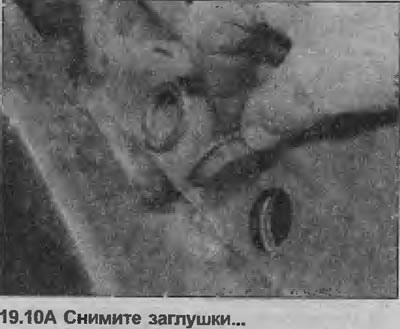
10. Remove the two plugs covering the amplifier mounting bolts (see illustrations).
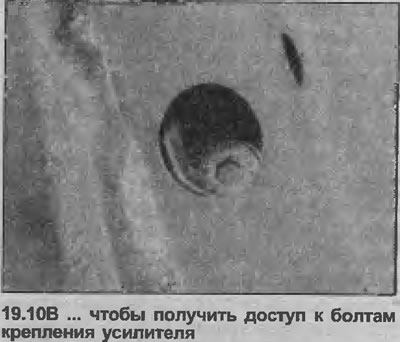

10. Remove the two plugs covering the amplifier mounting bolts (see illustrations).


11. Loosen the amplifier mounting bolts with a socket wrench and remove them, then remove the amplifier from the bulkhead (see illustrations).
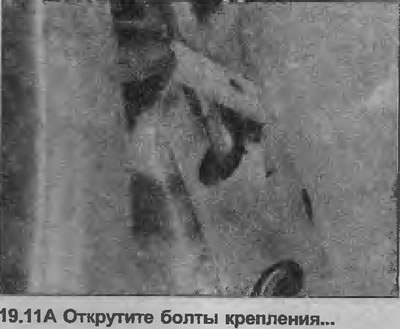
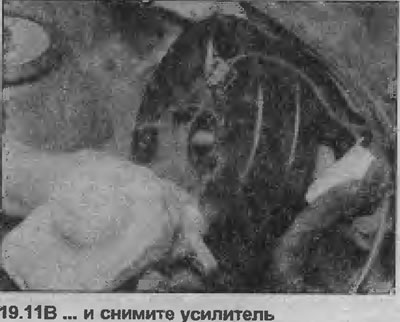

11. Loosen the amplifier mounting bolts with a socket wrench and remove them, then remove the…


11. Loosen the amplifier mounting bolts with a socket wrench and remove them, then remove the…


12. If necessary, remove the mounting bracket from the amplifier by unscrewing the four mounting nuts. Note that the bracket is seated on the amplifier using sealant.

13. It is impossible to disassemble the amplifier; if it is faulty, replace the unit.

Installation


14. Before installing the amplifier, make sure the working length of the fork is correct as described below.

[Material copied from this resource OpelBook.ru]

15. Measure the distance from the end of the booster housing to the center of the pivot pin hole in the fork. The distance should be 144.0 mm. To make the measurement easier, insert a bolt or rod of suitable diameter through the pivot pin holes and mark its center (see illustration).
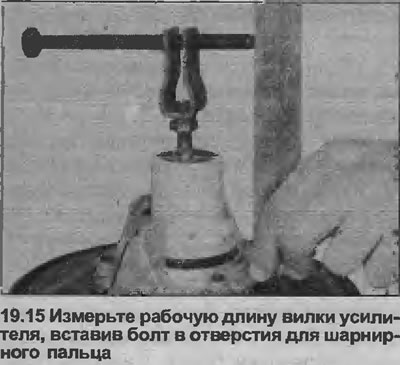


15. Measure the distance from the end of the booster housing to the center of the pivot pin hole in…


16. If adjustment is necessary, loosen the lock nut and rotate the fork to achieve the desired length, then tighten the lock nut.

17. Where applicable, coat the mating surfaces of the amplifier and mounting bracket with sealant, then install the bracket onto the amplifier and tighten the mounting nuts to the specified tightening torque Specifications.

18. Coat the threads of the booster mounting bolts with blocking compound, then install the booster onto the bulkhead and tighten the bolts.

19. Install the amplifier mounting bolt covers.

20. Install the master cylinder on the booster and tighten the fastening nuts to the specified tightening torque Specifications.

21. Connect the vacuum tube to the amplifier.

22. Install the coolant expansion tank as described in Section 3.

23. Install the windshield wiper motor and linkage as described in Section 12 then install the windshield fairing.

24. Then install in reverse order. Finally, check the amplifier operation as described in Chapter 18.


This article is available at russian, bulgarian, belarusian, ukrainian, serbian, croatian, romanian, polish, slovak, hungarian
Checking the article: Chernov Alexander

Share information:

Previous articles
Opel Vectra A: Brake system
Next articles

Vacuum booster — description and testing of operation
Master Cylinder (ABS Models) — General Description
Master Cylinder (Non ABS Models) — Overhaul
Master Cylinder — Removal and Installation
Front Brake Disc Guard — Removal and Installation
Rear Brake Shield — Removal and Installation
ABS hydraulic modulator — removal and installation
ABS Sensor Mounted on Wheel — Removal and Installation
ABS control unit — removal and installation
ABS Relay (ABS-2E System Only) — Removal and Installation
Pressure Regulating Valves — Removal and Installation
Brake pipes and hoses — general description, removal and installation


See similar ones from other Opel car manuals:
▶ Vacuum booster check valve — removal and installation Opel Astra G (1998-2004, petrol)
▶ Replacing and checking the brake booster servo vacuum pump… Opel Corsa B (1993-2000)
▶ Vacuum brake booster Opel Insignia A (2008-2017)
▶ Vacuum booster — testing Opel Omega A (1986-1993)
▶ Vacuum brake booster — removal and installation Opel Frontera A (1991-1998, petrol)
Link to this page in different formats

Visitor comments


No comments yet


How much will 21 + 45 =


Vectra C (2002-2008) 
  • General information
  • User manual
  • Vehicle device
  • Maintenance
  • Troubleshooting
  • Power unit
  • Engine repair
  • Cooling system
  • Power and control system
  • Engine electrics
  • Transmission
  • Clutch
  • Car gearbox
  • Drive shafts
  • Chassis
  • Car suspension
  • Steering
  • Brake system
  • Body
  • Exterior
  • Interior
  • Doors, locks and windows
  • Heating and ventilation
  • Electrical equipment
  • Equipment and devices
  • Headlights and lighting
  • Electrical circuits
Vectra B (1995-2002) 
  • General information
  • User manual
  • Weekly checks
  • Maintenance (gasoline)
  • Maintenance (diesel)
  • Troubleshooting
  • Power unit
  • SOHC gasoline engine
  • DOHC petrol engine
  • Diesel engine 1.7 liter
  • Diesel engine 2.0 liters
  • Engine repair
  • Cooling system
  • Fuel system (gasoline)
  • Fuel system (diesel)
  • Charging system
  • Launch system
  • Ignition and preheat
  • Transmission
  • Clutch
  • Mechanical gearbox
  • Automatic gearbox
  • Drive shafts
  • Chassis
  • Brake system
  • Wheel suspension
  • Steering
  • Body
  • Exterior
  • Interior
  • Doors and windows
  • Heating and ventilation
  • Electrical equipment
  • Equipment and devices
  • Electrical circuits
Vectra B (1995-2002, petrol) 
  • General information
  • Maintenance
  • Help with malfunctions
  • Power unit
  • Engine repair
  • Exhaust system
  • Cooling system
  • Fuel system
  • Multec injection system
  • Four point injection
  • Transmission
  • Clutch
  • Gearbox and drive
  • Chassis
  • Wheel suspension
  • Steering
  • Brake system
  • Wheels and tires
  • Body
  • Exterior
  • Interior
  • Electrical equipment
  • Fuses and electronics
  • Power devices
  • Ignition system
  • Lighting and signaling
  • Equipment and devices
  • Heating and ventilation
  • Electrical circuits
Vectra A (1988-1995) 
  • Power unit
  • Engine repair
  • Ignition system
  • Lubrication system
  • Cooling system
  • Injection system
  • Fuel system (carburetor)
  • Fuel system (diesel)
  • Exhaust system
  • Transmission
  • Clutch
  • Car gearbox
  • Chassis
  • Front suspension
  • Rear suspension
  • Steering
  • Brake system
  • Wheels and tires
  • Body
  • Exterior
  • Interior
  • Electrical equipment
  • Electrical circuits
Vectra A (1988-1995, petrol) 
  • General information
  • User manual
  • Maintenance
  • Power unit
  • SOHC engine
  • DOHC engine
  • Cooling and ventilation
  • Fuel system (carburetor)
  • Fuel system (injector)
  • Exhaust converter
  • Transmission
  • Clutch
  • Mechanical gearbox
  • Automatic gearbox
  • Drive shafts
  • Chassis
  • Brake system
  • Car suspension
  • Steering
  • Body
  • Body elements
  • Electrical equipment
  • Power devices
  • Equipment and devices
  • Electrical circuits
OpelBook.ru © 2017–2026 · Mobile version · · Sitemap: EN BG BY UA RS HR RO PL SK HU · Feedback · Site search
Astra F, petrol · Astra G, petrol · Astra G · Astra H · Astra J, petrol · Corsa B · Corsa C, petrol · Corsa C · Insignia A · Kadett D · Kadett E · Omega A · Omega B · Omega B2 · Vectra A, petrol · Vectra A · Vectra B, petrol · Vectra B · Vectra C · Zafira A, petrol · Frontera A, petrol · Frontera B · Ascona C · Vivaro A ·
We want your visit to be comfortable 🤝! We use cookies 🍪 to make that happen.