
OpelBook.ru
Cars AvtoVAZ Cars Mitsubishi Cars BMW Cars Mercedes Cars Nissan Cars Toyota Cars Chevrolet
English Русский
Български
Беларускі
Український
Српски
Hrvatski
Română
Polski
Slovenský
Magyar
 |  Sitemap  |  Contacts  |    


Main Astra Corsa Insignia Kadett Omega Vectra Zafira Others Articles
Vectra A (1988-1995, petrol) Vectra A (1988-1995) Vectra B (1995-2002, petrol) Vectra B (1995-2002) Vectra C (2002-2008)
  • Main
  • Vectra
  • Vectra A
  • Chassis
  • Brake system
  • Handbrake — adjustment

Handbrake — adjustment (Opel Vectra A)

            0

Contents: Models with rear drum brakes ⬇ Models with rear disc brakes ⬇

Models with rear drum brakes


1. Correct handbrake adjustment is maintained by the automatic adjustment of the rear brake shoes. However, as the cable stretches over time, the handbrake lever stroke may become excessive. In this case, follow these steps.

2. Block the front wheels, jack up and place the rear of the car on axle stands.

3. Release the handbrake completely.

4. Turn the knurled nut on the cable adjuster (mounted on a torsion beam), so that the brake shoes begin to rub against the drum (you will hear a rustling sound) when turning the rear wheels forward manually (see illustration).
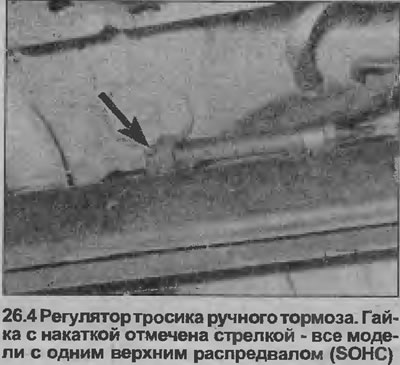
4. Turn the knurled nut on the cable adjuster (mounted on a torsion beam), so that the brake shoes…


Source is on this resource opelbook

5. Loosen the adjuster nut so that the shoes move slightly away from the drum.

6. The handbrake should engage when the lever moves to the second notch of the ratchet.

7. After completing the adjustment, make sure that the handbrake cables move freely. Apply a small amount of grease to the adjuster threads to prevent corrosion.

8. Lower the car to the ground.

Models with rear disc brakes


9. Where applicable, remove the hubcaps, then loosen the rear wheel bolts and block the front wheels. Jack up and support the rear of the vehicle on axle stands. Remove the wheels.


10. Move the handbrake lever to the second notch on the ratchet.

11. For models with two overhead camshafts (DOHC) equipped with a catalytic converter, unscrew the four mounting nuts and remove the thermal insulation shield of the central section of the exhaust pipe.

12. On all models with a single overhead camshaft (SOHC), loosen the knurled nut on the cable adjuster (mounted on a torsion beam).

13. On models with two overhead camshafts (DOHC), loosen the nut securing the cable equalizer to the handbrake lever drive rod.

14. Insert a screwdriver through the adjustment hole of one of the disc/hub units (see illustration) and turn the adjuster wheel so that the brake pads begin to rub against the disc (you will hear a rustling sound) when rotating the disc/hub forward manually.
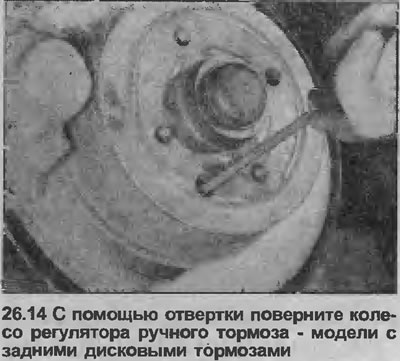
14. Insert a screwdriver through the adjustment hole of one of the disc/hub units (see…


15. Turn the adjuster wheel in the opposite direction so that the pads move slightly away from the disc/hub.

16. Repeat steps 14 and 15 on the second wheel.

17. Turn the nut on the adjuster or cable equalizer (depending on the model) to the position where the handbrake starts to work. Make sure that the brake works simultaneously on both wheels.


18. Release the handbrake completely, then tighten it again.

19. The discs/hubs should lock when the handbrake lever reaches the sixth notch on the ratchet. If necessary, turn the nut on the cable adjuster or equalizer (depending on the model), to achieve this.

20. Where applicable, install an exhaust system heat shield.

21. Install the wheels and lower the vehicle to the ground. Do not fully tighten the wheel bolts until the vehicle is lowered onto the wheels.


This article is available at russian, bulgarian, belarusian, ukrainian, serbian, croatian, romanian, polish, slovak, hungarian
Checking the article: Chernov Alexander

Share information:

Previous articles
Opel Vectra A: Brake system
Next articles

Brake pipes and hoses — general description, removal and installation
Pressure Regulating Valves — Removal and Installation
ABS Relay (ABS-2E System Only) — Removal and Installation
ABS control unit — removal and installation
ABS Sensor Mounted on Wheel — Removal and Installation
ABS hydraulic modulator — removal and installation
Handbrake cable — removal and installation
Handbrake lever — removal and installation
Detecting brake system faults


See similar ones from other Opel car manuals:
▶ Handbrake — adjustment Opel Astra F (1991-1998, petrol)
▶ Handbrake — adjustment Opel Ascona C (1981-1988)
▶ Checking the clutch pedal adjustment Opel Corsa B (1993-2000)
▶ Automatic dynamic headlight range adjustment Opel Insignia A (2008-2017)
▶ Adjustment and check of carburetor Solex 35 PDSI Opel Kadett E (1984-1995)
Link to this page in different formats

Visitor comments


No comments yet


How much will 50 + 37 =


Vectra C (2002-2008) 
  • General information
  • User manual
  • Vehicle device
  • Maintenance
  • Troubleshooting
  • Power unit
  • Engine repair
  • Cooling system
  • Power and control system
  • Engine electrics
  • Transmission
  • Clutch
  • Car gearbox
  • Drive shafts
  • Chassis
  • Car suspension
  • Steering
  • Brake system
  • Body
  • Exterior
  • Interior
  • Doors, locks and windows
  • Heating and ventilation
  • Electrical equipment
  • Equipment and devices
  • Headlights and lighting
  • Electrical circuits
Vectra B (1995-2002) 
  • General information
  • User manual
  • Weekly checks
  • Maintenance (gasoline)
  • Maintenance (diesel)
  • Troubleshooting
  • Power unit
  • SOHC gasoline engine
  • DOHC petrol engine
  • Diesel engine 1.7 liter
  • Diesel engine 2.0 liters
  • Engine repair
  • Cooling system
  • Fuel system (gasoline)
  • Fuel system (diesel)
  • Charging system
  • Launch system
  • Ignition and preheat
  • Transmission
  • Clutch
  • Mechanical gearbox
  • Automatic gearbox
  • Drive shafts
  • Chassis
  • Brake system
  • Wheel suspension
  • Steering
  • Body
  • Exterior
  • Interior
  • Doors and windows
  • Heating and ventilation
  • Electrical equipment
  • Equipment and devices
  • Electrical circuits
Vectra B (1995-2002, petrol) 
  • General information
  • Maintenance
  • Help with malfunctions
  • Power unit
  • Engine repair
  • Exhaust system
  • Cooling system
  • Fuel system
  • Multec injection system
  • Four point injection
  • Transmission
  • Clutch
  • Gearbox and drive
  • Chassis
  • Wheel suspension
  • Steering
  • Brake system
  • Wheels and tires
  • Body
  • Exterior
  • Interior
  • Electrical equipment
  • Fuses and electronics
  • Power devices
  • Ignition system
  • Lighting and signaling
  • Equipment and devices
  • Heating and ventilation
  • Electrical circuits
Vectra A (1988-1995) 
  • Power unit
  • Engine repair
  • Ignition system
  • Lubrication system
  • Cooling system
  • Injection system
  • Fuel system (carburetor)
  • Fuel system (diesel)
  • Exhaust system
  • Transmission
  • Clutch
  • Car gearbox
  • Chassis
  • Front suspension
  • Rear suspension
  • Steering
  • Brake system
  • Wheels and tires
  • Body
  • Exterior
  • Interior
  • Electrical equipment
  • Electrical circuits
Vectra A (1988-1995, petrol) 
  • General information
  • User manual
  • Maintenance
  • Power unit
  • SOHC engine
  • DOHC engine
  • Cooling and ventilation
  • Fuel system (carburetor)
  • Fuel system (injector)
  • Exhaust converter
  • Transmission
  • Clutch
  • Mechanical gearbox
  • Automatic gearbox
  • Drive shafts
  • Chassis
  • Brake system
  • Car suspension
  • Steering
  • Body
  • Body elements
  • Electrical equipment
  • Power devices
  • Equipment and devices
  • Electrical circuits
OpelBook.ru © 2017–2026 · Mobile version · · Sitemap: EN BG BY UA RS HR RO PL SK HU · Feedback · Site search
Astra F, petrol · Astra G, petrol · Astra G · Astra H · Astra J, petrol · Corsa B · Corsa C, petrol · Corsa C · Insignia A · Kadett D · Kadett E · Omega A · Omega B · Omega B2 · Vectra A, petrol · Vectra A · Vectra B, petrol · Vectra B · Vectra C · Zafira A, petrol · Frontera A, petrol · Frontera B · Ascona C · Vivaro A ·
We want your visit to be comfortable 🤝! We use cookies 🍪 to make that happen.