


Contents: Astra Models ⬇ Zafira Models ⬇
1. Adjustment is carried out in accordance with the Schedule of current maintenance (see Chapter 1), as well as every time after replacing or removing/installing the rear brake mechanisms, pads or discs. At service stations, a special key HAZET 4965-1 is used for adjustment.
Astra Models
2. Remove the diagnostic connector cover under the parking brake lever.
3. Using a plastic wedge or other available tool, pry the parking brake lever boot out of the console and lift it up to gain access to the adjusting nut at the front of the lever (see accompanying illustration).
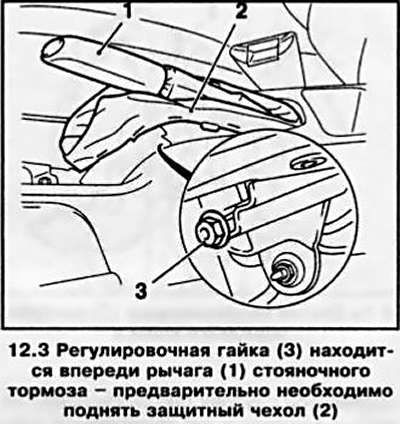
4. With a special key (HAZET 4965-1) loosen the adjusting nut, fully release the parking brake lever and slightly turn the nut to obtain slack in the cable.
5. Press the foot brake pedal at least five times until significant resistance to the pedal movement appears.
Note: The brake pedal must return completely to its original position after each press.
6. Fully cock the lever 5-6 times, then release it again.
7. Support the front wheels with wheel chocks, jack up the rear of the car and place it on supports.
8. Raise the lever 2 clicks, then tighten the adjusting nut until the rear wheels begin to seize - they should still be able to be turned manually. Both rear wheels should turn with the same resistance, otherwise check the freedom of movement of the drive cables in their casings.
9. Raise the lever to the third click - the rear wheels should be completely locked. Release the lever - both wheels should start to rotate freely. Repeat the adjustment if necessary.
10. Lower the vehicle onto its wheels, secure the parking brake lever boot to the center console and replace the diagnostic connector cover.
11. To allow the brake linings to settle in, drive the vehicle for approximately 300 m at low speed with the parking brake lightly applied.
Zafira Models
12. Release the parking brake lever and remove the cover over the diagnostic connector on the center console (see accompanying illustration).
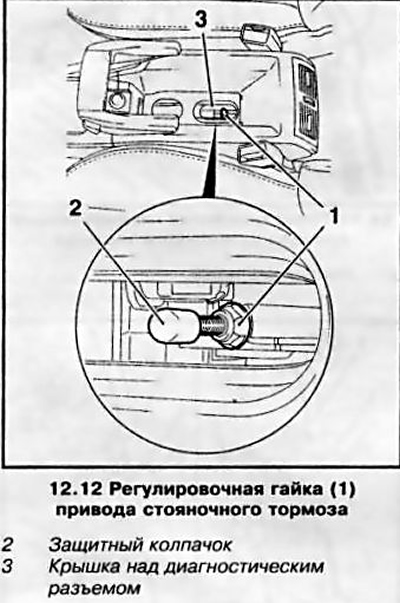
13. Remove the protective cap (see illustration 12.12) rear threaded rod and unscrew the adjusting nut to the end of the thread travel.
14. Press the foot brake pedal at least five times until significant resistance appears in the pedal movement.
Note: The brake pedal must return completely to its original position after each press.
15. Support the front wheels with wheel chocks, jack up the rear of the car and place it on supports.
16. Tighten the adjusting nut so that when the parking brake is released, the distance "a" (see accompanying illustration) between the parking brake actuator lever and the corresponding caliper stop was 0.1 mm. The same measurement on the caliper of the other wheel should not exceed 0.1 mm.
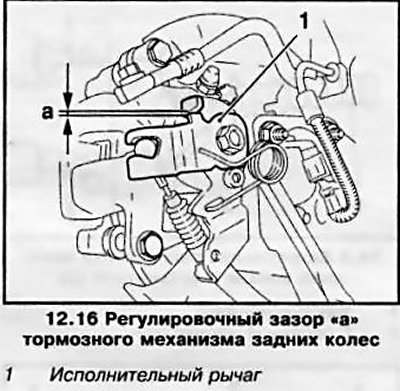
17. Apply the parking brake lever until you hear the first click - the parking brake is adjusted correctly if the rear wheels are heavy or almost locked. The braking force on both rear wheels should be equal. When you release the lever, the rear wheels should rotate freely. Repeat the adjustment if necessary.
18. To allow the brake linings to settle in, drive the vehicle for approximately 300 m at low speed with the parking brake slightly applied.
Visitor comments