


Vehicles with drum brakes on the rear wheels
Lower the parking brake lever to its lowest position.
Raise the car.
Check the free movement of the parking brake cable.
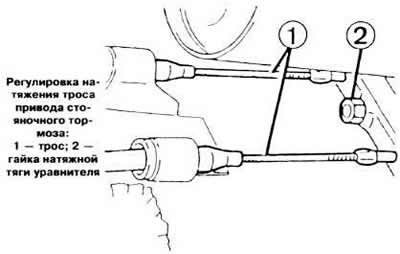
Turn the self-locking nut of the tensioner on the equalizer until the rear wheels turn with difficulty.
In this position, turn the self-locking nut in the opposite direction until the rear wheels rotate freely.
You can also check the parking brake adjustment using the parking brake shoe actuator lever cam. To do this:
- remove the plastic plug from the brake shield;
- measure the distance between the cam of the parking brake lever and the brake shoe, which should be approximately 3 mm;
- install the plastic plug back into the brake shield.
[The source is on the online website: OPELBOOK.ru]
You can also check the operation of the parking brake during a test drive. The parking brake should operate after moving the lever two teeth of the sector.
Cars with rear disc brakes
Raise the parking brake lever by two sector teeth.
Raise the rear of the vehicle, place it on stands and remove the rear wheels.
Loosen the equalizer tension rod nut.
Insert a screwdriver into the hole in the brake disc and turn the adjusting bolt for adjusting the clearance between the disc and the parking brake pads until the disc locks, then slightly unscrew the bolt to release the disc. Perform the same operations on the other brake mechanism.
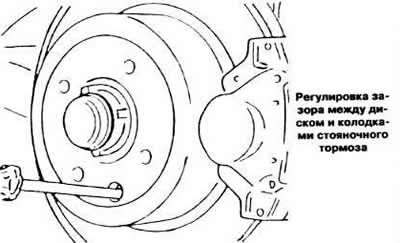
Tighten the equalizer tension rod nut so that the drive cable simultaneously acts on the shoes of both parking brake mechanisms. In this case, the parking brake drive lever should move six teeth of the sector.
Install the rear wheels and lower the vehicle.
Visitor comments