


Warning! The rear brake pressure regulator is not repairable and must be replaced as an assembly.
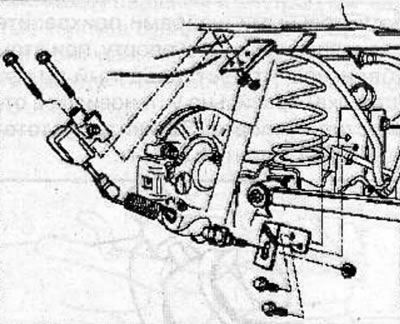
Checking and adjusting
When checking the rear brake pressure regulator, the vehicle must be in a loaded condition, the driver must be seated in the vehicle and the rear of the vehicle must be loaded so that the load on the rear axle is 800 kg.
Install pressure gauges instead of the bleed nipples of the front and rear brake mechanisms.
Bleed the hydraulic drive of the brake system.
Slowly apply the brake pedal until the brake fluid pressure reaches 98.05 bar (1422 psi).
Warning! The brake pedal must be pressed smoothly and evenly until the required pressure is reached, and not pumped.
If the brake fluid pressure in the front brakes has exceeded the required value, release the brake pedal completely and press it again from the original position.
Check the brake fluid pressure in the rear brake mechanisms, which should be equal to 38.44+7.85 bar (557±114 psi)
If the pressure in the rear wheel cylinder is not as required, adjust the spring tension by changing the position of the anchor bolt by measuring the position of the nuts. After adjustment, tighten the anchor bolt mounting nuts to 25 Nm.
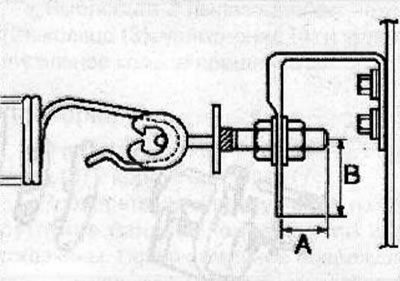
Changing dimension A by one turn of the nut results in a pressure change of 1.96 bar (28.5 psi).
A 1mm change in dimension B results in a 0.49 bar (7.0 psi) change in pressure.
If the pressure is low, increase the size A or B.
If the pressure is high, reduce the size A or B.
Remove the pressure gauges.
Bleed the hydraulic drive of the brake system.
Visitor comments