
OpelBook.ru
Cars AvtoVAZ Cars Mitsubishi Cars BMW Cars Mercedes Cars Nissan Cars Toyota Cars Chevrolet
English Русский
Български
Беларускі
Український
Српски
Hrvatski
Română
Polski
Slovenský
Magyar
 |  Sitemap  |  Contacts  |    


Main Astra Corsa Insignia Kadett Omega Vectra Zafira Others Articles
Omega A (1986-1993) Omega B (1993-1999) Omega B2 (1999-2003)
  • Main
  • Omega
  • Omega B2
  • Chassis
  • Brake system
  • Rear wheel brake caliper — removal, overhaul and installation

Rear wheel brake caliper — removal, overhaul and installation (Opel Omega B2)

            0

Contents: Removal ⬇ Bulkhead ⬇ Installation ⬇

Removal


Attention! If the caliper is to be removed only to dismantle the brake disc, do not disconnect the brake hose of the wheel brake cylinder from the caliper, because the brake system will have to be bled after installation. Secure the caliper to the body using a wire hook or wire. The brake hose should not be twisted or stretched.


1. Mark the position of the rear wheels on the hub with paint. This will allow you to install the balanced wheel in its original position during assembly.

2. Loosen the wheel mounting bolts. The car must stand on its wheels when performing this operation.

3. Place the vehicle on jack stands and remove the rear wheels.

4. Clamp the brake hose near the caliper with a special clamp if the hose is going to be disconnected (see illustration). It is also recommended to unscrew the brake fluid reservoir cap, cover the opening with plastic film and screw the cap back on. This technique helps to minimize the loss of brake fluid when disconnecting the hose from the caliper.
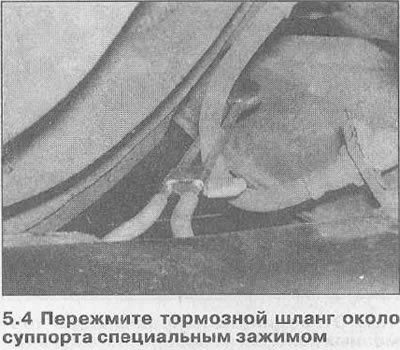
4. Clamp the brake hose near the caliper with a special clamp if the hose is going to be…


5. Remove the brake pads (see the relevant chapter).


6. Unscrew the lock nut securing the brake line to the caliper and disconnect the line (see illustrations 5.6 and 5.6a).
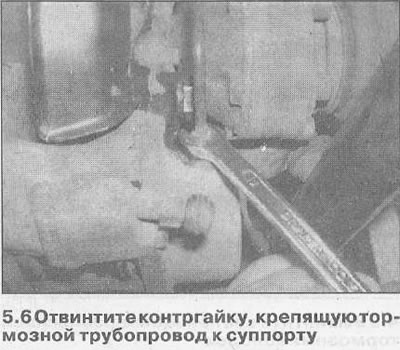
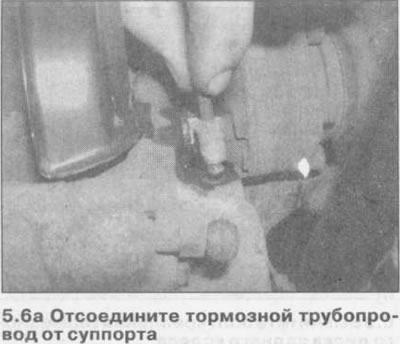
6. Unscrew the lock nut securing the brake line to the caliper and disconnect the line (see…


6. Unscrew the lock nut securing the brake line to the caliper and disconnect the line (see…


7. Unscrew the caliper mounting bolts and remove the caliper from the brake pad guide (see illustrations 5.7 and 5.7a).
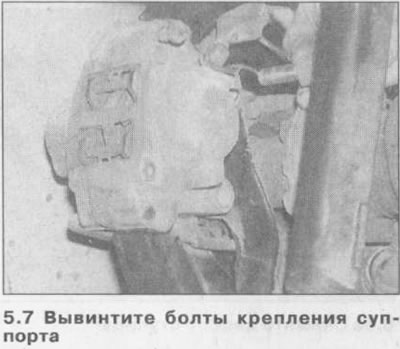
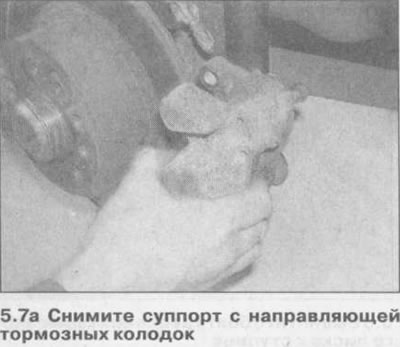
7. Unscrew the caliper mounting bolts and remove the caliper from the brake pad guide (see…


7. Unscrew the caliper mounting bolts and remove the caliper from the brake pad guide (see…


Bulkhead


8. Clean the outer surface of the caliper.

9. Press the dust seals on the caliper and remove them from the piston grooves (see illustration).

[Text copied from an online resource opelbook.ru]
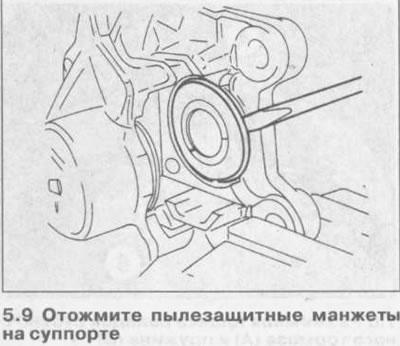
9. Press the dust seals on the caliper and remove them from the piston grooves (see illustration).


10. Place a wooden block between the pistons and blow through the inlet hole to remove the pistons from the cylinders. If one piston comes out before the other, remove it and plug the empty cylinder to allow the other piston to come out.

11. Remove the piston seals, being careful not to damage the cylinder walls.

12. Clean the pistons and cylinders with brake fluid and let them dry. Inspect the pistons and cylinders for damage, signs of wear and corrosion. If such damage is found, replace the caliper assembly. If the caliper is suitable for further use, purchase a repair kit of parts, which includes piston seals and dust seals, as well as a tube of paste for brake cylinders.

13. Apply a small amount of paste to the pistons, their seals and cylinder walls.

14. Install the piston seals into the cylinder grooves, then carefully insert the pistons so that they engage the seals. You may need to rotate the pistons to avoid them getting stuck in the seals.


Do not push the pistons all the way into the cylinders as this will make it difficult to install the dust seals.

15. Install the dust seals first into the piston grooves and then onto the caliper.

16. Install the retaining rings on the cuffs.

17. Press the pistons into the cylinders, then rotate them so that the slots point downwards at an angle of approximately 23°. This will ensure that the pistons are seated correctly on the pads.

Installation


18. Fasten the brake shoe guide to the steering knuckle if it was removed. In this case, replace the guide mounting bolts with new ones and lubricate them with a protective paste, such as Loctite 243. The tightening torque of the bolts is 130 Nm.

19. Install the brake pads.

20. Install the caliper on the brake pad guide, insert the mounting bolts and tighten them to 30 Nm.

21. Connect the brake line to the caliper by tightening the lock nut.

22. Remove the special clamp from the hose, remove the polyethylene from under the expansion tank cap and bleed the brake system drive (see the relevant chapter).

23. Install the wheels in accordance with the marks made during removal and secure with bolts.

24. Lower the vehicle and tighten the wheel bolts in a criss-cross pattern to 110 Nm.

Caution! Press the brake pedal forcefully several times until you feel strong resistance. This action centers the brake pads and they automatically adjust to the working position.


25. Check the brake fluid level in the expansion tank. If necessary, top up to the maximum mark.

26. Check the operation of the braking system.


This article is available at russian, bulgarian, belarusian, ukrainian, serbian, croatian, romanian, polish, slovak, hungarian
Checking the article: Shapovalov Yaroslav

Share information:

Previous articles
Opel Omega B2: Brake system
Next articles

Front Brake Caliper — Removal, Overhaul and Installation
Rear Brake Pads — Checking and Replacing
Front Brake Pads — Checking, Removing and Installing
General description of the braking system
Brake system specifications
Brake disc — inspection, removal and installation
Parking brake shoes — inspection, removal and installation
Parking brake lever and cables — removal and installation
Master Brake Cylinder — Removal and Installation
Expansion tank and brake fluid level sensor — removal and installation
Brake system — bleeding


See similar ones from other Opel car manuals:
▶ Rear Wheel Brake Caliper (Rear Disc Brakes) — Removal,… Opel Astra F (1991-1998, petrol)
▶ Rear Disc Brake Caliper — Removal, Overhaul and Installation Opel Vectra A (1988-1995, petrol)
▶ Pressure regulator valve in the hydraulic circuits of the… Opel Corsa B (1993-2000)
▶ Replacing the rear brake caliper bracket Opel Insignia A (2008-2017)
▶ Removal and installation of the wheel cylinder of the rear… Opel Kadett E (1984-1995)
Link to this page in different formats

Visitor comments


No comments yet


How much will 29 + 30 =


Omega B2 (1999-2003) 
  • General information
  • User manual
  • Maintenance
  • Troubleshooting
  • Power unit
  • Petrol 4-cylinder
  • Petrol 6-cylinder
  • Engine overhaul
  • Diesel engines 2.0 l
  • Diesel engines 2.5 l
  • Cooling and heating
  • Injection system (gasoline)
  • Fuel system (diesel)
  • Fuel system
  • Exhaust system
  • Ignition system
  • Transmission
  • Clutch
  • Mechanical gearbox
  • Automatic gearbox
  • Main gear and shafts
  • Chassis
  • Brake system
  • Car suspension
  • Steering
  • Body
  • Body elements
  • Electrical equipment
  • Equipment and devices
  • Electrical circuits
Omega B (1993-1999) 
  • General information
  • User manual
  • Tips for the car owner
  • Maintenance (gasoline)
  • Maintenance (diesel)
  • Power unit
  • Petrol engine SOHC 2.0 l
  • Petrol engine DOHC 2.0 l
  • Petrol engines 2.5 and 3.0 l
  • Repair of gasoline engines
  • Diesel engine 2.0 l
  • Diesel engine repair 2.0 l
  • Diesel engine 2.5 l
  • Cooling and heating
  • Power system (petrol)
  • Emission reduction
  • Fuel system (diesel 2.0 l)
  • Fuel system (diesel 2.5 l)
  • Launch system
  • Ignition system
  • Transmission
  • Clutch
  • Mechanical gearbox
  • Automatic gearbox
  • Drive shafts
  • Chassis
  • Brake system
  • Wheel suspension
  • Steering
  • Body
  • Exterior
  • Interior
  • Doors and windows
  • Electrical equipment
  • Equipment and devices
  • Wiring diagrams (early)
  • Wiring diagrams (late)
Omega A (1986-1993) 
  • General information
  • User manual
  • Maintenance
  • Changes and additions
  • Troubleshooting
  • Power unit
  • Gasoline engines
  • Diesel engines
  • Cooling system
  • Fuel system (gasoline)
  • Fuel system (diesel)
  • Ignition system
  • Transmission
  • Clutch
  • Mechanical gearbox
  • Automatic gearbox
  • Cardan shaft
  • Drive shafts
  • Chassis
  • Brake system
  • Car suspension
  • Steering
  • Body
  • Exterior
  • Interior
  • Electrical equipment
  • Power devices
  • Lighting and appliances
  • Electrical circuits
OpelBook.ru © 2017–2026 · Mobile version · · Sitemap: EN BG BY UA RS HR RO PL SK HU · Feedback · Site search
Astra F, petrol · Astra G, petrol · Astra G · Astra H · Astra J, petrol · Corsa B · Corsa C, petrol · Corsa C · Insignia A · Kadett D · Kadett E · Omega A · Omega B · Omega B2 · Vectra A, petrol · Vectra A · Vectra B, petrol · Vectra B · Vectra C · Zafira A, petrol · Frontera A, petrol · Frontera B · Ascona C · Vivaro A ·
We want your visit to be comfortable 🤝! We use cookies 🍪 to make that happen.