


Contents: Examination ⬇ Removal ⬇
Examination
1. Jack up the car and place it on jack stands.
2. Unscrew the wheel bolts and remove the wheel.
3. Make sure the brake disc mounting bolt is tight and rotate the brake disc to inspect for grooves and damage. Shallow grooves are acceptable, but if serious grooves are found, remove the disc and replace it or resurface it if the thickness of the disc allows.
4. Make sure that the disc runout approximately 10.0 mm from its edge does not exceed the maximum permissible value (see illustration).
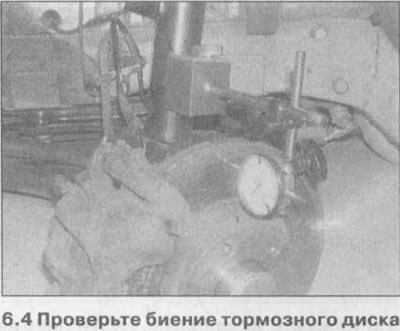
If the disc runout exceeds the permissible values, remove the disc and make sure that the contact surfaces of the disc and hub are not contaminated.
Source is on this resource (www.opelbook.ru)
5. Install the disc and check it again for runout.
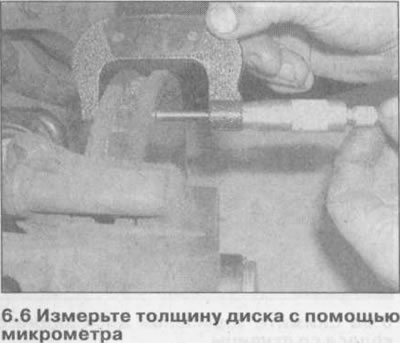
6. Check the thickness of the disc using a micrometer at several points in the areas where the brake pads are in contact, (see illustration). If one of the discs is worn to the minimum permissible thickness, replace both discs.
Removal
7. Unscrew the mounting bolts and remove the brake shoe guide from the steering knuckle. In this case, there is no need to remove the brake shoes. There is no need to disconnect the brake hose from the caliper. Secure the disconnected brake shoe guide together with the caliper to the body with wire.
8. Unscrew the bolt securing the brake disc to the hub, then remove the disc from the hub, tilting it as necessary (see illustrations 6.8 and 6.8a).
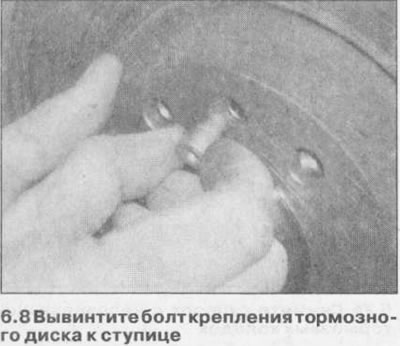
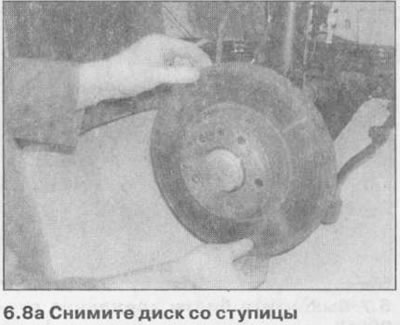
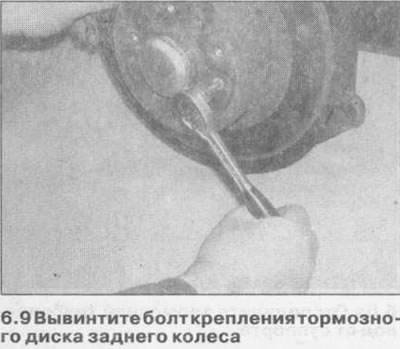
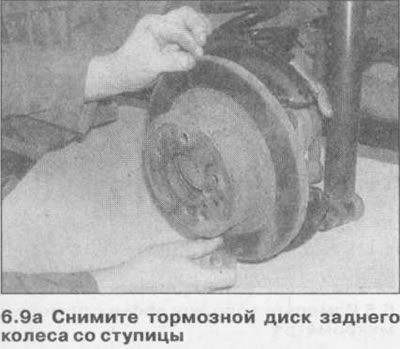
9. Move the release mechanism bar through the inspection hole in the brake drum of the disc so that the parking brake shoes move away from the walls of the drum, and remove the rear wheel brake disc by unscrewing the mounting bolt (see illustrations 6.9 and 6.9a).
The brake disc is installed in the reverse order of removal.
Visitor comments