


Contents: Removal ⬇ Installation ⬇
The brake system pipes are the connecting line between the master brake cylinder and the working brake mechanisms of the wheels.
Attention! The installation of metal pipes of the brake system should be entrusted to a specialized workshop, because this operation requires a certain amount of experience.
Brake hoses, designed for a certain pressure, serve as flexible connections between rigidly fixed and moving parts of the car.
If damage to the hoses appears that is visible to the naked eye, the hoses must be replaced.
The rubber of the hoses can swell over time, which leads to clogging of the hose and the brake fluid does not return to the expansion tank from the wheel cylinder. The brake mechanism of the corresponding wheel overheats. If in this case the nipple is opened, the wheel does not lock.
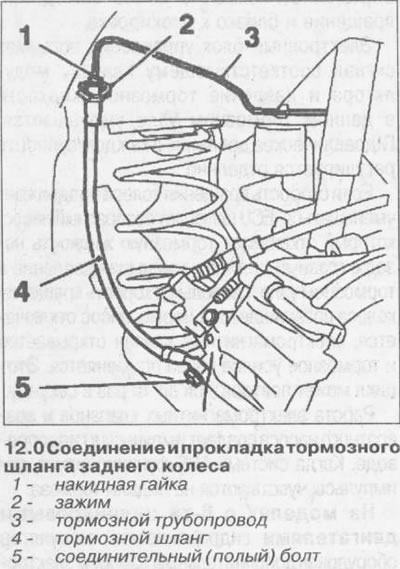
Attention! Protect brake hoses from contact with oil and kerosene, do not varnish them or coat them with anti-corrosion protection for the underbody.
Attention! If air has entered the ABS hydraulic modulator, it is recommended that air removal be entrusted to a specialized workshop. This can happen in the event of a depressurization of the ABS hydraulics or in the event that brake fluid has completely leaked out of at least one chamber of the expansion tank and, as a result, air has been pumped into the system.
Removal
1. Mark the direction of rotation of the wheels.
2. Loosen the wheel nuts. The car must be standing on its wheels when performing this operation.
3. Place the vehicle on jack stands and remove the wheels.
4. Unscrew union nuts 2 and disconnect pipeline 1 and hose 4. In this case, clamp 3 remains on the holder (see illustration).
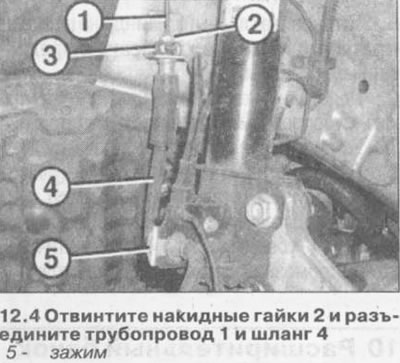
5. Plug the holes in the pipeline and hose with suitable plugs.
6. Unscrew bolt 6 and disconnect brake hose 4 from the caliper, avoiding twisting of the hose (see illustration). Collect the brake fluid that leaks out.
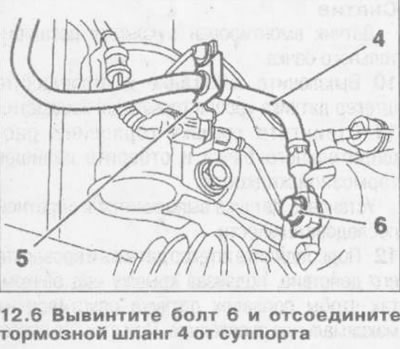
7. Remove clamp 5 and release the brake hose from the holder on the shock absorber strut (see illustration 12.6).
Installation
8. Install hoses approved by the vehicle manufacturer. Route the new brake hose in the same way as the old one, avoiding twisting.
9. Screw the brake hose bolt into the caliper threaded connection, replacing the old seals with new ones, and tighten the bolt with a force of 40 Nm.
10. Secure the brake hose in the holder and connect it to the pipeline by tightening the union nut with a force of 16 Nm.
11. Secure the brake hose to the holder on the shock absorber strut.
12. Turn the steering wheel of the jacked up vehicle left and right from lock to lock and make sure that the hose follows all the movements of the wheel and will not rub against nearby parts.
[Text was copied from the portal: www.opelbook.ru]
Caution! Bleed the brake system using a bleeder.
13. Install the wheels in accordance with the marks made during removal and tighten the wheel bolts in a cross pattern to a torque of 110 Nm.
14. Turn the steering wheel of the vehicle on its wheels from lock to lock, and make sure that the hose follows all movements of the wheel and does not come into contact with nearby parts.
Attention! Make sure that:
- a) the brake hoses are securely connected,
- b) the brake hose is secured in the holder,
- c) the brake drive bleed nipples are screwed in,
- d) there is a sufficient volume of brake fluid in the expansion tank.
15. Perform a leak test of the brake system with the engine running.
To do this, press the brake pedal with a force of 200-300 N (20-30 kg) for about 10 seconds. The pressure in the system and, accordingly, on the brake pedal, should not drop. Check all connections for leaks.
Visitor comments