


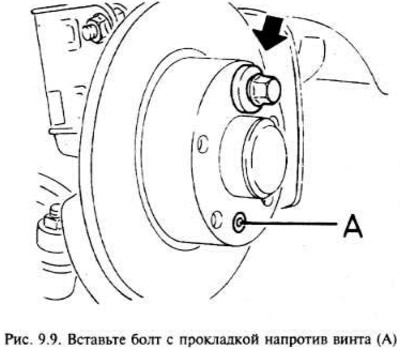
Make sure the brake disc mounting screw is tightened, then install a 10mm thick shim on one of the road wheel bolts, and install and secure the bolt in the hole opposite the mounting screw (Fig. 9.9).
Rotate the brake disc and check for deep scratches and pits. Shallow pits are normal; if the disc is heavily worn, it should be replaced (either install a new one, or subject the old one to mechanical processing within acceptable limits).
Using special devices or feeler gauges, check the disc runout; it should not exceed the values specified in the specification.
If the disc runout exceeds the established norms, remove the disc as described later in this section and ensure that the contact surfaces of the disc with the hub are absolutely clean.
After removing the disc, check the hub runout. If it exceeds the permissible limit, it is probably due to severe wear of the hub bearings or damage (see chapter 10).
Install the disc, check it again for runout. If the hub bearings are in good condition, then the defect is in the disc, which must be replaced.
Removal the front disc
If necessary, remove the wheel bolt with the shim used when checking the disc. Remove the brake pads as described earlier. Loosen the two mounting screws and remove the caliper bracket.
Remove the mounting screw and remove the disc from the hub.
Removal the rear disc
If necessary, remove the wheel bolt and shim used to check the disc.
Remove the brake pads as shown below.
Remove the brake caliper (see section below), but do not disconnect the pipeline. Move the bracket to the side and hang it on a wire or rope so that there is no load on the pipeline.
Remove the screw and pull the disc off the hub. If it is tight, apply pressure to the handbrake pads by inserting a screwdriver through the adjustment hole in the disc and turning the adjustment wheel.
Installation
Installation is carried out in the reverse order of removal, but it is necessary to ensure that the mating surfaces of the disc and hub are absolutely clean. Install the brake pads as described in the previous and following sections (depending on the design).
(Text copied from an internet website: OPELBOOK)
Visitor comments