


Removal
Place chocks under the front wheels, then lift the front of the car and secure it with jack stands under the axle. Remove the running wheel.
Remove the brake drum as described in the previous section.
Using pliers, remove the upper return spring hook from the brake shoes, marking their location, then spread the upper ends of the shoes apart to free them from the brake cylinder.
When working under the hood, remove the brake fluid reservoir cap and secure a piece of polyethylene to the filler neck with a rubber band or by reinstalling the cap. This will reduce fluid loss during subsequent operations.
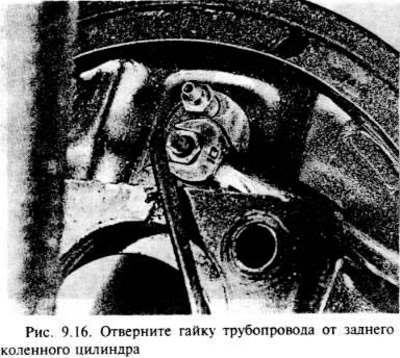
Unscrew the brake fluid line nut from the wheel brake cylinder and disconnect the line itself. Try not to stretch the tube. Fluid may leak, so plug both ends to prevent contamination and further fluid leakage (Fig. 9.16).
Remove the two mounting bolts from the rear of the brake pad support disc and remove the wheel brake cylinder.
Repair
Use a brush to remove dirt and dust from the wheel cylinder, being careful not to inhale the dust.
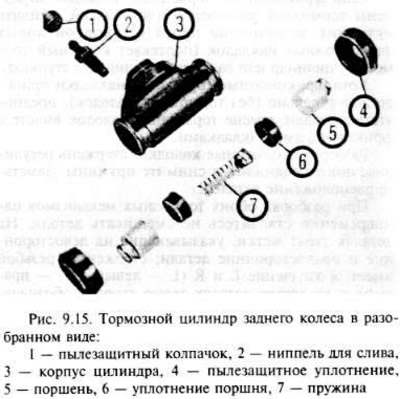
Remove the rubber dust seals from the cylinder body.
The pistons are usually pushed out by spring pressure; if necessary, tap lightly on the end of the cylinder body with a piece of wood or use low pressure air, such as from a foot pump, to the hole in the back of the cylinder body.
Inspect the piston surfaces and cylinder body bores for scratches or obvious metal-to-metal contact. If this is evident, replace the entire brake cylinder assembly.
If the pistons and cylinder bores are in good condition, the seals should be removed and the necessary new parts installed.
Lubricate the piston seals with clean brake fluid and insert them by hand into the cylinder bore with the spring between them.
Dip the pistons in clean brake fluid and insert them into the cylinder bore.
Install dust seals and ensure pistons move freely.
Installation
Place the wheel brake cylinder on the support disc and tighten the bolts.
Connect the brake fluid line to the cylinder and tighten the nut.
Position the brake pads against the pistons, then install the upper tension spring.
Install the brake drum and tighten the screw. If necessary, unscrew the fine adjustment knob until it sits on the shoes.
Remove the plastic wrap from the brake fluid reservoir neck and bleed the appropriate brake circuit as described in Section 2 of this chapter.
Adjust the brakes by operating the foot brake. A clicking sound indicates that the automatic adjuster in the drum is operating. When the clicking stops, the adjustment is complete.
Install the running wheel and lower the vehicle to the ground.
Visitor comments