


Removal
Disconnect the negative battery terminal.
Press the foot brake pedal several times to remove vacuum from the booster.
Disconnect the plug from the brake fluid level sensor located in the reservoir cap. Use a rubber bulb or clean battery hydrometer to remove the brake fluid.
Place a container under the master cylinder to collect any leaking fluid.
Note the location of the brake fluid lines, then remove the nuts and disconnect the lines from the master cylinder.
Unscrew the two nuts and remove the master cylinder from the studs located on the booster.
Remove any dirt from the outside of the cylinder, then use a screwdriver to carefully remove the fluid reservoir and seals at the top of the cylinder.
Repair
If desired, the master cylinder can be repaired on models with a conventional (non-ABS) braking system as described below. Repair of the master cylinder on models with an ABS system cannot be done.
Master brake cylinder type GMF
Clamp the master cylinder in a vice with soft pads.
Carefully remove the sealing ring from the end of the cylinder bore.
Press lightly on the piston with a piece of wood or plastic, then hold the piston in the depressed position by inserting a smooth pin or 3.0 mm diameter rod through the opening of the reservoir into the cylinder.
Remove the spring ring lock from the end of the cylinder bore using a screwdriver. Be careful not to damage the piston or bore.
Remove the pin or rod holding the piston.
Remove the main piston assembly from the cylinder and, if necessary, tap the cylinder lightly through a wooden shim to release it from the cylinder (fig. 9.26.).
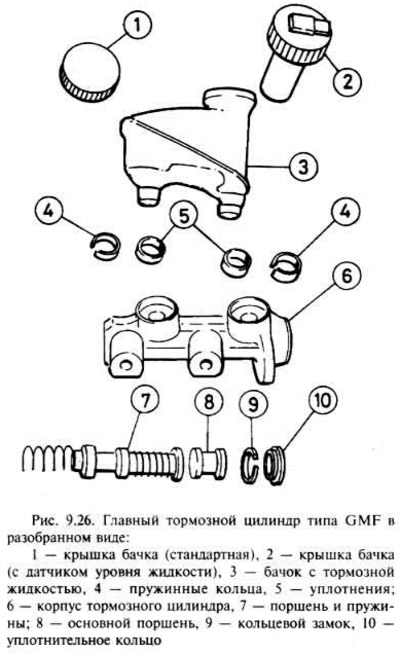
Apply low pressure air, such as from a foot pump, to the front opening of the reservoir in the cylinder to push the piston out.
Remove dirt from all parts by washing with clean brake fluid or denatured alcohol and inspect them for wear or damage. In particular, check the surfaces of the pistons and cylinder bores for scratches and corrosion. If there are obvious signs of wear, replace the entire master cylinder.
If the cylinder bore is in good condition, you can proceed with the repair as described below.
Lubricate the cylinder bore with clean brake fluid or brake grease, then clamp the cylinder in a vice with soft pads in a horizontal position.
Remove the plug from the end of the assembly pipe and insert the short section of pipe into the cylinder hole up to the shoulder on the pipe.
Use a suitable piece of wood or plastic to push the parts out of the pipe and into the cylinder bore, then hold the main piston in the recessed position by inserting a finger or rod.
Place a new snap ring on the end of the cylinder bore, making sure it is seated correctly and that the piston moves freely.
Push in the main piston and remove the pin or rod from the reservoir opening.
Place a new sealing ring on the end of the cylinder bore.
Master brake cylinder type ATE
Clamp the master cylinder in a vice with soft pads.
Carefully remove the sealing ring from the end of the cylinder bore.
Press the main piston in with a suitable piece of wood or plastic, then remove the snap ring from the end of the cylinder bore.
Remove the main piston assembly, noting the location of the gaskets.
Press in the other piston with a wooden or plastic stick and remove the lock screw from the end of the cylinder body.
[Material copied from this website: www.opelbook.ru]
Remove the other piston assembly from the cylinder, if necessary tapping the cylinder through a wooden shim to free the piston from the bore.
Remove dirt from the components using clean brake fluid or denatured alcohol only and inspect them for wear and damage. If there is evidence of wear, replace the entire master cylinder assembly.
If the cylinder bore is in good condition, you can proceed with the repair as described below.
Lubricate the cylinder bore with clean brake fluid or brake grease, then clamp the cylinder in a vice with soft pads in a horizontal position.
Place a new O-ring on the lock screw, then screw it into the cylinder body a few turns, but do not allow it to enter the hole.
Remove the plugs from the ends of the assembly tube, then remove all the parts from the short section of the tube and push the short section into the long section so that they are flush.
Insert the assembly pipe into the cylinder bore up to the seal on the short sleeve, then use a wooden or plastic stick to push the piston into the cylinder bore so that it contacts the thorium of the cylinder.
Lightly tighten the lock screw, then remove the wooden tool and assembly tube and fully tighten the lock screw (fig. 9.27.).
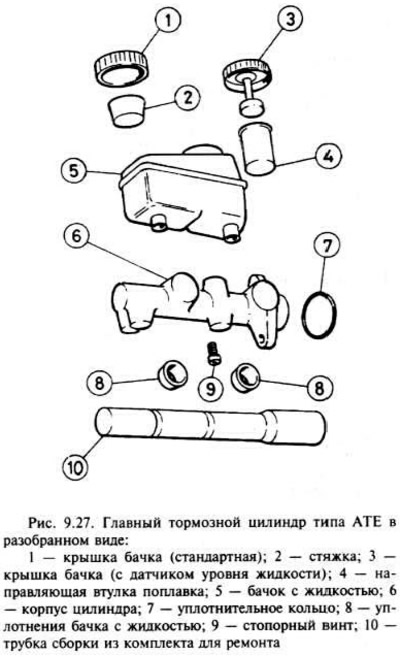
Place the master cylinder in a vise with the cylinder bore facing up.
Lightly lubricate the main piston skirt and seal grooves with special grease. Install the stop washer on the piston.
Adjust the assembly tube so that the end of the long section is flush with the inner shoulder of the short section.
Place the front seal on the main piston with the open end facing the front of the master cylinder.
Install the assembly tube on the cylinder to press the seal, insert the piston and tube partially into the cylinder bore, then pull out the tube.
Place the spacer ring on the main piston, then install the other seal using the assembly tube as shown earlier.
Place the stop washer on the main piston, then push the piston in slightly with a stick and install a new cylinder bore snap ring. Make sure it is seated correctly and that the piston moves freely.
Place a new O-ring at the end of the cylinder bore.
Installation
Installation is carried out in the reverse order of removal, however, after completion, completely drain the brake fluid from the hydraulic system as described in the second section.
Visitor comments