
OpelBook.ru
Cars AvtoVAZ Cars Mitsubishi Cars BMW Cars Mercedes Cars Nissan Cars Toyota Cars Chevrolet
English Русский
Български
Беларускі
Український
Српски
Hrvatski
Română
Polski
Slovenský
Magyar
 |  Sitemap  |  Contacts  |    


Main Astra Corsa Insignia Kadett Omega Vectra Zafira Others Articles
Frontera A (1991-1998, petrol) Frontera B (1998-2004) Ascona C (1981-1988) Vivaro A (2001-2014)
  • Main
  • Opel
  • Frontera A
  • Chassis
  • Brake system
  • Pressure regulator — removal and installation

Pressure regulator — removal and installation (Opel Frontera A)

            0

Contents: Removal ⬇ Installation ⬇
The pressure regulator cannot be repaired and is replaced if it is defective.

The serviceability of the pressure regulator can be checked using a special device in the conditions of Opel auto repair shops. The pressure regulator mount is shown in the illustration.
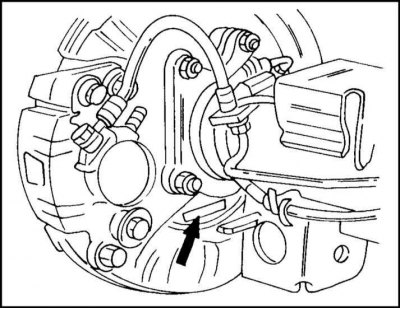
The regulator is replaced as follows:


The regulator is replaced as follows:

Removal


1. Raise the rear of the vehicle and place it on stands.

2. Disconnect the brake lines (1), (2) and (3) from the regulator. To prevent brake fluid from leaking out of the system, unscrew the cap of the reservoir on the master cylinder, fill the fluid to the upper level, put polyethylene on top and screw the cap back on. Plug the disconnected pipes to prevent dirt from entering the system.

3. Remove the cotter pin, nut (5), washer (6) and holder (7) from the bridge.

4. Unscrew the nuts (4), remove the two washers and remove the pressure regulator and spring assembly.

Installation


The regulator is installed as follows:

1. Install the regulator and spring assembly and secure them with two washers and nuts (4).

2. Tighten the nuts to a torque of 12 Nm.


3. Install the holder (7), washer (6) and nut (5) with cotter pin.

4. Tighten the nut to a torque of 13 Nm.

5. When installing the holder, make sure that its convex side faces the rubber bushing.

6. Connect the brake pipes (1) and (3) to their fittings.

7. Tighten the union nut to a torque of 16 Nm.

8. Make the connection carefully, as it has fine threads.

9. Finally, fill the system with fluid and bleed the air as described above.

10. Have the pressure regulator checked at a car repair shop.

[Original source on the website OPELBOOK.ru]


This article is available at russian, bulgarian, belarusian, ukrainian, serbian, croatian, romanian, polish, slovak, hungarian
Checking the article: Meshcheryakov Damir

Share information:

Previous articles
Opel Frontera A: Brake system
Next articles

Parking brake — removal, installation and adjustment
Vacuum brake booster — removal and installation
Bleeding the brake system
Master Brake Cylinder — Removal and Installation
Replacing the parking brake pads
Replacing the rear brake disc cover
Brake hoses for front and rear brake mechanisms
Anti-lock braking system (ABS) — removal and installation


See similar ones from other Opel car manuals:
▶ Removal, installation and adjustment of the pressure… Opel Astra G (1998-2004)
▶ Pressure regulator valve in the hydraulic circuits of the… Opel Corsa B (1993-2000)
▶ Speedometer drive unit, band brake servo regulator,… Opel Kadett E (1984-1995)
▶ Fuel pressure regulator — removal and installation Opel Vectra A (1988-1995, petrol)
▶ Fuel Pressure Regulator — Checking and Replacing Opel Zafira A (1999-2005, petrol)
Link to this page in different formats

Visitor comments


No comments yet


How much will 50 + 16 =


Vivaro A (2001-2014) 
  • General information
  • User manual
  • Power unit
  • Petrol engine F4R
  • Diesel engine F9Q
  • Diesel engine G9U
  • Transmission
  • Clutch and drive shafts
  • Manual gearbox
  • Chassis
  • Front suspension
  • Rear suspension
  • Brake system
  • Body
  • Exterior
  • Interior
  • Electrical equipment
  • Heating and ventilation
  • Air conditioner
  • Equipment and devices
  • Electrical diagrams
Ascona C (1981-1988) 
  • General information
  • Maintenance
  • Power unit
  • Gasoline engines
  • Diesel engines
  • Cooling system
  • Fuel and exhaust system
  • Contact ignition system
  • Contactless ignition system
  • Transmission
  • Clutch
  • Mechanical gearbox
  • Automatic gearbox
  • Drive shafts
  • Chassis
  • Steering
  • Brake system
  • Car suspension
  • Body
  • Exterior
  • Interior
  • Doors and windows
  • Electrical equipment
  • Equipment and devices
  • Power devices
  • Electrical circuits
Frontera B (1998-2004) 
  • General information
  • User manual
  • Maintenance
  • Power unit
  • Petrol engines 2.2 l
  • Petrol engines 3.2 l
  • Diesel engines 2.2 l
  • Cooling system
  • Fuel system (petrol)
  • Fuel system (diesel)
  • Ignition system
  • Transmission
  • Clutch
  • Manual gearbox MUA5C
  • Automatic gearbox 4L30E
  • Chassis
  • Suspension and axles
  • Steering
  • Brake system
  • Body
  • Exterior
  • Interior
  • Doors, locks and windows
  • Heating and air conditioning
  • Electrical equipment
  • Power devices
  • Equipment and devices
  • Lighting and signaling
  • Electrical diagrams
Frontera A (1991-1998, petrol) 
  • General information
  • Introduction to guide
  • User manual
  • Maintenance
  • Power unit
  • Engine repair
  • Lubrication system
  • Cooling system
  • Power and exhaust system
  • Engine electrics
  • Transmission
  • Clutch
  • Mechanical gearbox
  • Cardan shafts
  • Chassis
  • Brake system
  • Front suspension
  • Rear suspension
  • Steering
  • Body
  • Repair and care
  • Electrical equipment
  • Equipment and devices
  • Electrical circuits
OpelBook.ru © 2017–2026 · Mobile version · · Sitemap: EN BG BY UA RS HR RO PL SK HU · Feedback · Site search
Astra F, petrol · Astra G, petrol · Astra G · Astra H · Astra J, petrol · Corsa B · Corsa C, petrol · Corsa C · Insignia A · Kadett D · Kadett E · Omega A · Omega B · Omega B2 · Vectra A, petrol · Vectra A · Vectra B, petrol · Vectra B · Vectra C · Zafira A, petrol · Frontera A, petrol · Frontera B · Ascona C · Vivaro A ·
We want your visit to be comfortable 🤝! We use cookies 🍪 to make that happen.