


Contents: Removal the front brake caliper ⬇ Replacing the front brake piston seal ⬇ Restoring free travel of brake…⬇ Removal the front brake disc ⬇
Both pads should always be replaced on the right and left. Use pads with AVE only. Since the pistons in the brake calipers move out more and more as the pads wear out, they need to be pressed back before installing new, thick pads. In this case, the brake fluid is squeezed out through the tubes into the expansion tank. If brake fluid was added in the interval that is not needed, the excess must now be sucked out. Otherwise, the brake fluid that has come out of the expansion tank will corrode the painted parts located around in the engine compartment. For suction, use an absolutely clean pipette or an old injection syringe - never suck out the fluid by mouth!
Raise the front of the vehicle and support it.
Remove the wheel.
Turn the steering wheel.
On vehicles with a monitoring system, carefully pry the brake pad wear indicator wire connector out of the inner pad recess using a small screwdriver.
Use a screwdriver to pry up the clamp on the outside of the brake caliper.
On the inside of the caliper, remove the protective caps from the guide pins.
Now insert the key with the internal hexagon (7 mm) into the exposed hexagon of the guide fingers and loosen the bolts.
Press the brake caliper housing outward.
Remove the brake caliper housing.
The inner brake lining is secured to the brake piston with a clamping clamp - remove the lining.
To prevent the brake caliper housing from pulling the brake hose, it is tied with a cord or wire. If necessary, press the clamp and remove the brake hose from the bracket on the shock absorber strut.
Clean the brake pad guides in the brake caliper with alcohol and a rag.
Install new brake pads.
Use a clamp to push back the piston in the brake caliper.
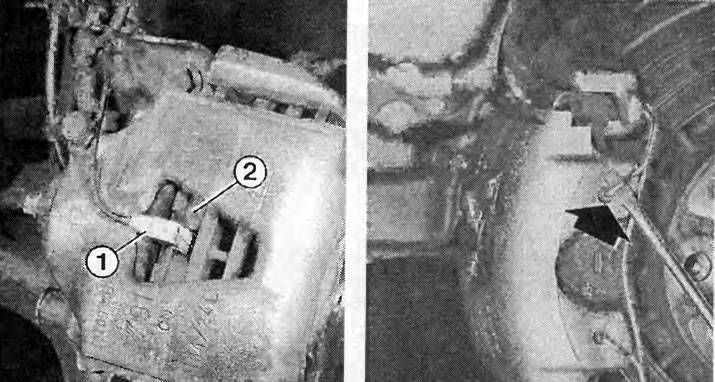
Left:the wire (1) of the control system sensor is secured in the clamps on the inner brake lining (2).
Right:the clamp is pressed away from the brake caliper using a screwdriver.
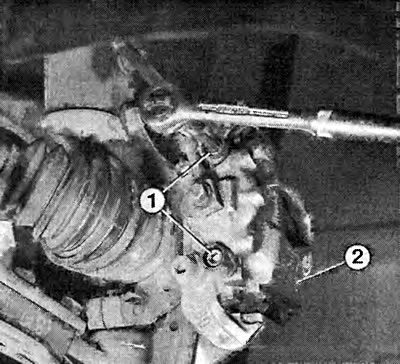
After loosening the guide bolts (1), the brake caliper housing can be removed.
Install the brake caliper housing.
Tighten the guide bolts to 30 Nm and reinstall the protective caps.
Install a clamp on the outside of the brake caliper. If necessary, install a clamp on the shock absorber strut.
Press the brake pad wear indicator wire into the recess in the inner pad.
After assembly, press the brake pedal several times so that the pads fit against the brake disc. Otherwise, there will be no braking effect!
With new brake pads, brake carefully for the first 200 km, if possible.
Tip: If the ground-in brake pads are used again, they must be installed in the same place. Replacing them from the outside to the inside or vice versa, or from one wheel to another, can lead to uneven braking effect.
Removal the front brake caliper
Remove the brake pads.
With the control system, use a screwdriver to press the brake pad wear indicator wire connector out of the recess in the inner lining.
Where available, use a screwdriver or chisel to pry off the protective caps on the brake caliper mounting bolts.
Remove the brake caliper mounting bolts.
Hang the brake caliper or brake caliper housing with the brake hose bolted on so that the hose is not under tension. If necessary, release the clamp and remove the brake hose from the bracket on the shock absorber strut.
Press and hold the brake pedal to prevent brake fluid from leaking out (see "Advice on work" in this chapter).
When installing, lubricate both mounting bolts with safety compound and tighten them to 95 Nm. Then tighten the bolts by 30-45°.
Screw on the brake hose with a new sealing ring (40 Nm). If necessary, mount the clamping clamp on the shock absorber strut.
Press the brake pad wear indicator wire connector into the recess of the inner pad.
If the brake hose was unscrewed, bleed the brake system.
Before your first ride, press the brake pedal several times to establish normal pedal clearance.
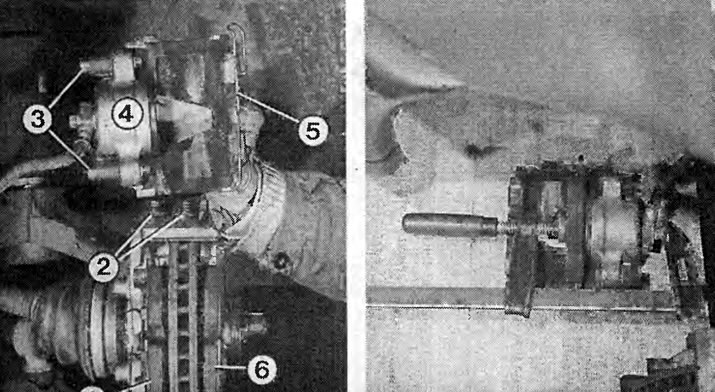
Left:removed brake caliper housing. The numbers indicate:
1 - inner brake lining;
2 - protective caps;
3 - guide bolts;
4 - brake caliper housing;
5 - tension clamp;
6 - outer brake lining.
Right:here the piston in the brake caliper is pressed back with a clamp so that new brake pads can be installed. An internal brake pad is placed for protection.
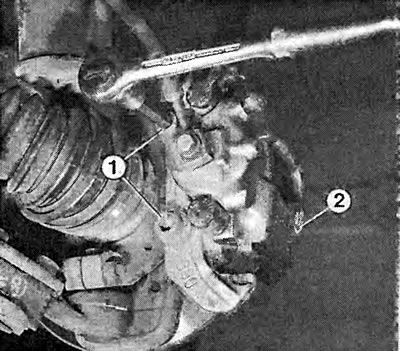
The brake caliper can be removed together with the brake pads. To do this, press the brake caliper housing outward with a screwdriver as described in the section "Measuring the front disc brake pads". Then unscrew the mounting bolts (1) and remove the brake caliper from the steering knuckle.
Replacing the front brake piston seal
If the brake piston seal in the brake caliper has been damaged, you should take care of replacing it as soon as possible, otherwise the brake piston will soon jam due to corrosion and dirt. Unfortunately, seals are sold only together with the brake piston - sealing ring (which remains after repairs).
Unscrew the brake caliper housing.
Press the brake piston seal away from the housing using a flat-head screwdriver or chisel.
When installing a new seal, the brake piston should protrude slightly more from the brake caliper housing. Do not change the position of the piston (the protruding pressure surfaces of the piston must be in a horizontal position).
If necessary, have your assistant press the brake pedal a little harder so that the piston protrudes by about 10 mm.
Insert the new seal into the groove on the brake piston and pull it onto the roller on the brake caliper. If necessary, press the dust seal with a plastic wedge.
Check: The cuff should be evenly positioned in the brake caliper along the entire perimeter. It should fit perfectly in the groove of the brake piston.
Restoring free travel of brake caliper and piston
Due to corrosion of the sliding surfaces of the brake caliper, its movement may be difficult. A defective piston cuff contributes to the fact that the piston in the brake caliper jams due to dirt and corrosion. Both of these cause uneven braking effect.
Remove the brake pads.
Check if the pads move easily in their guides.
Otherwise, grind the guides. Be careful not to damage the piston seal.
Also check and clean the sliding bushings.
To check the ease of movement of the pistons, install a clamp with a block of wood inserted into it as a stop for the pistons so that they cannot slip out too far.
Have an assistant gently press the brake pedal. Does the piston move?
If the piston does not extend, pump the brake pedal until the piston begins to move.
Press the piston back as described in the "Replacing Disc Brake Pads" section.
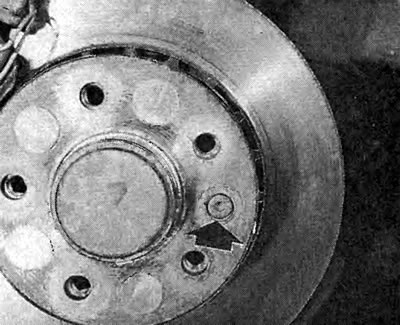
The photo shows the front brake disc mounting bolt. Once the bolt is loosened, the brake disc can be removed from the wheel hub.
Repeat these steps until the piston moves easily. Do not change the position of the piston. The protruding pressure surfaces of the piston must be horizontal.
Lubricate the side surfaces of the piston with ATE brake paste.
Removal the front brake disc
Brake discs should always be replaced in pairs. Replacing them on one side may result in uneven braking performance.
Remove the brake caliper.
Secure the brake caliper body to the body with wire; hydraulic hoses remain connected.
Unscrew the brake caliper from the steering knuckle.
Unscrew the mounting bolt (between the holes of the wheel bolts) with an Allen key.
Pre-treat the bolt with rust remover or use an impact driver.
Now the brake disc can be removed manually from the wheel hub. If it is rusted, help yourself with vigorous hammer blows - but only if the disc is going to be replaced.
Before installing a new brake disc, clean the mating surface of the wheel hub
Tighten the brake disc mounting bolt to 4 Nm.
Remove the anti-corrosion wax from the new disc with solvent.
Visitor comments