


Contents: Removal ⬇ Installation ⬇
Attention! Removal and installation of the toothed belt can only be performed on a cold engine.
Removal
1. Disconnect the negative cable from the battery, then position piston #1 at TDC on the compression stroke (see Chapter 3).
Caution! On models with Opel Anti-Theft System (ATWS), the negative cable must be disconnected from the battery terminal within 15 seconds after the ignition is turned off, otherwise the alarm will be triggered.
2. Remove the crankshaft pulley as described in Chapter 5.
3. Make sure that the timing marks on the camshaft sprockets are aligned with the marks on the camshaft cover and the crankshaft sprocket mark is aligned with the slot on the oil pump housing.
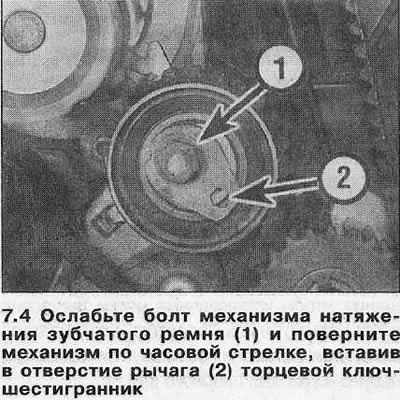
4. Loosen the timing belt tensioner bolt (see illustration). Using an Allen key, turn the tensioner lever clockwise to the stop to release the timing belt tension and tighten the mounting bolt again.
5. Pull the timing belt off the sprockets and remove it from the engine. If the belt is not replaceable, mark it with a direction of rotation mark. Do not move the crankshaft or camshafts until the timing belt has been reinstalled.
6. Check the timing belt for signs of uneven wear, cracks, and oil contamination, and replace it if there is any doubt about the condition of the component. If the engine is due for rebuild, the vehicle has traveled more than 40,000 miles, or the belt has been in use for more than 4 years, replace the belt regardless of its condition (since 1997, the belt replacement interval has been increased to 130,000 km or 8 years). If the belt is contaminated with oil, identify the source of the leak and repair it. Wash the belt and all associated components to remove oil.
Material copied from this portal www.opelbook.ru
Installation
7. When assembling, thoroughly clean the toothed belt sprockets and tensioner pulleys.
8. Make sure the crankshaft sprocket timing mark is still aligned with the slot on the oil pump housing and the camshaft sprocket timing marks are aligned with the marks on the camshaft cover. If the camshaft cover has been removed, align the sprocket timing marks with the tabs on the front camshaft bearing caps (see illustration).
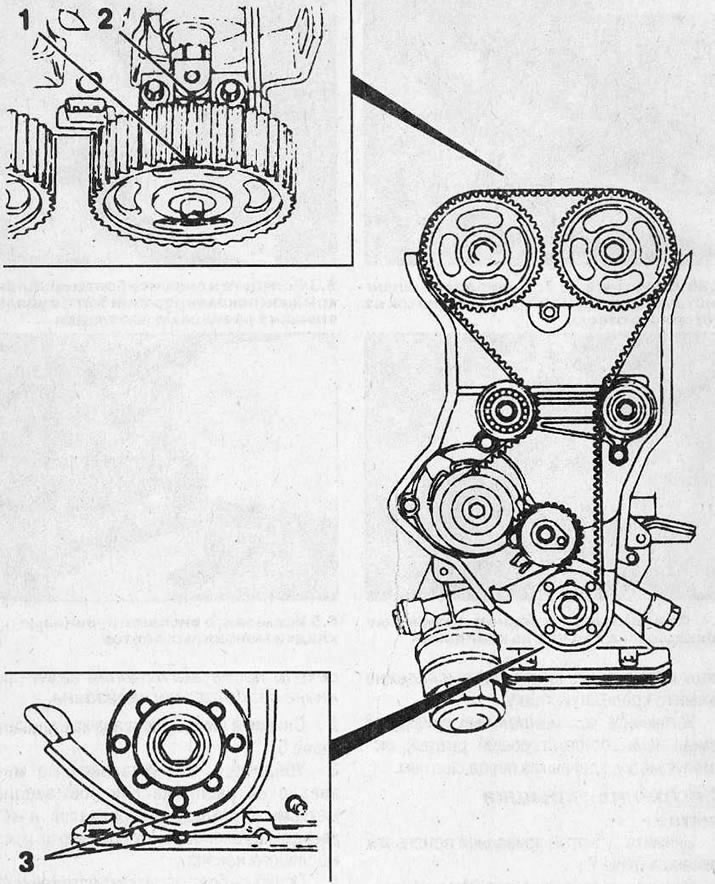
7.8 Align the camshaft sprocket marks (1) with the marks on the bearing caps (2) or camshaft cover, and the crankshaft sprocket mark with the slot on the oil pump (3)
9. Install the toothed belt on the camshaft and crankshaft sprockets and on the intermediate pulleys so that the left section of the belt is tightly tensioned (that is, all the sag should be on the side of the belt tensioner mechanism), then pass the belt over the water pump sprocket and tensioner pulley. Make sure the belt teeth are seated in the sprocket grooves and that the timing marks are still aligned. If installing the old belt, orient it according to the rotation direction mark made before removal.
10. Loosen the timing belt tensioner bolt to release the tensioner spring. Turn the tensioner lever counterclockwise toward the stop (see illustration). While holding the mechanism in this position, tighten the mounting bolt securely.
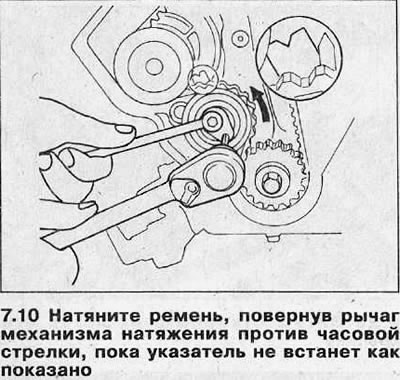
11. Check that the timing marks on the sprockets are still aligned. If not, release the tensioner again, then remove the belt from the sprockets and make any necessary adjustments.
12. Install the socket onto the crankshaft sprocket bolt and rotate the shaft two full turns (720°) in its direction of rotation to adjust the position of the timing belt components.
13. Make sure that the timing marks on the camshaft and crankshaft sprockets are aligned, then loosen the tensioner bolt again.
14. If a new timing belt is being installed, position the tensioner so that the pointer is aligned with the "NEW" notch or mark (depending on the type of tensioning mechanism) on the support shield (see illustration). While holding the tensioner in this position, tighten the mounting bolt with the specified tightening force Specifications. Rotate the crankshaft two full revolutions in the direction of its rotation to re-align the timing marks on the sprockets. Make sure the tensioner pointer is still aligned with the slot/mark on the support plate.
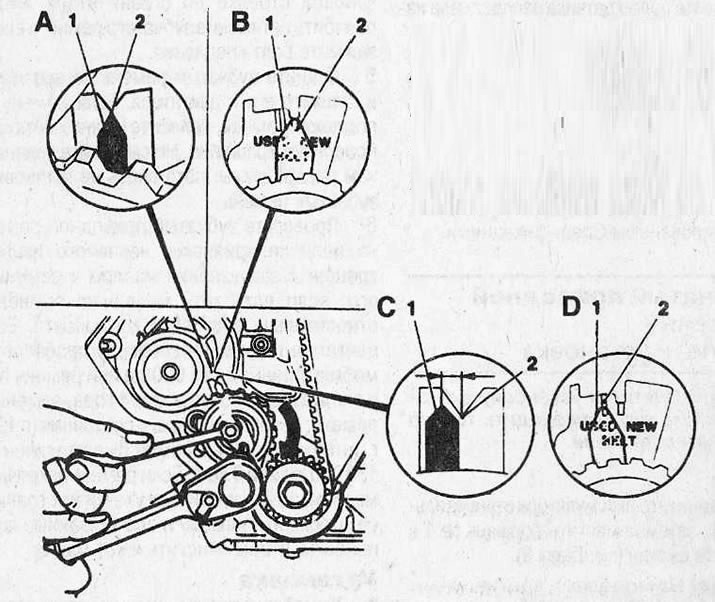
7.14 Make sure that the timing belt tensioner lever (1) is correctly positioned relative to the slot/mark on the support plate (2) (see text)
A The correct position for the new belt is the tensioner with a slot
B Correct position for new belt - tensioner with marks
C Correct position for the old belt - tensioner with slot
D Correct position for the old belt - tensioner mechanism with marks
15. If the old belt is being installed, position the tensioner so that the pointer is 4 mm to the left of the slot or aligned with the "USED" mark (depending on the type of tensioning mechanism) on the support shield (see illustration 7.14). While holding the tensioner in this position, tighten the mounting bolt to the torque specified in the Specifications. Rotate the crankshaft two full revolutions in the direction of rotation. Check that the tensioner pointer is still aligned with the slot/mark on the support plate.
16. If the tensioner indicator position is out of alignment, repeat the procedure described in step 14 (new belt) or 15 (old belt).
17. Install the timing belt cover and crankshaft pulley as described in Chapter 5 and Chapter 6.
Visitor comments