


Proceed with the work only after the engine has completely cooled down!
Removal
1. Disconnect and remove the battery (see Chapter Engine electrical systems).
2. Drain the cooling system (see Chapter Engine cooling, interior heating and air conditioning systems).
3. Remove the spark plugs and the accessory drive belt (see Chapter Vehicle settings and routine maintenance).
4. Remove the timing belt (see section Removal and installation the timing belt).
Cylinder Head Assembly Components
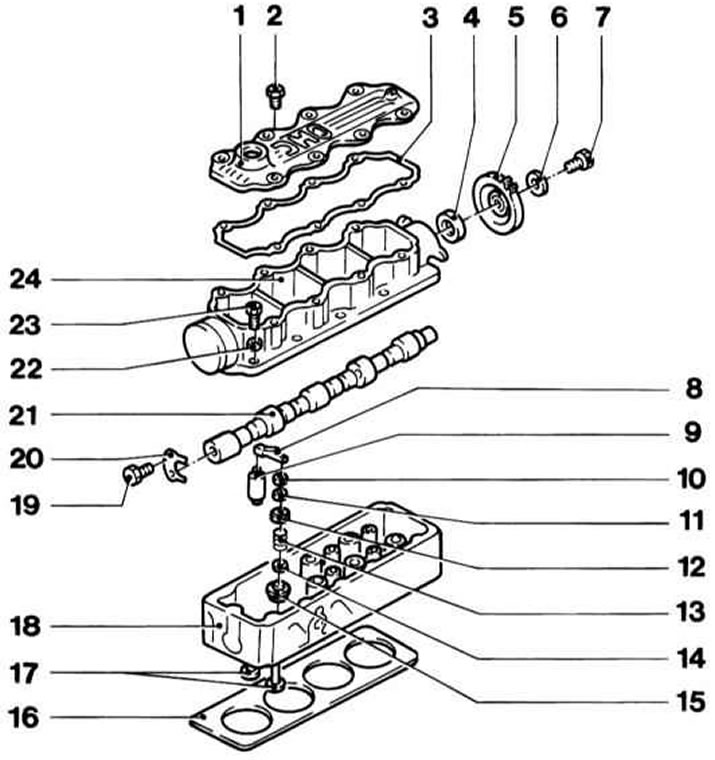
1 — Camshaft bed cover
2 — Bolt, tightening force: 8 Nm
3 - Sealing gasket
4 — Camshaft oil seal. To remove, turn the washer and use pliers to remove the bolt together with the sealing ring.
5 — Camshaft gear wheel
6 — Washer
7 — Bolt, tightening torque: 45 Nm; must be replaced
8 — Rocker arm
9 — Hydraulic compensator
10 — Pressure element
11 - Rusks
12 — Upper spring plate
13 — Spring
14 — Oil deflector cap
15 — Lower spring plate
Exhaust valve: valve rotary device
Inlet valve: spring seat
16 — Cylinder head gasket
17 — Valve
18 — Cylinder head
19 — Bolt, tightening torque: 8 Nm
20 - Limit plate
21 — Camshaft
22 — Washer
23 — Cylinder head mounting bolt
24 — Camshaft bed
5. Remove the intake manifold and exhaust manifold (see Chapter Fuel, exhaust and emission control systems). If the cylinder head is not serviceable, it can be removed as a complete assembly with the pipe and manifold:
Material provided by this website (OpelBook)
- Tape off and disconnect all electrical wiring going to the cylinder head, intake manifold and throttle body;
- Relieve the fuel system pressure and disconnect the fuel lines from the fuel rail. Also disconnect all vacuum and coolant hoses from the intake manifold/throttle body;
- Remove the support bracket from the intake manifold, also remove the upper generator mounting bracket;
- Disconnect the accelerator cable;
- Disconnect the exhaust manifold exhaust pipe assembly with the support bracket from the exhaust manifold;
- Disconnect the electrical wiring from the lambda probe.
6. Remove the timing cover (see section Removal and installation the timing cover).
7. Remove the camshaft timing gear (see section Removal and installation timing gear wheels).
8. Unscrew the bolts securing the rear timing cover to the timing mechanism housing.
9. On c14NZ engine disconnect the electrical wiring connectors and high-voltage cables from the ignition distributor. On engines X12SZ and C14SE disconnect the wiring harness connectors at the DIS ignition module. Loosen the ground bus mounting bolt at the front of the head and remove the wiring harness protective cover from the head.
10. Loosen the mounting clamps and disconnect the cooling system hoses from the thermostat housing.
11. Make sure that all hoses, tubes, wires and other communication lines are disconnected and do not interfere with the removal of the cylinder head.
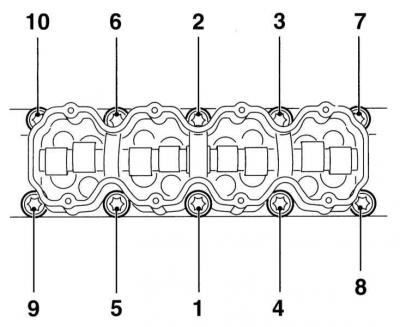
12. Proceed in the reverse order to that shown in the illustration, gradually, a quarter turn at a time, loosen the cylinder head mounting bolts enough to allow them to be unscrewed by hand. Remove the bolts from the head complete with their washers.
13. Lift up and separate the timing case from the head; if necessary, tap the case on the sides with a soft-faced hammer.
Never pry the housing with a lever to avoid damaging the mating surfaces!
16. Mark the position of the two guide bushings, remove them from the head and put them in a safe place.
17. Separate the cylinder head from the block - try not to drop the valve drive levers and oil deflector caps. If necessary, lightly tap the sides of the head with a soft-faced hammer - under no circumstances should you pry it off with a lever! Mark the position of the two guide bushings, remove them and put them in a safe place.
18. Remove the sealing gasket - do not discard the gasket yet in order to identify the new one.
Preparing for installation
1. Thoroughly clean and wipe dry the mating surfaces of the cylinder head and block. Use a hard plastic or wooden scraper to remove all traces of old gasket material and carbon deposits. Also clean the piston crowns. Be extremely careful - the surfaces are easy to damage. Remember that dirt should not get into the oil ducts, water galleries, channels and threaded holes - plug them with plugs or seal them with tape. To prevent carbon deposits from getting into the gaps between the pistons and cylinders, pack the latter with thick grease, which can be easily removed with a stiff brush after the cleaning procedure is complete. After cleaning, wipe all surfaces with a clean, dry rag.
2. Inspect the mating surfaces of the head and block for deep scratches, cracks and other damage. Minor defects can be removed with a fine scraper; in more serious cases, the head should be ground or replaced.
3. Make sure the threaded holes are clean and dry - blow them out with compressed air just in case (you can use a bicycle pump). The presence of traces of grease in blind holes can lead to the destruction of the block when tightening the bolts as a result of the increase in hydraulic pressure.
4. The head mounting bolts must be replaced without fail, regardless of their current condition.
5. Using a steel ruler and a blade-type feeler gauge, check the flatness of the mating surface of the head (see section General and major engine repairs).
6. Replace the cylinder head mounting bolts - the bolts must be replaced without fail, regardless of their current condition.
Installation
1. Bring the piston of the first cylinder to the TDC position at the end of the compression stroke.
2. Using a clean cloth, wipe the mating surfaces of the block and head dry.
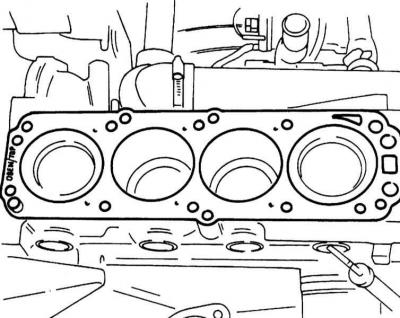
3. Make sure that both guide bushings are installed in their sockets. Place a new sealing gasket on the mating surface of the cylinder block, with the "OBEN/TOP" marking facing up.
Correct position of the cylinder head gasket
4. Install the head on the cylinder block - make sure that the guide bushings fit correctly into the receiving sockets.
5. Wipe dry the mating surfaces of the head and timing case with a clean rag. Make sure that the valve drive levers, oil deflector caps and hydraulic compensators are installed correctly.
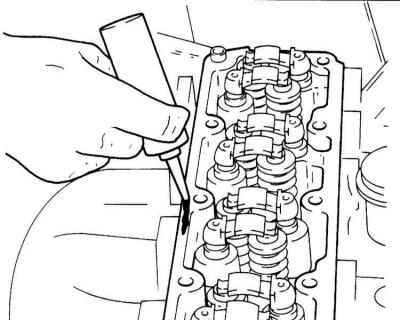
6. Apply a layer of OPEL ET-No. 15 03 166 sealant to the upper mating surface of the cylinder head.
Applying sealant to the surface of the head mating with the timing case
7. Install the guide bushings and lubricate the valve actuator levers with clean engine oil.
8. Carefully install the timing belt housing with the camshaft embedded in it on the cylinder head, make sure that the guide bushings are correctly inserted into the receiving sockets, and make sure that the guide bushings are correctly inserted into the receiving sockets.
9. Place washers on NEW cylinder head bolts, then install bolts and hand tighten.
10. Tighten the bolts evenly and in a precise sequence to specification.
Cylinder Head Bolt Tightening Sequence
11. Screw in the timing belt rear cover mounting bolts and tighten them to the required torque.
12. Install the camshaft timing gear (see section Removal and installation timing gear wheels) and timing belt (see section Removal and installation the timing belt).
13. Restore the original wiring connection, ensure that the harnesses are correctly routed and securely fastened in all the provided intermediate fasteners.
14. Connect the cooling system hoses to the thermostat housing - make sure the fastening clamps are securely tightened.
15. Install the intake manifold and exhaust manifold (see Chapter Fuel, exhaust and emission control systems).
16. Reinstall the engine guard and right front wheel. Lower the vehicle to the ground and tighten the wheel bolts to the specified torque.
17. Make sure that all hoses are connected correctly and securely, then fill the cooling system (see Chapter Engine cooling, interior heating and air conditioning systems).
18. Connect the battery.
19. Start the engine and check it for signs of developing fluid leaks.
Visitor comments