
OpelBook.ru
Cars AvtoVAZ Cars Mitsubishi Cars BMW Cars Mercedes Cars Nissan Cars Toyota Cars Chevrolet
English Русский
Български
Беларускі
Український
Српски
Hrvatski
Română
Polski
Slovenský
Magyar
 |  Sitemap  |  Contacts  |    


Main Astra Corsa Insignia Kadett Omega Vectra Zafira Others Articles
Corsa B (1993-2000) Corsa C (2000-2006, petrol) Corsa C (2000-2006)
  • Main
  • Corsa
  • Corsa B
  • Power unit
  • SOHC gasoline engines
  • Removal and installation the oil pan

Removal and installation the oil pan (Opel Corsa B)

            0

Contents: Removal ⬇ Installation ⬇

Removal


1. Disconnect the negative cable from the battery.

2. Set the parking brake, then jack up the front of the vehicle and place it on supports. If equipped, remove the crankcase guard.

3. Drain the engine oil (see Chapter Vehicle settings and routine maintenance), then, replacing the sealing washer, screw the plug back into place and tighten it to the required torque.

4. Remove the exhaust pipe (see Chapter Fuel, exhaust and emission control systems).

5. If equipped, disconnect the oil level sensor wiring from the pan.

6. On models without a CV joint, unscrew the mounting bolts and remove the flywheel cover.

Removal the flywheel cover
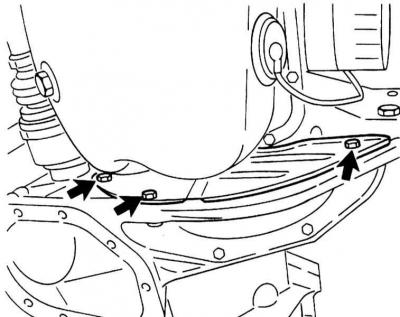
Removal the flywheel cover


7. On models with a K/V, unscrew the bolts securing the oil pan to the gearbox housing.

Engine oil pan to gearbox mounting bolts
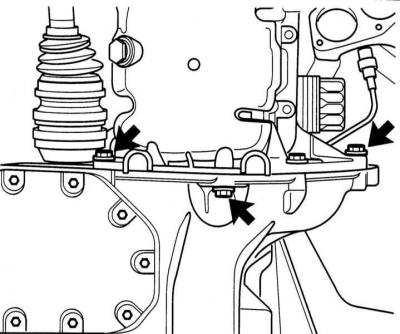
Engine oil pan to gearbox mounting bolts


8. Remove the bolts securing the oil pan to the cylinder block.


Engine oil pan to cylinder block mounting bolts
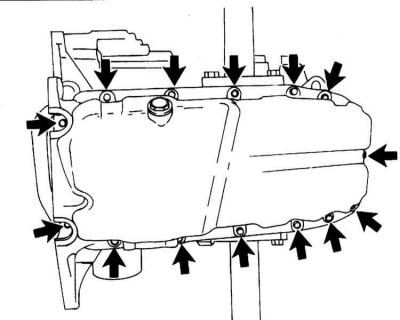
Engine oil pan to cylinder block mounting bolts


9. Lightly tap the sides of the pan with a soft-faced hammer, separate it from the engine crankcase, lower it and remove it from under the car.

10. After removing the oil pan, it is recommended to also disconnect the mesh oil intake and clean it.

Mesh oil intake mounting bolts
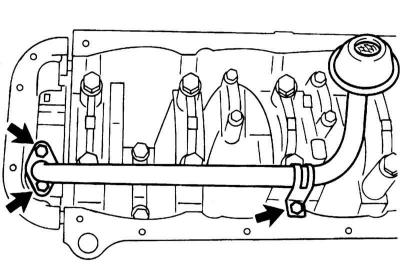
Mesh oil intake mounting bolts


11. Check the oil intake screen for damage, replace if necessary. Check the oil intake screen filter for patency - wash the screen with solvent or replace the filter.

Installation


1. Thoroughly clean and wipe dry the mating surfaces of the oil pan flange and the crankcases of the power unit. Remove all traces of oil, dirt and old sealant from the threads of the oil pan and oil intake bolts.


2. If necessary, replace the sealing ring and reinstall the oil pickup. Apply a locking anaerobic sealant, such as OPEL 15 10 177, to the threaded portion of the mounting bolts, screw them in and tighten them with force 8 Nm.

Installing a new oil pickup seal ring
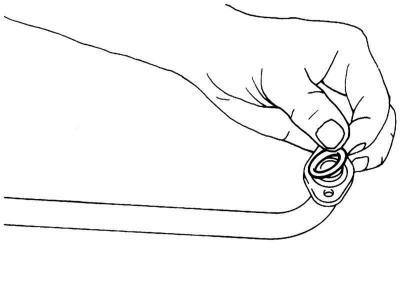
Installing a new oil pickup seal ring


3. On 1.6L engine and 1.4L engine with CV tighten the oil pan to gearbox housing mounting bolts with force 60 Nm.

4. Apply a layer of sealant, for example, OPEL 15 03 294 (90 001 851) on the mating surface of the cylinder block in the area where the oil pump and rear main bearing cover are installed.

Places where sealant is applied to the surface of the cylinder block mating with the oil pan
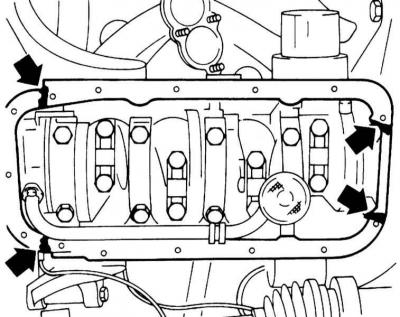
Places where sealant is applied to the surface of the cylinder block mating with the oil pan


5. Place a new gasket on the pan, then press the pan to the block. Lubricate the threaded part of the pan mounting bolts with an anaerobic fixing sealant, for example, OPEL 15 10 177. Screw in the bolts and, moving from the center to the edges, tighten them diagonally to the required force.


6. Further installation is carried out in the reverse order of dismantling the components.

7. Fill the engine with fresh oil (see Chapter Vehicle settings and routine maintenance).

8. Take a test drive and check the oil pan and drain plug for leaks, lightly tighten the oil pan mounting bolts if necessary.

9. If removed, reinstall the oil intake.

10. Thoroughly clean and wipe dry the mating surfaces of the oil pan flange and the crankcases of the power unit. Remove all traces of oil, dirt and old sealant from the threads of the oil pan and oil intake bolts.

11. Apply a coat of suitable sealant to the mating surface of the cylinder block in the area where the oil pump and rear main bearing cap are installed.

12. Place a new gasket on the pan, then press the pan onto the block. Apply anaerobic sealant to the threaded portion of the pan mounting bolts. Screw in the bolts and tighten them diagonally to the required torque, moving from the center to the edges.

13. Screw in and tighten the pan mounting flange bolts to the required torque. Install rubber plugs in the flange cutouts.

14. Install the exhaust pipe (see Chapter Fuel, exhaust and emission control systems). If equipped, connect the wiring to the oil level sensor on the side of the pan.

15. If equipped, reinstall the crankcase guard, then lower the vehicle.

16. Fill the engine with fresh oil (see Chapter Vehicle settings and routine maintenance).


This article is available at russian, bulgarian, belarusian, ukrainian, serbian, croatian, romanian, polish, slovak, hungarian
Checking the article: Trifonova Emilia

Share information:

Previous articles
Opel Corsa B: SOHC gasoline engines
Next articles

Removal and installation the cylinder head
Removal, inspection and installation of valves
Removal, condition check and installation of the camshaft with the timing mechanism housing
Replacing the camshaft seal
Removal and installation timing gear wheels
Removal and installation the timing belt
Removal, maintenance and installation of the oil pump
Removal, checking condition and installing flywheel/drive disk
Replacing crankshaft seals


Link to this page in different formats

Visitor comments


No comments yet


How much will 34 + 44 =


Corsa C (2000-2006) 
  • General information
  • Introduction to guide
  • Troubleshooting
  • Vehicle device
  • User manual
  • Maintenance
  • Power unit
  • Engine repair
  • Cooling system
  • Power and exhaust system
  • Control system
  • Engine electrical equipment
  • Transmission
  • Clutch
  • Mechanical gearbox
  • Automatic gearbox
  • Drive shafts
  • Chassis
  • Brake system
  • Wheel suspension
  • Steering
  • Body
  • Exterior
  • Interior
  • Doors and windows
  • Heating and air conditioning
  • Electrical equipment
  • Equipment and devices
  • Lamps and lighting
  • Electrical circuits
Corsa C (2000-2006, petrol) 
  • User manual
  • Car access
  • Governing bodies
  • Seat control
  • Heating and air conditioning
  • Driving and maintenance
  • Engines 1.0 and 1.2 l
  • Engine repair
  • Cooling and lubrication system
  • Injection system
  • Engines 1.4, 1.6 and 1.8 l
  • Engine repair
  • Cooling and lubrication system
  • Injection system
  • Transmission
  • Clutch
  • Mechanical gearbox
  • Automatic gearbox
  • Drive shafts
  • Chassis
  • Wheels and tires
  • Wheel suspension
  • Steering
  • Brake system
  • Body
  • Exterior
  • Doors and windows
  • Electrical equipment
  • Equipment and devices
  • Lighting system
  • Electrical circuits
Corsa B (1993-2000) 
  • General information
  • Introduction to guide
  • User manual
  • Maintenance
  • Power unit
  • SOHC gasoline engines
  • DOHC gasoline engines
  • Diesel engines
  • Engine repair
  • Cooling system
  • Supply system
  • Injection system (gasoline)
  • Injection system (diesel)
  • Exhaust systems
  • Control system (gasoline)
  • Preheat system (diesel)
  • Charge and launch system
  • Transmission
  • Mechanical gearbox
  • Automatic gearbox
  • Clutch and drive shafts
  • Chassis
  • Brake system
  • Front suspension
  • Rear suspension
  • Steering
  • Body
  • Ventilation and heating
  • Exterior
  • Interior
  • Doors and windows
  • Electrical equipment
  • Equipment and devices
  • Lamps and lighting
  • Electrical circuits
OpelBook.ru © 2017–2026 · Mobile version · · Sitemap: EN BG BY UA RS HR RO PL SK HU · Feedback · Site search
Astra F, petrol · Astra G, petrol · Astra G · Astra H · Astra J, petrol · Corsa B · Corsa C, petrol · Corsa C · Insignia A · Kadett D · Kadett E · Omega A · Omega B · Omega B2 · Vectra A, petrol · Vectra A · Vectra B, petrol · Vectra B · Vectra C · Zafira A, petrol · Frontera A, petrol · Frontera B · Ascona C · Vivaro A ·
We want your visit to be comfortable 🤝! We use cookies 🍪 to make that happen.