


Signs of cylinder head gasket defects are:
- engine power reduction;
- coolant loss (white smoke in exhaust gases);
- increased oil consumption;
- coolant gets into the engine oil. The oil level does not decrease, but increases. Gray color of engine oil, bubbles on the dipstick, liquid oil;
- oil getting into the coolant;
- strong foaming of coolant;
- low compression in two adjacent cylinders.
Removal
Disconnect the ground wire from the battery.
Remove the air filter and (if equipped) the suction hose and pre-chamber.
Remove the bent section of the hose after loosening the clamp.
Remove the V-belt and push the generator to the side.
For vehicles with a poly V-belt: remove the belt and pulley.
For fuel injected engines: remove the accelerator rod at the throttle valve.
For carburetor engines: disconnect the accelerator cable at the carburetor and support.
Disconnect all hoses and lines going to the cylinder head, carburetor and intake manifold.
Disconnect the fuel line at the fuel pump and plug the end with a suitable plug.
Disconnect the wires from the spark plugs and the wire from the coil at the distributor.
Remove the front timing belt cover.
Set the piston of the 1st cylinder to TDC. To do this, turn the crankshaft by the pulley mounting bolt clockwise with a bent open-end wrench until the mark on the engine housing aligns with the mark on the pulley. At the same time, the mark on the camshaft pulley should coincide with the mark on the camshaft housing.
Loosen the timing belt and remove it from the top.
Remove the camshaft housing cover.
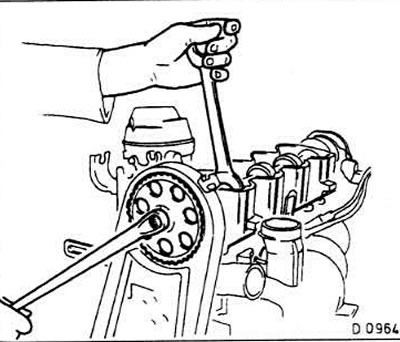
Remove the camshaft toothed pulley. Hold the camshaft from turning with a wrench.
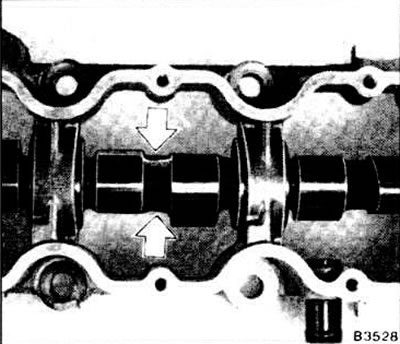
There are flats for a wrench between the cam lobes of the 3rd cylinder.
Remove the camshaft timing pulley.
Remove the intake pipe from the exhaust manifold.
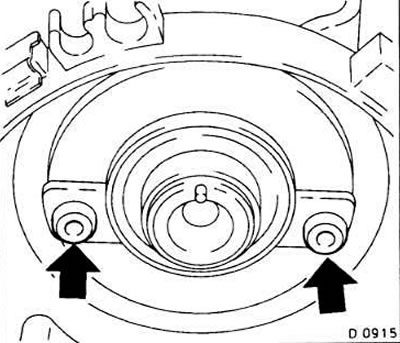
Loosen the upper bolts securing the rear timing belt cover.
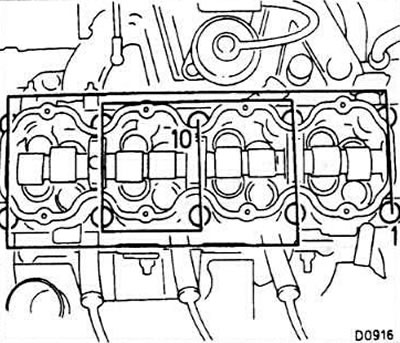
Loosen the cylinder head mounting bolts (see fig.) first by 1/4 turn, then by another ½ turn. After that, unscrew the bolts completely.
Attention! The cylinder head mounting bolts can only be loosened when the engine is cold.
Remove the camshaft housing.
Remove the valve rocker arms, stops and hydraulic clearance compensators and arrange them in such a way that they are not mixed up during assembly and are installed in their places in the same order.
Remove the intake and exhaust manifolds.
Installation
Clean the mating surface of the cylinder block from gasket residue. Cover the block holes with a rag to prevent dirt from getting into them.
Check the mating surface of the cylinder block for straightness.
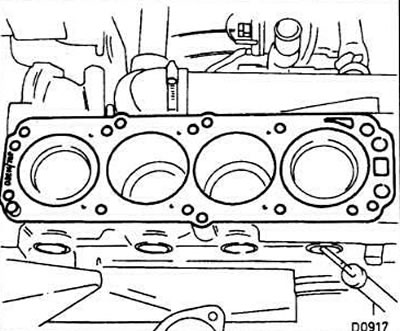
Install a new gasket without using sealant. There should be no grease on the mating surface of the cylinder block.
Place the gasket so that it does not cover the block holes.
Clean the mating surface of the cylinder head.
Check the mating surface for straightness.
Clean the mating surface of the cylinder head adjacent to the camshaft housing.
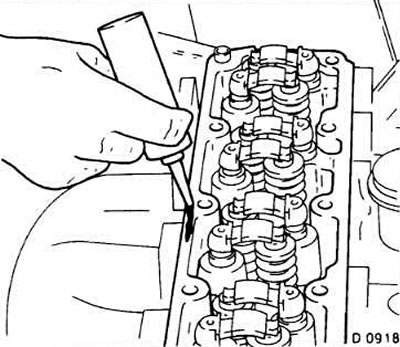
Install the cylinder head.
Install hydraulic valve clearance compensators, having previously lubricated them with engine oil. Lightly lubricate the valve rocker arms with MoS₂ - based paste and install them.
Clean the mating surface of the camshaft housing.
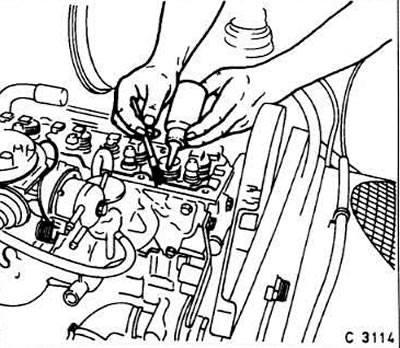
Apply a layer of sealant ET N1503166 to this surface.
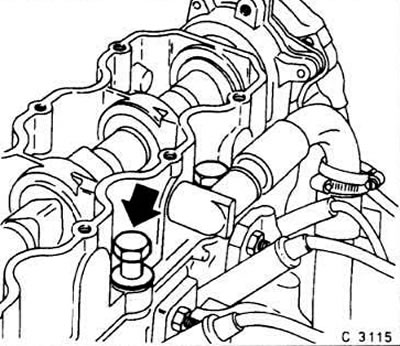
Install the camshaft housing, lightly tighten its bolts in a spiral from the inside out (use new bolts).
Attention! Tighten the bolts in four stages. Use only a tested and serviceable torque wrench for this. Instead, you can use an angle washer to control the tightening of the threaded connections.
Tightening of the cylinder head bolts must be done especially carefully, also using a tested and serviceable torque wrench.
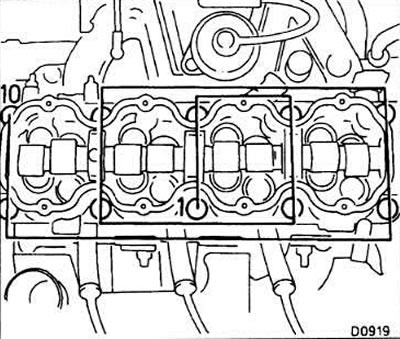
Tighten the cylinder head bolts in a spiral pattern from the inside out to a torque of 25 Nm.
Tighten the bolts in the same sequence by 60°.
Tighten the bolts in the same sequence at an angle of 60°.
Tighten the bolts in the same sequence to the angle:
- for 1.4 and 1.6 l engines: 30°;
- for 1.8 and 2.0 l engines: 60°;
In order to precisely maintain the specified tightening angles, it is recommended to apply corresponding marks on the camshaft housing cover. To do this, put a wrench on the nut and apply marks with chalk at 30° (or 60°, depending on the engine). You can also cut out a corresponding template from cardboard. To maintain maximum accuracy, it is recommended to purchase a device specially designed for this purpose from Hazet.
Attention! When the engine is warm, it is necessary to tighten the bolts again.
Install the camshaft toothed pulley and secure it with a bolt, holding the shaft from turning with a wrench by the flats. The bolt tightening torque is 45 Nm.
Attention! Use only a new bolt!
Install a new camshaft housing gasket and tighten the bolts to 8 Nm.
Put on the timing belt and tighten it.
Install the front timing belt cover.
Put on the V-belt and tighten it.
For vehicles with a poly V-belt: install the pulley and put on the belt.
Fill with coolant.
Connect all hoses, lines and cables going to the cylinder head, intake manifold, carburetor and fuel pump.
Connect the wires to the spark plugs in the sequence indicated in the table "Main engine parameters" (see at the beginning of the book)Cylinder No.1 is on the right, looking in the direction of vehicle travel.
Secure the intake pipe to the exhaust manifold.
Check the engine oil level, top up if necessary. If the cylinder head was removed due to a gasket defect, it is recommended to replace the oil and oil filter, as the oil may contain coolant.
Install the air filter.
Connect the ground wire to the battery.
Start and warm up the engine.
Check the ignition timing.
Check idle speed and CO content in exhaust gases.
Check the coolant level.
Tighten the cylinder head mounting bolts (on a warm engine) in the order indicated above, at an angle of 30°. Subsequent tightening (for example, after 1000 km of running) not needed.
Diesel engine 17YD 1.7 l
Disconnect the fuel lines at the injectors and the high-pressure fuel pump. Disconnect the lines as a set, without bending them.
Remove the upper and lower timing belt covers.
Remove the cover from the clutch housing.
Set the piston of the 1st cylinder to the ignition advance position before TDC.
Remove the vacuum pump.
Loosen and remove the timing belt.
Install a new cylinder head gasket.
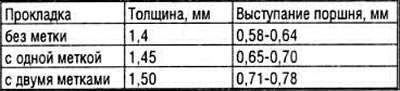
Attention! Depending on the piston protrusion, a gasket of different thickness is installed. When replacing a gasket, pay attention to its designation. The designation is on the side of the gasket in the form of one, two marks, or none.
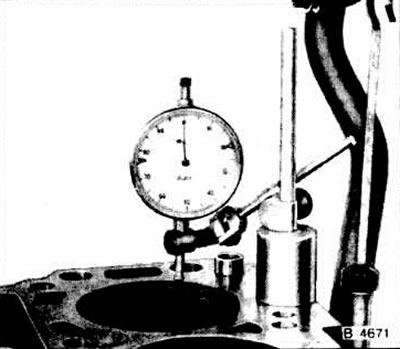
Check the pistons and valves for wear. If the wear is insignificant, it is enough to install a thicker gasket. To do this, measure the piston protrusion with an indicator.
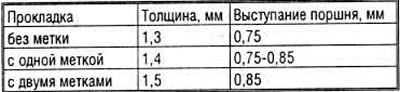
Attention! Tighten the bolts in four stages. Use only a tested and serviceable torque wrench. Instead of a wrench, you can use an angle washer to control the tightening of threaded connections.
Tighten the cylinder head bolts in a spiral pattern from the inside out to a torque of 25 Nm.
Tighten the bolts in the same sequence by 90°.
Tighten the bolts in the same sequence to an angle of 90°.
Tighten the bolts in the same sequence at an angle of 45°
Attention! When the engine is warm, it is necessary to tighten the bolts again.
Install the camshaft toothed pulley. Screw in the pulley mounting bolt without tightening it.
Put on and tighten the timing belt.
Tighten the toothed pulley mounting bolt to a torque of 90 Nm.
Check injection advance.
Install the vacuum pump.
Install a new sealing gasket under the camshaft housing cover and secure the cover with bolts.
Install the lower and upper timing belt covers.
Connect the fuel lines to the high-pressure fuel pump and injectors.
Start and warm up the engine (oil temperature 60°C).
Check the coolant level.
Tighten the cylinder head mounting bolts in the above order at an angle of 30° using a rigid wrench. Subsequent tightening of the bolts (for example, after 1000 km of running) not needed.
Check idle speed and maximum speed.
1.7L turbocharged diesel engine TC4EE1
Remove the intake manifold.
Disconnect the fuel lines from the injection pump and injectors. Remove the lines as a set, without bending them.
Disconnect the fuel drain line from the injectors.
Remove the radiator fan.
Remove the timing belt cover.
Set the piston of the 1st cylinder to TDC.
Remove the camshaft timing pulley.
Loosen and remove the timing belt.
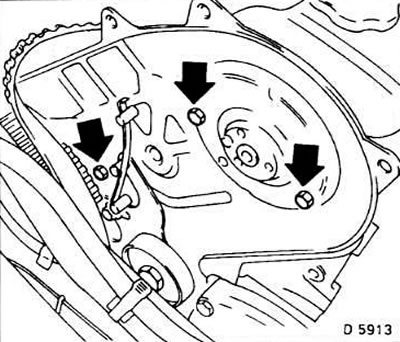
Loosen the three bolts securing the rear timing belt cover.
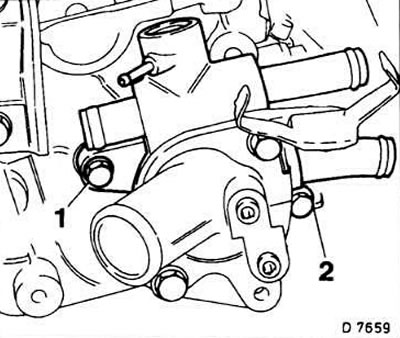
Unscrew bolts 1 and 2 securing the thermostat housing (see fig.).
Disconnect the cooling system hose from the turbocharger, having first removed the mounting clamp.
Disconnect the oil supply and drain lines between the turbocharger and the cylinder block.
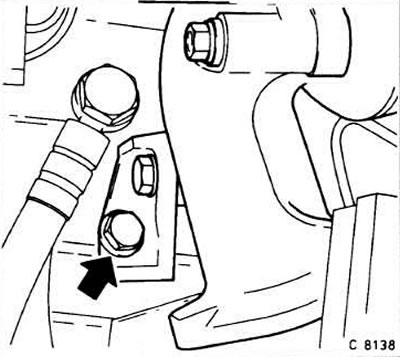
Loosen the turbocharger mounting bolts.
Remove the dipstick tube.
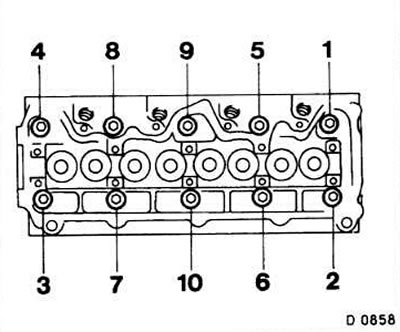
Loosen the cylinder head mounting bolts in the sequence shown (see fig.).
Remove the cylinder head by pushing aside the rear timing belt cover.
Install a new cylinder head gasket.
Attention! Depending on the piston protrusion, a gasket of different thickness is installed. When replacing a gasket, pay attention to its designation. The designation is on the side of the gasket in the form of one, two marks, or none.
Check the pistons and valves for wear, replace them if necessary. If the wear is insignificant, it is enough to install a thicker gasket. To do this, measure the piston protrusion with an indicator.
Attention! Tighten the bolts in three stages. Use only a tested and serviceable torque wrench for this. Instead, you can use an angle washer to control the tightening of the threaded connections.
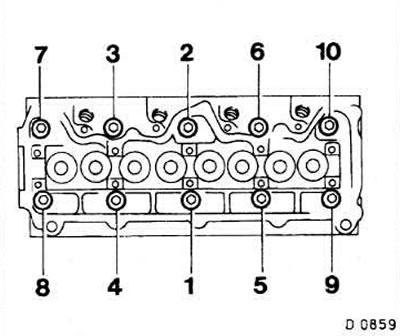
Tighten the cylinder head bolts in the order shown (see fig.) to a torque of 40 Nm.
Tighten the bolts in the same sequence to an angle of 60-75°.
Tighten the bolts in the same sequence to an angle of 60-75°.
Attention! Subsequent tightening of bolts (for example, after 1000 km of running) not needed.
Install the dipstick tube.
Install and secure the turbocharger.
Secure the oil supply and drain lines between the turbocharger and the cylinder block.
Clean the mating surface of the thermostat housing, install the thermostat assembly and tighten its mounting bolts to a torque of 30 Nm.
Install the three timing belt rear cover mounting bolts and tighten them to 8 Nm.
Install the camshaft toothed pulley and tighten its mounting bolt to a torque of 10 Nm.
Put on the timing belt and tighten it.
Install a new sealing gasket under the camshaft housing cover and secure the cover with bolts.
Install the radiator fan.
Install the timing belt cover.
Secure the fuel lines at the high-pressure fuel pump and injectors with a torque of 25 Nm.
Secure the fuel drain line to the injectors.
Install the intake manifold.
Check injection advance.
Start and warm up the engine to an oil temperature of 60°C.
Check the coolant level.
Check the idle speed and maximum speed, and adjust if necessary.
16-valve engines
Removal
Disconnect the ground wire from the battery.
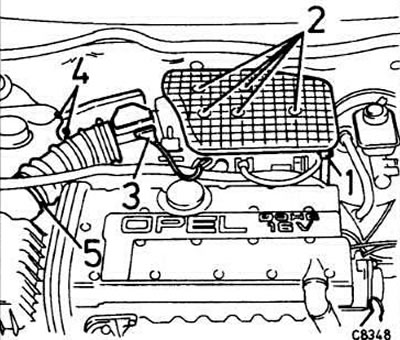
Disconnect hose 1 of the crankcase ventilation system.
Loosen bolts 2.
Disconnect connector 3 from the air volume sensor.
Loosen the 4 air volume sensor mounting bolts.
Loosen the hose clamps 5.
Remove the throttle chamber.
Remove the air filter mount.
Drain the coolant.
Disconnect the accelerator cable at the carburetor throttle valve.
Tag and disconnect all hoses and lines leading to the cylinder head and intake manifold.
Remove the exhaust manifold.
Remove the air filter.
Remove the alternator V-belt and, if present, the power steering pump V-belt.
Remove the front timing belt cover.
Set the piston of the 1st cylinder to the TDC position.
Remove the oil cooler pipe bracket. Place the gasket so that it does not block the holes in the block.
Loosen and remove the timing belt.
Remove the high voltage wire cover.
Remove the spark plug caps.
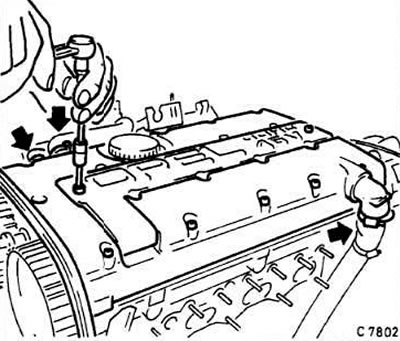
Loosen the hose clamps (see arrows in Fig.C7802).
Remove the cylinder head cover.
Remove the camshaft timing pulleys by holding the camshafts with a hex key.
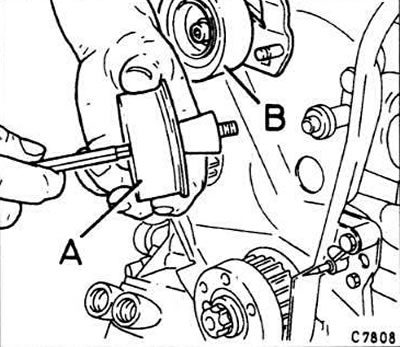
Remove guide roller A and tension roller B together with the base.
Attention! Pay attention to the position of the spacer sleeve (large diameter to the engine).
Remove the rear timing belt cover.
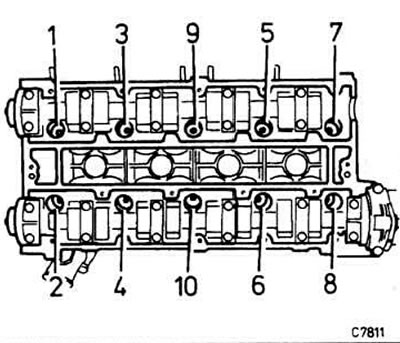
Loosen the cylinder head mounting bolts in the sequence shown in the figure, first by ¼ turn, then by ½ turn. Then completely unscrew the bolts and remove them together with the washers. To unscrew, you need a wrench for Torx bolts of 12 mm, for example, Hazet 880 Mlg E-12 with a 958-2 head.
Attention! This operation should only be carried out on a cold engine!
Remove the cylinder head.
Installation
Clean the mating surfaces from gasket residue. To prevent contamination from entering the cylinder block holes, cover them with a rag.
Check the straightness of the cylinder block surface.
Place the new gasket on the block surface without using sealant. The gasket should not cover the holes in the block.
Clean the mating surface of the cylinder head.
Install the cylinder head.
Install all washers under the head mounting bolts.
Insert new cylinder head mounting bolts and tighten them with a wrench until they fit snugly.
Attention! Tighten the bolts in four stages. Use only a tested and serviceable torque wrench for this. Instead, you can use an angle washer to control the tightening of the threaded connections.
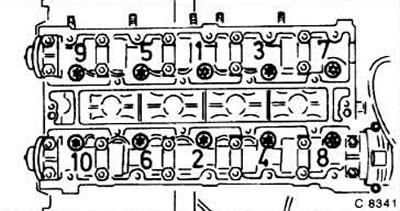
Tighten the cylinder head bolts in the order shown (see fig.) to a torque of 25 Nm.
Tighten the bolts in the same sequence to an angle of 65°.
Tighten the bolts in the same sequence to an angle of 65°.
Tighten the bolts in the same sequence to an angle of 65°.
Attention! When the engine is warm, it is necessary to tighten the bolts again.
Tighten the rear timing belt cover mounting bolts to a torque of 6 Nm, after having lubricated them with a sealant, for example, Opel 1510177.
Install the tension and guide rollers.
Attention! The spacer bushings must be facing the rollers with their smaller diameter.
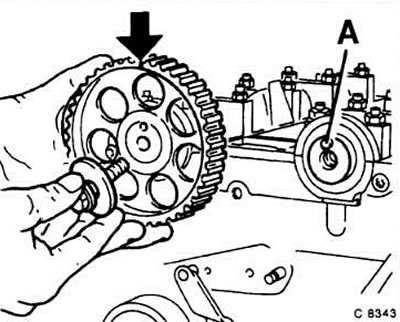
Install the camshaft toothed pulleys. In this case, the mark (see arrow in Fig.C8343) should be facing outward. Pin A of the camshaft should be facing upward and enter the hole of the toothed pulley.
While holding the camshaft from turning with a wrench, tighten the pulley mounting bolt in two stages (use a new bolt):
- first stage - 50 Nm;
- the second stage - at an angle of 60-75°.
Place a new gasket under the cylinder head cover and tighten the bolts to 8 Nm.
Connect both hoses to the cylinder head cover and secure them with clamps.
Place the spark plug caps on the spark plugs in accordance with the firing order of the cylinders. The firing order of the cylinders is given in the table "Main engine parameters" (see at the beginning of the book)Cylinder No.1 is on the right, looking in the direction of vehicle travel.
Secure the high voltage wire cover.
Install the exhaust manifold.
Install a new timing belt and tighten it.
Install the front timing belt cover.
Put on the V-belt and tighten it.
Install the front pipes of the air filter, mixing chamber, and air volume sensor.
Connect the connector to the air volume sensor.
Connect all pipes, hoses and cables leading to the cylinder head.
Fill with coolant.
Check the engine oil level, top up if necessary. If the cylinder head was removed due to a faulty gasket, it is recommended to replace the oil and filter, as the oil may contain coolant.
Connect the ground wire to the battery.
Start and warm up the engine.
Check the ignition timing.
Check idle speed and CO content in exhaust gases.
Check the coolant level.
Tighten the cylinder head mounting bolts on a warm engine in the above order to an angle of 30-45°. Subsequent tightening (for example, after 1000 km of running) not needed.
Visitor comments