


Contents: Cleaning ⬇ Inspection ⬇
1. A complete cleaning of the cylinder head components and valves followed by a detailed inspection will allow you to determine what procedures need to be performed during an engine overhaul.
Cleaning
2. Clean all traces of the old gasket from the cylinder head.
3. Clean the combustion chambers and bores of carbon deposits, then thoroughly wash the cylinder head with kerosene or a suitable solvent. Scrape off most of the carbon deposits from the valves, then use a wire brush to remove any remaining carbon deposits from the valve heads and stems.
4. If the head is extremely dirty, it must be steam cleaned. Finally, remove all plugs and clean all oil holes and oil passages. Then, using a suitable sealant, install new oil passage plugs into place in the cylinder head.
Inspection
Important! Perform all inspection procedures before concluding that it is necessary to contact an auto repair shop for regrinding. Make a list of all components that require regrinding.
Cylinder head
5. Carefully inspect the head for cracks and other damage, as well as coolant leaks. If cracks are found, replace the head.
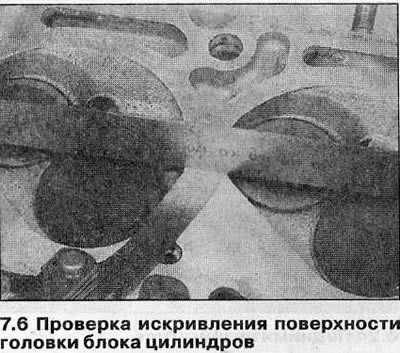
6. Use the edge of the ruler and feeler gauge to ensure that the cylinder head surface is not deformed (see illustration). The surface of the head can be re-ground, but on condition that the height of the cylinder head does not become less than that specified in Specifications values.
7. Inspect the valve seats in each combustion chamber. If they are heavily pitted, cracked or burnt, have them reground by a specialist. If the pitting is minor, it can be removed by grinding the head and valve seat with a special fine-grain paste as described below.
8. If the valve guides are worn (the valve moves along the horizontal axis), replace them. Measure the diameter of the existing valve stems (see below) and the inside diameter of the guides, then calculate the clearance and compare it to the specified value. If the clearance is not within the specifications, replace the valves and/or guides as necessary.
9. It is best to have an engine repair specialist replace the valve guides. When installing a new guide, first place it in the refrigerator for at least an hour, then insert it into the hole in the head on the camshaft side until the guide protrudes above the cylinder head surface to the height specified in the Specifications.
10. If it is necessary to regrind the valve seats, this should be done only after replacing the guide bushings.
Valves
Caution! On 3.0L engines, the exhaust valves are filled with sodium and must be handled with care. Remember that sodium reacts very violently with water.
11. Inspect each valve head for pitting, burns, cracks, or other signs of wear, and check the valve stem for scratches and worn areas. Rotate the valve carefully to check for signs of deformation. Inspect the end of each stem for pitting and signs of excessive wear. Damaged or worn valves should be replaced.
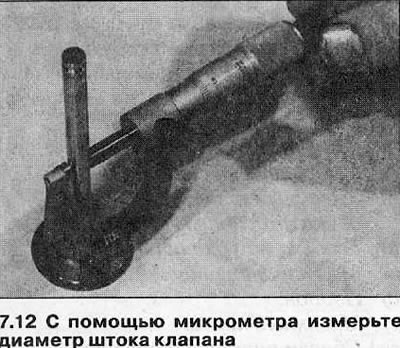
12. If the valve condition appears satisfactory, measure the stem diameter in several places using a micrometer (see illustration). Any significant difference in the obtained data indicates wear of the valve stem, which means the valve must be replaced.
13. If the valves are not damaged, they should be lapped to ensure a tight fit on the seats. If pitting is minor, use only fine-grained lapping paste.
14. The valve grinding is performed as follows: Place the cylinder head upside down on the workbench.
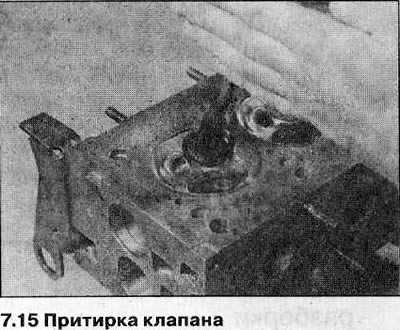
15. Apply the appropriate grade of lapping paste to the valve seat surface and attach a special suction cup to the valve head. Rotate the valve back and forth half a turn to grind the head against the seat, occasionally lifting the valve to redistribute the paste (see illustration). Installing a weak spring under the valve head will make the job much easier.
16. If coarse grinding paste is used, work until the contact surfaces of the seat and valve become dull, matte, then wipe off the compound and repeat the process with fine-grained paste. When the surfaces of the seat and valve acquire an even light gray color, lapping is considered complete. Do not lap the valves longer than necessary, this will lead to an unwanted deepening of the seat into the cylinder head.
17. Once all valves have been lapped, carefully wash off all traces of grinding paste using kerosene or a suitable solvent.
Valve components
18. Inspect the valve springs for signs of damage and discoloration, and measure their free length with a caliper or steel ruler, or compare with a new spring.
19. Place each spring on a flat surface and check them for deformation using a square. If any of the springs are damaged, distorted or weak, purchase a new complete set of springs. It is recommended that the springs be replaced after each removal during an engine overhaul, regardless of their condition.
Visitor comments