


Connecting rod, pin and piston
Select pistons taking into account the cylinder size category stamped on the block or based on the repair size obtained after boring the cylinders.
Check the tolerance of parallelism and skew of the axes of the connecting rod head holes, which should not exceed 0.025 mm over a length of 125.4 mm, and straighten the connecting rods if necessary.
Press the piston pin out of the connecting rod using a mandrel without heating. The piston and piston pin must be replaced.
Place the connecting rod in an electric oven or on a heating plate with a power of 1500-2000 W, heat it to a temperature of 280°C, controlling the heating temperature with a thermochromic pencil.
Install the piston pin on the mounting device and lubricate with oil. Remove the connecting rod from the oven and quickly clamp it in a vice. Put the piston on the upper head of the connecting rod, aligning the holes for the pin. Push the piston pin on the mounting device into the hole in the connecting rod until the shoulder of the mounting device stops against the piston skirt.
Note: To ensure proper connection of the pin to the connecting rod, press the pin in as quickly as possible, since the connecting rod cools quickly and after cooling it will not be possible to change the position of the pin without deforming the piston.
When connecting a new piston to a connecting rod, maintain the nominal installation dimensions specified in the subsection "Design and technical characteristics".
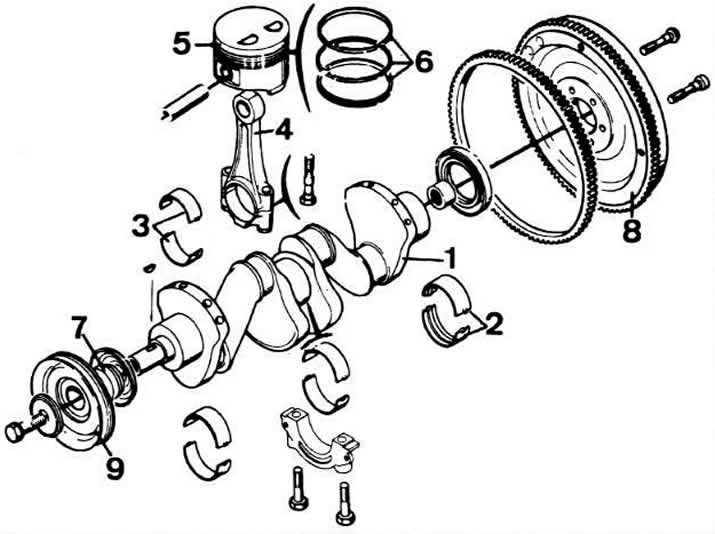
Crank mechanism parts:
1 — crankshaft;
2 — main bearing shells;
3 — connecting rod bearing shells;
4 — connecting rod;
5 — piston;
6 - piston rings;
7 — crankshaft sprocket;
8 — flywheel;
9 — crankshaft pulley.
(Material copied from the portal: www.opelbook.ru)
Visitor comments