


All engines
1. The connecting rod and piston assemblies must be thoroughly cleaned beforehand. The piston rings must be removed.
Piston rings must be replaced without fail.
2. Using a special device or several blade-type feeler gauges, remove the rings from the pistons - try not to accidentally damage the walls of the latter.
Removal piston rings using a blade-type feeler gauge (it is better to use two or three probes at the same time)
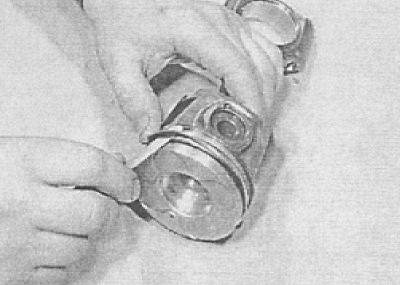
Remember that the rings are made of brittle metal and can break if you squeeze them too hard - don't get hurt!
3. Scrape off any traces of carbon deposits from the piston crowns. After the bulk of the deposits have been removed, hand-clean the surface with a wire brush or a piece of fine-grit sandpaper.
Never use wire drill bits to clean pistons made of soft material and easily eroded! After cleaning, the markings on the piston bottoms must be clearly visible.
4. Using a special tool, clean the ring grooves on the pistons. Alternatively, you can use a piece of an old piston ring for this purpose, but be careful not to scratch the bottom and walls of the groove or cut your fingers.
Cleaning the grooves for installing piston rings using a special tool
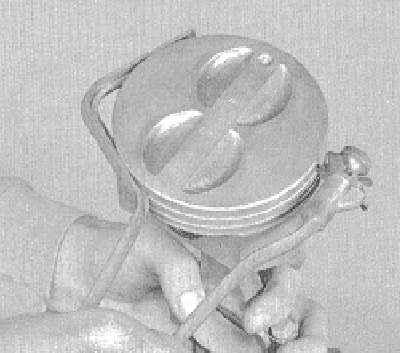
5. After removing the main deposits, wash the connecting rod assemblies with solvent and dry them thoroughly, using compressed air if possible. Check the patency of the oil return holes in the rear walls of the piston ring grooves, as well as the oil holes in the lower connecting rod heads.
When using compressed air, remember to wear safety glasses!
6. If the piston walls and cylinder faces are not damaged or excessively worn, and the engine block has not been machined or replaced, there is no need to replace the pistons. Normal piston wear is shown as vertical wear marks on the thrust surface and a slight slack in the fit of the upper compression ring in its groove. Do not forget that piston rings must be replaced, regardless of their condition.
7. Carefully inspect each piston for cracks in the skirt, around the piston pin mounts and in the ring area.
8. Check the piston skirt thrust surfaces for scratches, the bottom for through holes and burnouts along the edge. The presence of scratches on the skirt can be regarded as a sign of prolonged engine overheating or too early ignition of the air-fuel mixture - check the proper functioning of the cooling system. Burnouts along the edges of the bottom are evidence of detonation. In any case, the cause of the detected violation must be eliminated to avoid relapse. Possible causes of the formation of the listed defects can also be intake air leaks, incorrect air-fuel mixture arrangement, incorrect ignition timing, incorrect functioning of the ignition and EGR systems.
9. Piston pitting in the form of cavities indicates coolant entering the combustion chambers and/or crankcase. Again, make sure that the cause of internal leaks is eliminated.
10. Estimate the size of the lateral clearance of the piston rings in their grooves, for which insert a new ring from the outside into its groove on the piston and measure the remaining clearance with a blade-type feeler gauge. Repeat the measurement at two or three points along the perimeter of the groove. Be careful not to mix up the compression rings - the upper one is different from the second. If the clearance value exceeds the permissible value (see Specifications in Chapter Engines), the pistons must be replaced.
Checking the clearance of the piston ring in the groove
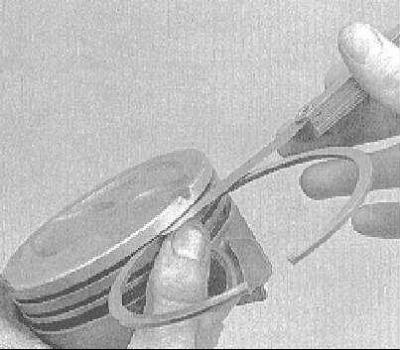
11. Determine the size of the piston landing clearance in your cylinders by measuring the diameters of the latter (see section Cleaning and checking the condition of the cylinder block) and subtract from them the diameters of the corresponding pistons. The piston diameter is measured along the thrust surface of the skirt at an angle of 90 degrees to the axis of the piston pin and at a specified distance from the bottom. If the piston seat clearance in the cylinder exceeds the permissible value (see Specifications in Chapter Engines), the block should be given for resurfacing with the selection of new pistons and piston rings of repair diameter.
The piston diameter is measured in a plane perpendicular to the axis of the piston pin…
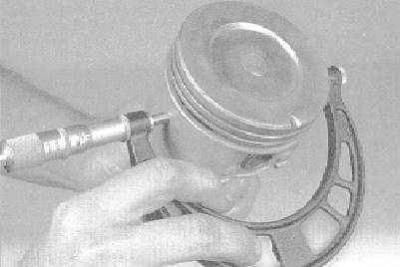
12. Assess the correctness of the piston seating on the connecting rods by attempting to rotate the components in opposite directions. The presence of any noticeable play indicates excessive wear of the joint. To correct the situation, the connecting rod and piston assemblies should be delivered to a car service workshop, where the necessary restoration repairs and replacement of the pins will be carried out.
Petrol engines
On all petrol engines the piston pins are fitted into the upper heads of the connecting rods with tension and have a floating fit in the piston bosses, due to which the procedure for removing the pistons from the connecting rods (if such a need arises) should also be entrusted to car service specialists. In parallel, the connecting rods can be checked for signs of bending, twisting and other deformations using special diagnostic equipment.
Do not remove pistons from connecting rods unless necessary.
Diesel engines
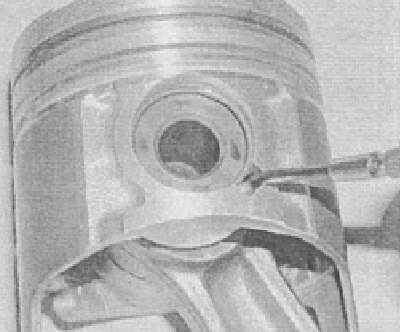
1. On diesel engines, the pins also have a floating fit in the connecting rods and are secured to the pistons using retaining rings. If necessary, remove the retaining rings using a suitable screwdriver and manually press the pin out of the assembly. Mark the removed pin with tape to indicate its connection to the connecting rod and piston assembly and put it in a safe place. Retaining rings must be replaced during assembly.
(Article posted on Internet portal www.OPELBOOK.ru)
Removal the piston pin retaining ring
2. Inspect the upper head of the connecting rod and the piston pin for signs of wear, scoring, and other mechanical damage. Measure the diameter of the pin with a micrometer and compare the measurement result with the requirements of the Specifications in Chapter Engines, replace if necessary. If the pin or connecting rod is worn, both parts must be replaced.
3. The connecting rods themselves (in the absence of mechanical damage) do not need replacement - visually assess them for signs of obvious deformations; if you suspect bending/twisting, seek help from car service specialists, or replace the defective components.
4. After assessing the condition of all components, prepare replacement parts. Replacement pistons are supplied to the aftermarket complete with pins and retaining rings.
Retaining rings can be purchased separately.
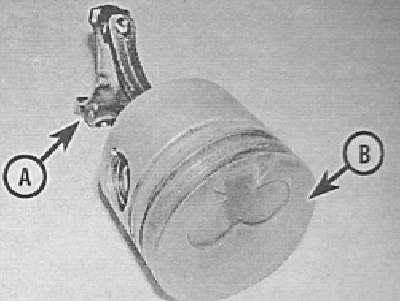
5. Assemble the pistons with the connecting rods so that the protrusion on the connecting rod on the bearing side is on the flywheel side, the arrow on the piston bottom should point in the direction of the engine timing belt
The connecting rod is installed on the engine with the protrusion (A) towards the flywheel/drive disk, and the arrow stamped on the piston bottom should point in the opposite direction (towards the timing drive)
6. Lightly lubricate the piston pins with clean engine oil and secure the pistons to the upper connecting rod heads. Make sure the piston can rotate freely relative to the connecting rod on the pin axis. Install new retaining rings (locks up) and make sure that they are securely seated in the receiving grooves.
All engines
1. Check the connecting rods for cracks and other mechanical damage. Temporarily remove the lower head caps, remove the old bearing shells, wipe the beds in the caps and heads and check them for burrs, scoring and roughness. After completing the check, put the liners back in place, install the caps on the lower heads of the connecting rods, and tighten the mounting bolts by hand.
If the engine is being overhauled to eliminate pin knock, replace the connecting rod assemblies.
Visitor comments