


Contents: Cleaning ⬇ Examination ⬇
Cleaning
1. Remove all externally mounted components and sensors from the unit.
2. Using a blunt punch, press the edge of the release plug and turn it in its seat at 90 degrees. Once all the plugs have been turned, they can be easily removed from the engine using pliers.
3. Scrape off all traces of the old gasket material from the mating surface of the block - try not to leave scratches or burrs.
4. Unscrew all threaded plugs of oil galleries. The plugs may be tightened very tightly, to the point that they will have to be drilled out and then restored to the threads in the block. During assembly, the plugs are subject to replacement.
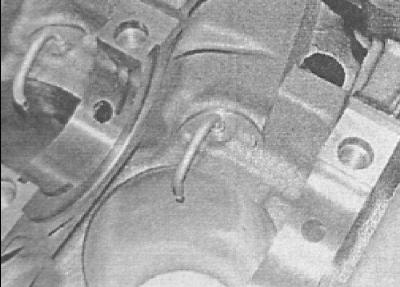
5. On diesel engines, remove the piston oil supply nozzles. The nozzles are pressed into the block and can only be removed using a special tool
The nozzles are pressed into the mounting sockets in the block body
6. Remove the caps of all main bearings from the block and extract the liners from their beds. Immediately mark the extracted liners with tape to indicate which bearing and bed they belong to (block or cover), then set them aside.
7. If the engine is heavily externally contaminated, it should be taken to a car service workshop for steam or heat treatment.
8. After returning the unit from the workshop, thoroughly clean all oil holes and galleries again - special cylindrical brushes of a special shape are produced for this purpose (ask in car accessories stores). Rinse the cavities and channels with warm water - continue rinsing until clean water starts to flow out from the opposite side of the block. Dry the block thoroughly, then lightly lubricate all machined surfaces with liquid oil to protect them from corrosion. If you have access to a source of compressed air, use it to speed up the drying process of the block and blow out hard-to-reach cavities and channels.
When working with compressed air, do not forget to wear safety glasses!
9. If the block is heavily soiled or slagged, use a brush cleaning with hot water and soap. Do not try to save time by neglecting the thoroughness of cleaning the block. Regardless of the method chosen, ensure that hard-to-reach cavities, channels and holes are thoroughly cleaned. Finally, dry the block and lubricate the machined surfaces with liquid oil to protect them from corrosion.
10. Tap all the threaded holes in the block with a tap of the appropriate size to ensure that the torque wrench indicator readings correspond to the actual tightening forces developed when assembling the engine. If possible, then blow out the tapped holes with compressed air, removing all small debris and chips from them. After finishing processing the holes, go over the threaded part of the bearing cap and cylinder head mounting bolts with a bench press.
11. Install the main bearing caps, hand tightening their fasteners.
12. Lubricate the sealing surfaces of the new release plugs with a sealant such as Permatex No.1 and install them in their regular places in the block. Make sure that the plugs are seated perpendicularly - it would be best to use a special cylindrical mandrel, but it can be easily replaced by a socket head of the appropriate size, which should rest only on the inner part of the end surface of the plug (not in the flange!).
13. Lubricate the threaded portion of the new oil gallery plugs with a non-hardening sealant such as Permatex No.2 (alternatively wrap them with FUM tape). Screw the plugs into their regular places and tighten as tightly as possible.
14. On diesel engines, press the piston oil supply nozzles into place.
15. If you are not going to start assembling the engine immediately, place the block in a large plastic bag to protect it from contamination.
Examination
1. The block must first be thoroughly cleaned (see section Removal the crankshaft). Perform an external inspection of the block to detect traces of corrosion, cracks and other damage. Check the condition of the threaded holes. It would also be reasonable to test the block for hidden cracks in a car service workshop using special diagnostic equipment. If defects are detected, the block is subject to restoration repair or replacement.
2. Check the condition of the cylinder mirrors.
3. Estimate the values of the existing conicity and ovality of the cylinders:
- Measure the diameter of each of the cylinders at the top (just below the step wear boundary), central and lower sections in a plane parallel to the crankshaft axis
- Now measure the diameters at the same three levels, but in a plane perpendicular to the block axis;
- The conicity of a cylinder is determined by the difference between the measurement results in the upper and lower sections. Ovality (in this section of the cylinder) is the difference in diameters measured in planes parallel and perpendicular to the crankshaft axis.
The cylinder diameter is measured in three sections
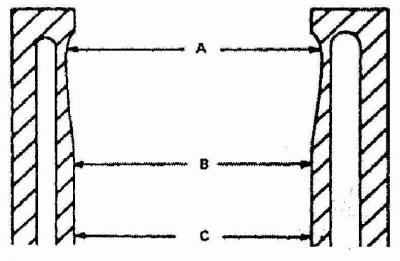
A - Below the boundary of step wear
B - In the middle part
C - At the bottom
4. Compare the test results with the requirements of the Specifications in Chapter Engines. Proceeding in the manner described, check all cylinders in turn.
Remember that there are several standard cylinder diameter groups that allow for different manufacturing tolerances. The size group marking is usually located on the top edge of the cylinder block.
5. If noticeable defects are detected or the measurement results deviate from the standard requirements, the cylinder block is subject to mechanical restoration in the conditions of the car service workshop. If the cylinders were bored during the restoration repair, the engine must be equipped with new pistons of the repair grade (in excess) size.
6. If the condition of the cylinder mirrors during the inspection is found to be satisfactory while simultaneously complying with the regulatory requirements for the shape of the cylinders and clearances for the pistons to fit in them (see section Checking the condition of the connecting rod and piston group components), there is no need to bore the cylinders - it will be enough to simply hone their mirrors (see section Honing of cylinder mirrors).
7. Check the flatness of the block head mating surface - the check is carried out in a manner similar to that described for the cylinder head mating surfaces (see section Cleaning and checking the condition of the cylinder head). Compare the measurement result with the requirements of the Specifications in Chapter Engines, if necessary, give the block a regrind.
Visitor comments