


Contents: Removal ⬇ Installation ⬇
Removal
When working in the engine compartment, it is necessary to keep in mind that the radiator fan can turn on by itself when the engine is off and the ignition is on (position "II" of the ignition key). Due to the heat removal processes taking place in the engine compartment, this can happen repeatedly. Therefore, if possible, the ignition should be turned off when working in the engine compartment.
It should not be forgotten that fuel is a highly flammable liquid! When working with components of the fuel system, observe all accepted fire safety measures. Do not smoke, do not approach the work site with an open flame or unprotected portable equipment. Do not service the system in a room equipped with heating devices operating on natural gas and equipped with a pilot torch (such as water heaters and clothes dryers). Do not forget that fuel is a carcinogen that promotes the development of cancer. Try to avoid fuel coming into contact with exposed areas of the body - use protective rubber gloves, in case of accidental unexpected contact, wash your hands thoroughly with warm water and soap. Collect spilled fuel immediately and do not store fuel-soaked rags near open flames. Remember that the fuel system of models equipped with fuel injection is constantly under pressure. Before disconnecting the fuel lines, release the residual pressure in the system (for more details, see Chapter Fuel, exhaust and emission control systems). Wear safety glasses when servicing fuel system components. Always keep a class B fire extinguisher on hand!
The air conditioning system line is also constantly under pressure, so before disconnecting the refrigeration lines, the system must be discharged in a specialized workshop.
All modern cars come standard with the SRS system, the main components of which are airbags. Before performing any work near the location of the SRS directional overload sensors, in the area of the steering column or instrument panel, be sure to turn off the system to avoid accidental deployment of the airbags, which can lead to serious injuries.
The authors of this Manual recommend removing the engine together with the transmission. The assembly of the unit is lowered down and removed from under the vehicle, so care should be taken to ensure that the vehicle is securely fixed in the raised position.
Depending on the year of manufacture and equipment, vacuum hoses and cooling system hoses may have different routing routes. It is recommended to mark the connections with adhesive tape before disassembling them. The following describes the removal of the C14SE engine. Operations with other engines are performed similarly.
1. Drive the car onto a flat, horizontal surface with a sufficiently hard surface. Remove the hood (see Chapter Body). Place the front wheels in a straight-ahead position, remove the key from the ignition switch and lock the steering column.
2. Remove the battery (p. Chapter Engine electrical systems).
Disconnecting the battery erases memory information, such as DTC or audio code. Disconnect the battery only when the ignition is off. Otherwise, the injection control unit may be damaged.
3. Remove the air filter with the supply hose (see Chapter Fuel, exhaust and emission control systems).
4. Drain the coolant into a clean container.
5. Disconnect all cooling system hoses from the radiator. First loosen the clamps and move them back.
6. Disconnect the fan motor connector and disconnect the wiring harness from the air intake hose.
7. Unscrew the air intake sleeve mounting bolts and, pulling it upwards from the holder, remove it from the radiator.
8. Remove the throttle cable from the throttle body and set it aside (see Chapter Fuel, exhaust and emission control systems).
9. Remove all vacuum hoses from the throttle body.
10. Remove the vacuum hose from the brake booster.
Disconnecting the vacuum hose from the brake booster
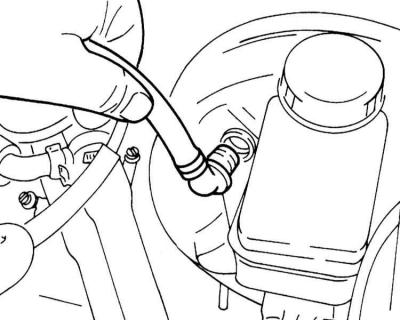
11. Disconnect the injector connectors and move the wiring harness to the side.
12. Disconnect the coolant hoses from the expansion tank and remove it.
13. Disconnect the heater hoses from the pipes on the engine compartment bulkhead.
Fastening heater hoses
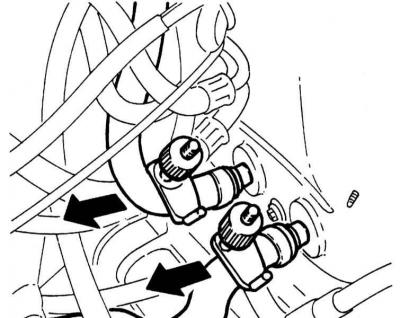
14. Remove the bracket from the clutch cable and disconnect the cable from the clutch lever.
Clutch cable mount and reversing light switch connector
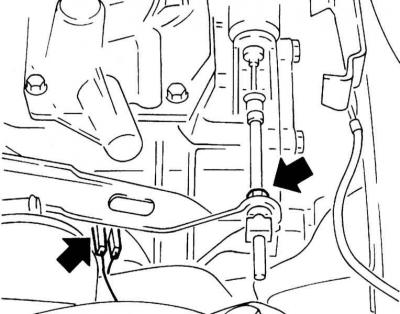
15. Disconnect the reversing light switch connector (arrow on the left in the illustration).
16. Mark the fuel supply and return hoses to avoid confusion during assembly. Clamp the hoses. Disconnect the fuel hose holder at the inlet manifold and remove the hoses. Collect any leaking fuel with a rag.
Fuel Hose Holder Fastening
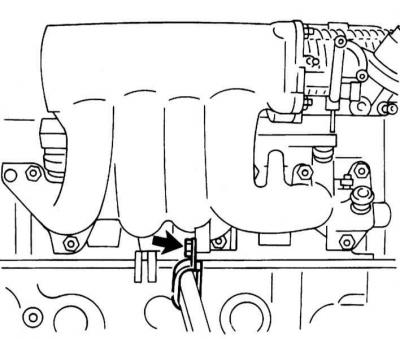
17. Disconnect the speedometer from the gearbox.
18. Tape off all electrical wiring going to the engine and disconnect it.
19. If the vehicle is equipped with a power steering system, loosen the tension of the V-belt and remove it (see Chapter Vehicle settings and routine maintenance).
20. If the equipment is equipped accordingly, unscrew the mounting bolts and remove the power steering pump from the holder on the cylinder block and, without disconnecting the hoses from the pump, tie it with wire so that it does not interfere with further disassembly and so that the hoses are not stretched.
Power steering pump fastener
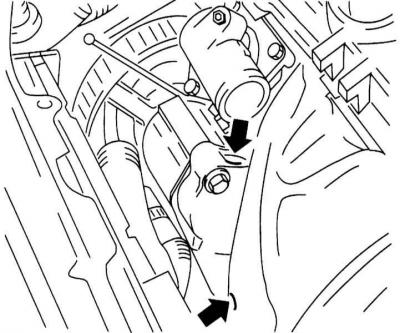
21. Mark the position of the relevant front wheel relative to its hub so that you can later install the balanced wheel in its original position. Loosen the wheel mounting bolts with the car on the ground. Jack up the front of the car, place it on stands and remove the front wheel.
22. Remove the gear shift lever from the rod on the gearbox. To do this, loosen the clamp on the lever. Mark both parts in advance so that they can be installed in their original position during assembly.
Clamp on the gear shift lever
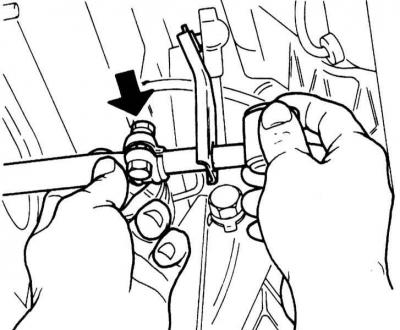
23. Disconnect the electrical wiring from the generator and starter (see Chapter Engine electrical systems).
24. Disconnect the intake pipe from the exhaust manifold, remove it from the holders and tilt it to the side.
25. Remove the ball joints from the steering knuckles on the right and left. First, unscrew the clamp bolts.
26. Disconnect the front wishbones from the body.
27. Loosen the mounting bolts and remove the front suspension rod holder from the front subframe cross member together with the rod and anti-roll bar.
Front Suspension Rod Holder Mounting Bolts
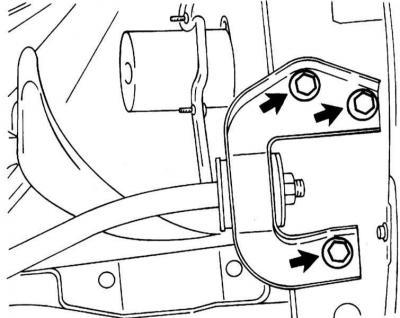
28. Knock both drive shafts out of the gearbox housing.
29. Place a hoist under the engine and lift the power unit slightly. You can also use a lifting device by hooking it onto the engine lifting eyes. Raise the engine so that both of its upper mounts are unloaded.
30. Loosen the mounting bolts and remove the engine shock absorber blocks from the front frame longitudinal beam and from the engine. In the accompanying illustration shown is the front left shock absorber unit on vehicles without power steering or crankshaft control systems.
Front left shock absorber block mounting bolts
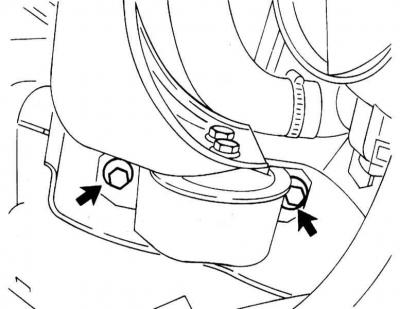
31. Check that all hoses, wiring and other lines are disconnected from the engine.
32. Carefully lower the engine and gearbox out of the engine compartment.
33. Disconnect the gearbox from the engine (see Chapter Manual 5-speed gearbox or Automatic 4-speed transmission).
Installation
1. Check the engine mounts, coolant hoses, oil and fuel hoses for cracks or other damage and replace the relevant parts if necessary. Carefully tap the threads in the holes of the front frame beam to remove any remaining sealant.
2. Check the thickness of the clutch driven disc, as well as the condition of the friction linings. If there is significant wear or high mileage, replace the driven disc as a set. If the clutch release bearing makes noise when you press the clutch pedal, replace the bearing.
3. Clean the clutch release bearing and lubricate the splines with a thin layer of MoS2 grease.
4. Connect the gearbox to the engine (see Chapter Manual 5-speed gearbox or Automatic 4-speed transmission).
5. Using lifting equipment, carefully insert the engine with the gearbox into the engine compartment. Align the engine with the supports and tighten the mounting bolts.
[Material was taken from a resource: www.opelbook.ru]
6. Rock the engine from side to side.
7. After cleaning the threads of the engine shock absorber mounting bolts with a brush and lubricating them with OPEL-90 167 347/15 10 sealant, tighten them with the required force.
8. Insert both drive shafts into the gearbox housing until they stop.
9. Install the wishbones, rods and stabilizer in place (see Chapter Suspension and steering).
10. Connect the generator and starter wiring (see Chapter Engine electrical systems).
11. Install the exhaust system into the rubber mounts and tighten the bolts with force 25 Nm to the exhaust manifold.
Use a new gasket.
12. Place the gear shift lever on the rod and align the marks made during removal.
13. Check the adjustment of the gear shift mechanism (see Chapter Manual 5-speed gearbox or Automatic 4-speed transmission).
14. Reinstall the front wheels and align the marks made during removal. Screw on the wheel mounting bolts. Lower the car to the ground and tighten the bolts crosswise with force 110 Nm.
15. Secure the speedometer shaft to the gearbox.
16. Connect the clutch cable, install the clamps.
17. Connect the reversing light wiring.
18. Place the heater hoses on the fittings on the engine compartment bulkhead and secure the hoses with clamps.
19. Connect the fuel hoses in accordance with the previously applied markings and secure them with clamps. The fuel supply hose should be put on the corresponding pipe far enough. Make sure that the clamps do not touch adjacent elements. Secure the fuel hoses to the holders at the exhaust manifold.
20. Attach the vacuum hose to the brake booster and check that the connection is secure.
21. Secure the coolant reservoir to the engine compartment bulkhead. Connect the cooling system hoses and secure them with clamps.
22. Connect the engine wiring harness connectors.
23. Connect the engine oil temperature and pressure sensors.
24. Connect the injector connectors and secure the wiring harness.
25. Attach the throttle actuator to the throttle body and check its adjustment (see Chapter Fuel, exhaust and emission control systems).
26. Secure the air intake funnel to the holders on the radiator.
27. Connect the fan motor and thermostat connector. Secure the wiring harness.
28. Connect the lambda probe connector.
Electrical wiring should be routed as far away from the fan as possible.
29. Attach the upper and lower hoses to the radiator and secure them with clamps.
30. Install the air supply hose and air filter. At the same time, clean the air filter and its housing, replace the filter if necessary (see Chapter Fuel, exhaust and emission control systems).
31. If equipped, secure the power steering pump to the holder. Put on the V-belt (see Chapter Vehicle settings and routine maintenance).
32. Connect the negative battery cable.
Connect the battery only when the ignition is switched off. Otherwise, the injection system control unit may be damaged.
33. Check the quality of the coolant and fill it into the cooling system (see Chapter Vehicle settings and routine maintenance).
34. Allow the engine to cool and check the coolant level. Check all hose connections for leaks.
35. Check and, if necessary, adjust the oil level in the gearbox.
Visitor comments