


Contents: Pistons ⬇ Dimensional groups of cylinders and…⬇ Piston pins ⬇ Piston rings ⬇ Connecting rods ⬇ Connecting rod bearing shells ⬇ Crankshaft dimensions ⬇ Dimensions of camshaft journals and…⬇ Connecting rod markings depending on…⬇ Crankshaft ⬇ Main bearing shells ⬇ Marking of main bearing shells ⬇ Flywheel ⬇
Pistons
Pistons with a steel thermostatic ring, with continuous skirts, are made of aluminum alloy with a lead coating.
Piston weight, g: 364.
The gap between the piston and the cylinder, measured at the bottom of the skirt, no more than, mm: 0.01.
Groove depth, mm:
- for compression rings: 3.63-3.75;
- for oil scraper ring: 4.23-4.35.
The dimensions of the piston and cylinder groups must be selected in strict accordance with the table below.
Dimensional groups of cylinders and pistons
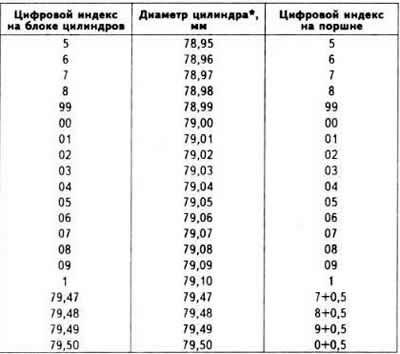
*Piston diameter should be 0.01 mm smaller
Offset of the axis of the hole for the piston pin relative to the diametrical plane of the piston, mm: 0.8.
Piston pins
The piston pins are made of heat-treated steel. The pin is pressed with tension into the upper head of the connecting rod, which is preheated to a temperature of 280°C, and rotates freely in the piston bosses.
Piston pin outer diameter, mm: 20.
Piston pin length, mm: 65.
Clearance between piston pin and piston, mm: 0.0015-0.0195.
Piston rings
Each piston has three rings: two compression rings and one oil scraper ring.
Gap in the lock, mm:
- upper and lower compression rings: 0.30-0.45;
- oil scraper ring: 0.40-1.40.
Connecting rods
Connecting rod steel, forged, with I-section rod. In terms of weight, connecting rods without pistons and connecting rod bearing liners of one engine should not differ from each other by more than 8 g.
Distance between connecting rod head axes, mm: 122.
Axial clearance of connecting rods on crankshaft journals, no more than, mm: 0.11-0.24.
Connecting rod bearing shells
The connecting rod bearing liners are trimetallic. The bearing pad is made of steel tape.
Width of connecting rod bearing shells, mm: 19.0.
Clearance between bearing shells and connecting rod journals, mm: 0.02-0.06.
The spare parts include liners of two repair sizes: with a thickness increased by 0.25 mm (mark "A") and by 0.50 mm (mark "B").
Crankshaft dimensions

Dimensions of camshaft journals and diameters of bearing bushing holes

Connecting rod markings depending on weight

Crankshaft
The crankshaft is steel, forged, with three supports. The shaft journals are hardened in an induction furnace.
Ovality of main and connecting rod journal surfaces, no more than, mm: 0.006.
Taper of main and connecting rod journal surfaces, no more than, mm: 0.01.
Permissible runout of the middle main journal when supported by the outer main journals, no more than, mm: 0.03.
Permissible deviation from parallelism between connecting rod and main journals, no more than, mm: 0.012.
Permissible runout of the crankshaft flange, no more than, mm: 0.015.
Axial clearance of the crankshaft, measured at the middle support, mm: 0.09-0.20.
Clearance between liners and main journals of the crankshaft, no more than, mm:
- 1st root neck: 0.020-0.046,
- 2nd root neck: 0.010-0.036;
- 3rd molar neck: 0-0.0315.
Width of supports, mm.
- 1st support: 25.00;
- 2nd support: 29.00;
- 3rd support: 22.00.
Main bearing shells
The main bearing shells are trimetallic. The bearing pad is made of steel tape.
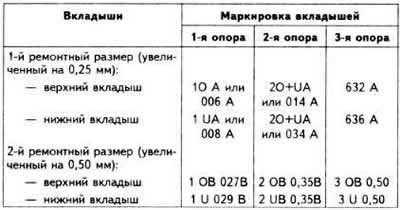
Upper liners of nominal and repair (increased by 0.25 and 0.50 mm) the sizes have green marks, and the lower ones are brown. Repair liners are made of increased thickness for crankshaft journals reduced by 0.25 and 0.50 mm. These liners, in addition to the color mark, have a corresponding alphanumeric code.
Marking of main bearing shells
Flywheel
The flywheel is cast iron and is attached to the rear end of the crankshaft with six bolts.
Flywheel diameter, mm: 248.
Maximum permissible flywheel runout, measured on the toothed rim, mm: 0.5.
Maximum thickness of the metal layer removed when grinding the flywheel surface under the driven clutch disc, mm: 0.3.
The size between the supporting surface of the clutch housing and the mating plane of the driven disk, mm: 5.1±0.1.
The number of teeth on the toothed rim is 122.
Visitor comments