


Contents: Removal the crankshaft ⬇ Checking the crankshaft parts ⬇ Installing the crankshaft ⬇ Crankshaft seals ⬇ Removal oil seals ⬇ Installation of seals ⬇ Replacing the front oil seal ⬇ Replacing the rear oil seal ⬇ Flywheel ⬇ Flywheel ring gear ⬇ Automatic transmission drive disc ⬇ Replacing the guide bearing ⬇
Removal the crankshaft
To remove the crankshaft, you need to remove the engine.
The following description assumes that the necessary parts have already been removed as described above.
The description of the work is given separately for different types of engines.
2.0L OHC Engine
1. Drain the engine oil into a container by unscrewing the drain plug.
2. Remove the oil pan and oil pump as described in the appropriate section.
3. Using a screwdriver to hold the flywheel ring gear from turning, unscrew the bolts that secure it. In most cases, the bolts are loosened with a spanner without holding the flywheel. To do this, the open-end wrench is set at a right angle to the line passing through the axes of the flywheel and the bolt being unscrewed, and it is struck with a hand. To hold the clutch, use a steel plate with two drilled holes. The plate is secured to the clutch with flywheel bolts. Support the engine and remove the bolts. Throw away the bolts immediately, as they cannot be reused. Tighten the bolts to the required angle.
4. Remove the drive disk in the same manner (automatic transmission).
5. Loosen the bolts and remove the oil pan.
6. Remove the timing belt and cylinder head (see separate description).
7. If it is necessary to remove only the crankshaft, the pistons with the connecting rod may remain in the cylinders. Otherwise they must be removed as described earlier in the section Cylinder head and valves. If the pistons and connecting rods remain in the cylinders, mark the connecting rod caps and remove them, storing them together with the liners. In this case, the connecting rod bolts must be replaced.
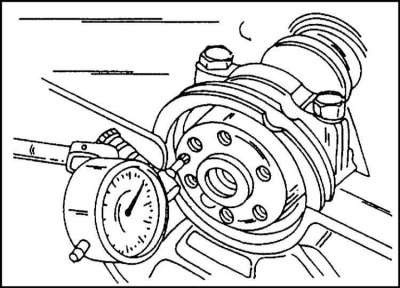
8. Position the indicator at the front of the cylinder block so that its measuring tip rests against the outer journal of the crankshaft, as shown in the illustration. Press the crankshaft to one side with a screwdriver and set the indicator to zero. Press the crankshaft to the other side. The indicator reading represents the axial play of the crankshaft. Write down the obtained value. If the play is outside the established limits, this must be taken into account during assembly.
If there is no indicator, the play can be measured with a feeler gauge on the central bearing between the bearing flange and the plane of the crankshaft.
9. Mark the main bearing caps and evenly unscrew their mounting bolts from the outside towards the inside. Remove the lids. Make sure the cap numbers are clearly visible.
10. Remove the bearings from the crankshaft journals and store them complete with the appropriate cover.
11. Remove the thrust half rings from one of the bearings to adjust the axial clearance.
12. Carefully remove the crankshaft from the cylinder block. Be careful not to damage the speed sensor gear, if equipped.
13. Remove the remaining liners from the bottom of the cylinder block and assemble them into a set with the other halves and covers. Mark the inserts.
2.4L OHC Engine
1. Install and secure the engine on the stand.
2. Drain the engine oil into a container by unscrewing the drain plug.
3. Remove the cylinder head as described for the engine in question.
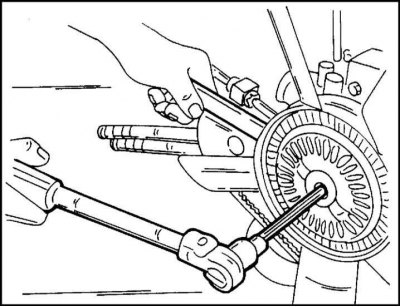
4. Loosen the viscous coupling fan mounting bolt as shown in the illustration. On the reverse side, the fan is held by a hex key. The details of this operation are described in the relevant section.
Please note: The fan mounting bolt has a left-hand thread.
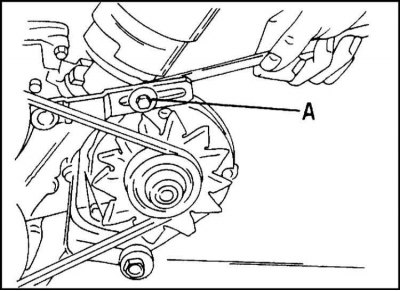
5. Loosen the generator tensioner mounting bolt (A) in the illustration, push the generator inward and remove the V-belt.
6. Unscrew the bolt securing the ground cable from the cylinder head, press the generator down and remove it together with the bracket, disconnecting the latter.
7. Loosen the terminal bolt at the base of the distributor and remove the distributor.
8. Use a spanner to loosen the crankshaft pulley mounting bolt, holding the flywheel with a screwdriver to prevent it from turning. There is also a special lock to hold the flywheel.
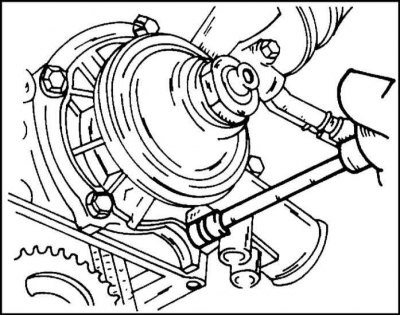
9. Loosen the mounting bolts and remove the coolant pump (illustration).
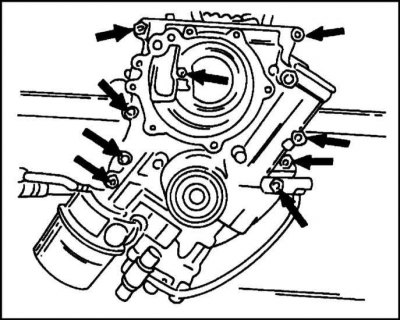
10. Remove the camshaft drive chain tensioner, timing case and oil pan in the sequence shown. If the engine is in the position shown in the illustration, remove the bolts shown by the arrows.
11. Remove the helical gear from the distributor shaft.
12. Paint an arrow on the drive chain to indicate the direction of rotation and remove the sprocket together with the chain.
13. Remove the crankshaft sprocket using a puller. Be sure to place a gasket between the puller stop screw and the end of the crankshaft.
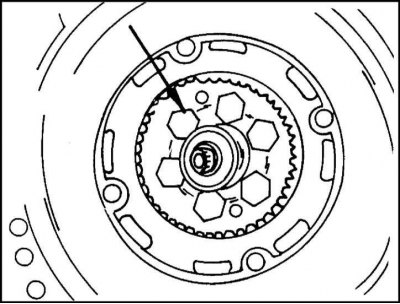
14. Mark the relative positions of the clutch basket and flywheel, unscrew the bolts and remove the basket. A description of the clutch disassembly is given in the relevant section. A locking bolt is screwed into the flywheel (illustration). Its position should be noted before disassembling the unit.
15. Mark all connecting rod bearing caps starting with the number "1" on the coolant pump side.
Loosen the bolts and remove the oil pump intake pipe.
16. If it is necessary to remove only the crankshaft, the pistons with connecting rods may remain in the cylinders. Otherwise, both pistons and connecting rods are removed as described in the section Cylinder head and valves. If the pistons and connecting rods remain in the cylinder block, mark the connecting rod caps in order and remove them together with the bearings.
17. Measure the crankshaft axial clearance.
Position the indicator at the front of the cylinder block so that its measuring tip rests against the outer journal of the crankshaft, as shown in the illustration. 8. Press the crankshaft to one side with a screwdriver and set the indicator to zero. Press the crankshaft to the other side. The indicator reading represents the axial play of the crankshaft. Write down the obtained value. If the play is outside the established limits, this must be taken into account during assembly.
If there is no indicator, the play can be measured with a feeler gauge on the central bearing between the bearing flange and the plane of the crankshaft.
18. Mark the main bearing caps and evenly unscrew their mounting bolts from the outside towards the inside. Remove the lids. Make sure the cap numbers are clearly visible.
19. Remove the bearings from the crankshaft journals and store them complete with the appropriate cover.
Remove the thrust half rings from one of the bearings to adjust the axial clearance.
20. Carefully remove the crankshaft from the cylinder block. Be careful not to damage the speed sensor gear, if equipped.
21. Remove the remaining liners from the bottom of the cylinder block and assemble them into a set with the other halves and covers. Mark the inserts.
DOHC Engine
1. Secure the engine to the stand, unscrew the bolts and disconnect the engine mount beam from the cylinder block.
2. If the engine oil has not yet been drained, remove the drain plug and drain the oil into a container.
3. Remove the oil pan and oil pump as described in the appropriate section. It is necessary to take into account the year of manufacture of the car, since after 1997 the design of the oil pump was changed.
4. For engines produced since 1997, remove the bearing bridge and oil baffle plate. The description of this work is given separately.
5. Using a screwdriver to hold the flywheel ring gear from turning, unscrew the bolts that secure it. In most cases, the bolts are loosened with a spanner without holding the flywheel. To do this, the open-end wrench is set at a right angle to the line passing through the axes of the flywheel and the bolt being unscrewed and is struck with a hand. A steel plate with two drilled holes is used to hold the clutch. The plate is secured to the clutch with flywheel bolts. Support the engine and remove the bolts. Throw away the bolts immediately, as they cannot be used. Tighten the bolts with angular control.
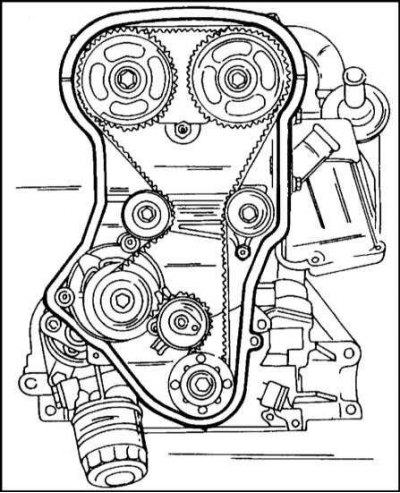
6. Remove the timing belt and cylinder head (see separate description).
7. If it is necessary to remove only the crankshaft, the pistons with the connecting rod may remain in the cylinders. Otherwise they must be removed as described in section Cylinder head and valves. If the pistons and connecting rods remain in the cylinders, mark the connecting rod caps and remove them, storing them together with the liners. In this case, the connecting rod bolts must be replaced.
8. Position the indicator at the front of the cylinder block so that its measuring tip rests against the outer journal of the crankshaft, as shown in the illustration. 8. Press the crankshaft to one side with a screwdriver and set the indicator to zero. Press the crankshaft to the other side. The indicator reading represents the axial play of the crankshaft. Write down the obtained value. If the play is outside the established limits, this must be taken into account during assembly.
If there is no indicator, the play can be measured with a feeler gauge on the central bearing between the bearing flange and the plane of the crankshaft.
9. Mark the main bearing caps and evenly unscrew their mounting bolts from the outside towards the inside. Remove the lids. Make sure the cap numbers are clearly visible.
10. Remove the bearings from the crankshaft journals and store them complete with the appropriate cover.
Remove the thrust half rings from one of the bearings to adjust the axial clearance.
11. Carefully remove the crankshaft from the cylinder block. Be careful not to damage the speed sensor gear, if equipped.
12. Remove the remaining liners from the bottom of the cylinder block and assemble them into a set with the other halves and covers. Mark the inserts.
Checking the crankshaft parts
1. Carefully inspect the crankshaft for damage and measure the diameters of the connecting rod and main journals. The connecting rod and main journals can be reground several times, after which bearings of reduced repair size can be used. Due to the presence of different markings, the choice of inserts is quite difficult. Therefore, it is best to perform the operation in question in a car repair shop.
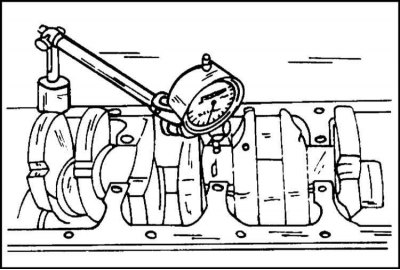
2. Place the crankshaft in the lathe centers (or in prisms with journals) and check the runout of the middle main journal with an indicator. The runout should not exceed 0.03 mm. If the specified value is exceeded, the crankshaft is replaced. If there is no indicator, the crankshaft can be placed with well-cleaned liners in the cylinder block and the runout of the middle journal can be measured with an indicator (see illustration.).
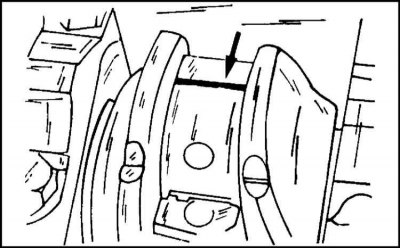
3a. Measure the clearances of the main and connecting rod bearings:
- Clean the bearings thoroughly and install them in the cylinder block bed or connecting rods.
- Place pieces of plastic wire "Plastigage" on all main journals as shown in the illustration. 3a, and close the journals with bearing caps and liners.
Tighten the cover mounting bolts to the specified torque. In this case, do not turn the crankshaft.
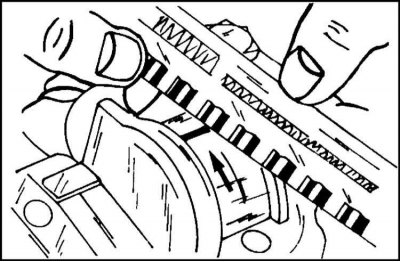
3b. To check the clearances in the connecting rod bearings, install the connecting rods on the crankshaft journals and place pieces of plastic wire on top "Plastigage". Cover the journals with the connecting rod caps and tighten the mounting nuts to the specified torque. In this case, turning the crankshaft is not allowed. Therefore, the measurement is performed only for two crankpins located at BDC.
- Remove the main bearing cap bolts and connecting rod bolts.
- Using the included gauge "Plastigage" measure the maximum thickness of the flattened wire (ill. 3b). If the obtained value "Plastigage" goes beyond the established limits, it is necessary to install new bearing liners. In this case, it is necessary to determine whether the shaft journals have been ground previously.
- Turn the crankshaft and measure the bearing clearance of the other two connecting rod journals.
Installing the crankshaft
OHC 2.0 engine
If the crankshaft TDC sensor gear was removed, it must be installed in place and secured with bolts to a torque of 13 Nm (since mid-1995).
1. If a manual transmission is installed, replace the pilot bearing on the end of the crankshaft if necessary.
2. Wipe the bearing beds in the cylinder block and place the liners in them in accordance with the markings so that the protrusions of the liners enter the grooves of the beds. If the cylinder block has been polished, in most cases new liners are installed.
They should also be labeled. Before installing, generously lubricate the inserts with oil.
3. Install both thrust half rings into place in the cylinder block. The oil grooves must face towards the block.
4. Carefully place the crankshaft into the main bearings. If the pistons and connecting rods are in the cylinder block, carefully guide the connecting rods onto the crankshaft journals.
5. Install the liners into the main bearing caps (protrusions into grooves) and grease them generously.
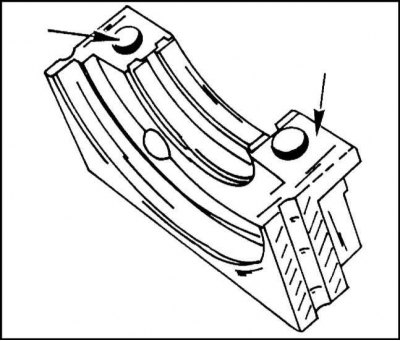
6. Install the bearing caps into the cylinder block seats and tap them with a rubber hammer. Lids must be installed in accordance with markings. In addition, the inner surface of the front and rear covers on the outside, right and left should be lubricated with sealant, as shown in the illustration. Only the surfaces shown by the arrows are lubricated. There are grooves on the outer sides of both covers. They are filled with sealant.
Note: After installing the caps, press the sealant on top again so that it protrudes from the grooves.
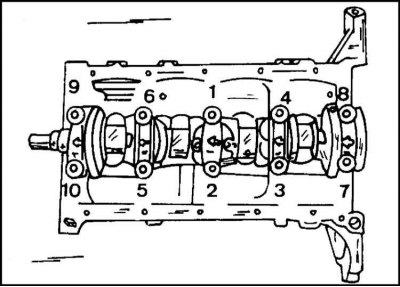
7. Tighten the new cover mounting bolts from the center out in the sequence shown in the illustration. in several steps with a torque of 50 Nm. After tightening to the specified torque, replace the torque wrench with a lever and tighten the bolts to an angle of 40°–50°. The illustration applies to all engine types.
8. After installing the covers, fill the holes to the right and left of the first cover with sealant so that the sealant appears at the points of contact with the cylinder block (see above).
9. Turn the crankshaft several times to identify any possible jams.
10. Recheck the axial clearance as described when removing the crankshaft (see illus. 8).
11. Install the connecting rod and piston group as described above.
12. Install both seals.
13. Install the toothed wheel with the key.
14. Fit the timing belt as described in Section Camshaft drive.
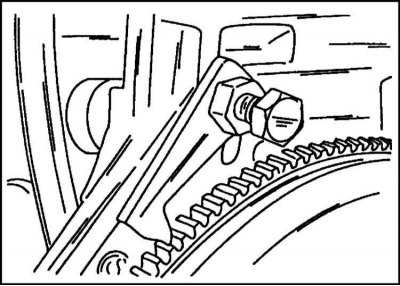
15. Install the flywheel (see the relevant subsection) and secure it with bolts. To prevent the crankshaft from turning, insert a wooden block between the crankshaft journal and the cylinder block wall or otherwise prevent the crankshaft from turning (illust., for all engines).
16. Install the clutch onto the flywheel according to the marking. Center the clutch driven disc properly. Tighten the mounting bolts evenly in a crisscross pattern.
17. Install the oil pump (see section Work with the lubrication system on a 2.4 l engine).
18. Install the oil pan, screw in the drain plug and tighten it to 55 Nm. Now, if necessary, you can fill the engine with engine oil.
19. Install other parts in the reverse order of removal.
OHC 2.0L engine since mid-1995
In this case, the crankshaft installation is performed similarly to the description given, taking into account the following:
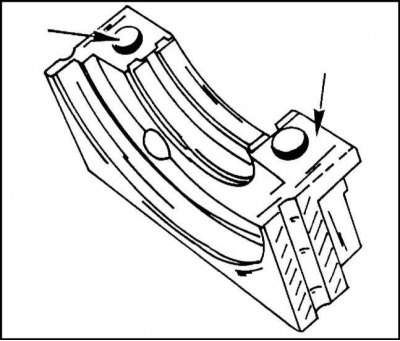
1. Fill the grooves on the outside of the rear main bearing cap with sealant. After installing the cover, insert the sealant from above again so that it protrudes from the groove. The areas shown in the illustration on the engine are no longer lubricated with sealant.
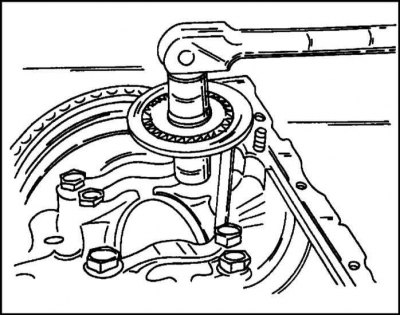
2. Tighten the main bearing cap bolts to a torque of 50 Nm and from this position turn them by an angle of 45° and then by another 15°. For this purpose, it is advisable to use a graduated scale, as shown in the illustration.
3. Install the bearing bridge and oil baffle as described in section Lubrication system.
4. Install the oil pump and oil pan as described in the appropriate subsection.
5. Attach the lugs to the engine and tighten the bolts to 60 Nm.
6. Screw in and tighten the drain plug to 45 Nm.
2.4L OHC Engine
1. Wipe the bearing beds in the cylinder block and place the liners in them in accordance with the markings so that the protrusions of the liners enter the grooves of the beds. If the cylinder block has been polished, in most cases new liners are installed. They should also be labeled. Before installing, generously lubricate the inserts with oil.
2. Carefully place the crankshaft into the main bearings. If the pistons and connecting rods are in the cylinder block, carefully guide the connecting rods onto the crankshaft journals.
3. Install the liners into the main bearing caps (protrusions into grooves) and grease them generously.
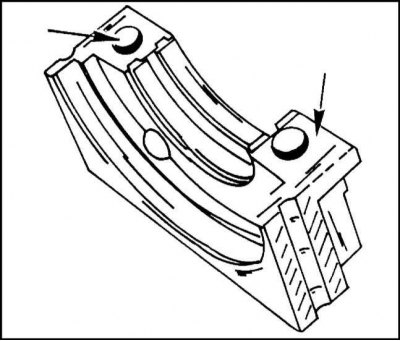
4. Install the bearing caps into the cylinder block seats and tap them with a rubber hammer. Lids must be installed in accordance with markings. In addition, the inner surface of the front and rear covers on the outside, right and left should be lubricated with sealant, as shown in the illustration. Only the surfaces shown by the arrows are lubricated. There are grooves on the outer sides of both covers (width about 6 mm). They are filled with sealant.
Note: After installing the caps, press the sealant on top again so that it protrudes from the grooves.
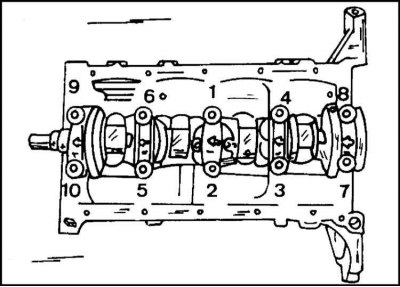
5. Hand tighten the main bearing cap bolts from the center to the edges in the sequence shown in the illustration. Before final tightening, install the rear bearing seal as described in a separate subsection. After this, tighten the bolts in several stages in the specified sequence to a torque of 110 Nm.
6. After installing the covers, fill the holes to the right and left of the first cover with sealant so that the sealant appears at the points of contact with the cylinder block (see above).
7. Turn the crankshaft several times to identify any possible jams.
8. Recheck the axial clearance as described when removing the crankshaft (see also fig. point 5 here). For this engine, the axial clearance should not exceed 0.152 mm.
9. Install the connecting rod and piston group as described above.
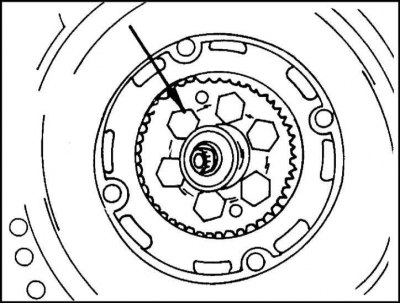
10. Install the flywheel, paying attention to the position of the locking bolt and tighten the bolts by hand. While holding the flywheel ring gear from turning, tighten the mounting bolts evenly to a torque of 60 Nm.
11. Install the clutch as described in the relevant section.
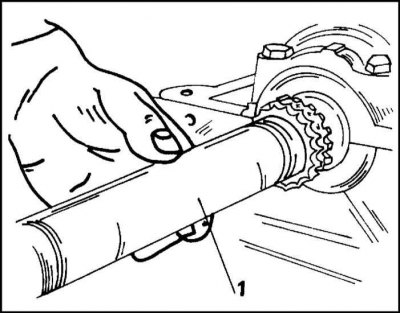
12. Press the sprocket using the pipe (1) as shown in the illustration. onto the crankshaft until it stops.
13. Install the following parts in order: drive chain, chain cover, coolant pump, pulley, viscous fan. The description of the specified works is given separately.
14. Install the following parts in the order shown below: oil pan, cylinder heads, distributor, generator, compressor (with air conditioning). Installation details are described in the following sections.
15. Install the remaining parts in the reverse order of removal.
DOHC Engine
1. If the crankshaft TDC sensor gear was removed, it must be installed in place and secured with bolts to a torque of 13 Nm (since mid-1995).
2. For manual transmission, replace the pilot bearing at the end of the crankshaft if necessary.
3. Wipe the bearing beds in the cylinder block and place the liners in them in accordance with the markings so that the protrusions of the liners enter the grooves of the beds. If the cylinder block has been polished, in most cases new liners are installed. They should also be labeled. Before installing, generously lubricate the inserts with oil.
4. Install both thrust half rings into place in the cylinder block. The oil grooves must face towards the block.
5. Carefully place the crankshaft into the main bearings. If the pistons and connecting rods are in the cylinder block, carefully guide the connecting rods onto the crankshaft journals.
6. Install the liners into the main bearing caps (protrusions into grooves) and grease them generously.
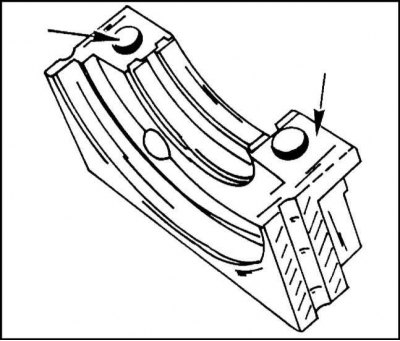
7. Install the bearing caps into the cylinder block seats and tap them with a rubber hammer. Lids must be installed in accordance with markings. In addition, the inner surface of the front and rear covers on the outside, right and left should be lubricated with sealant, as shown in the illustration. Only the surfaces shown by the arrows are lubricated. There are grooves on the outer sides of both covers. They are filled with sealant.
Note: After installing the caps, press the sealant on top again so that it protrudes from the grooves.
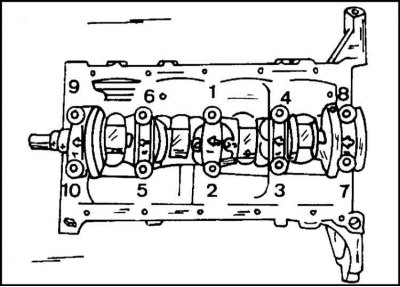
8. Tighten the new cover mounting bolts from the center out in the sequence shown in the illustration in several steps to a torque of 50 Nm. After tightening to the specified torque, replace the torque wrench with a lever and tighten the bolts to an angle of 45°. Finally, tighten all the bolts again to an angle of 15°.
9. After installing the covers, fill the holes to the right and left of the first cover with sealant so that the sealant appears at the points of contact with the cylinder block (see above).
10. Turn the crankshaft several times to detect possible jams.
11. Recheck the axial clearance as described when removing the crankshaft (see also fig. 8).
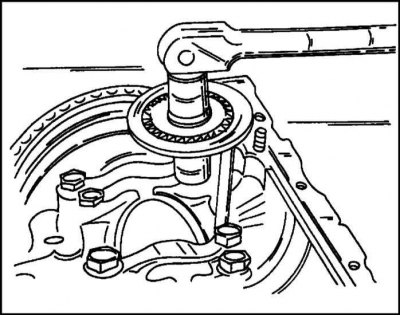
12. Install the connecting rod and piston group as described above. Tighten the caps to a torque of 35 Nm and then tighten to an angle of 45° and again to an angle of 15°. For this purpose, it is recommended to use a graduated washer, as shown in the illustration.
13. Install both seals (see below).
14. Install the toothed wheel with the key.
15. Fit the timing belt as described in Section Camshaft drive.
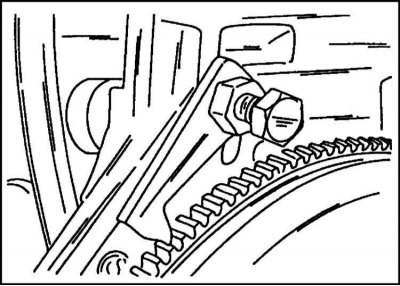
16. Install the flywheel (see the relevant subsection) and secure it with bolts. To prevent the crankshaft from turning, insert a wooden block between the crankshaft journal and the cylinder block wall or otherwise prevent the crankshaft from turning (illust., for all engines).
17. Install the clutch onto the flywheel according to the marking. Center the clutch driven disc properly. Tighten the mounting bolts evenly in a crisscross pattern.
18. For engines produced since 1997, install the bearing bridge and oil baffle plate. The specified works are described in Section Lubrication system.
19. Install the oil pump (see section Work with the lubrication system on a 2.4 l engine).
20. Install the oil pan, screw in the drain plug and tighten it to 45 Nm. Now, if necessary, you can fill the engine with engine oil.
21. Install other parts in the reverse order of removal.
Crankshaft seals
2.0L OHC and DOHC engines
After each removal of the crankshaft, the front and rear oil seals must be replaced with new ones. No special tool is required for this. The seals can be replaced without removing the engine if an oil leak is detected in their area.
A leaking rear oil seal may, for example, be the cause of clutch slippage. The front oil seal is located in the oil pump housing.
Removal oil seals
General instructions apply to all engines. Replacing the front oil seal involves removing the oil pump housing, since that is where the oil seal is located. The relevant instructions are given in Section Lubrication system.
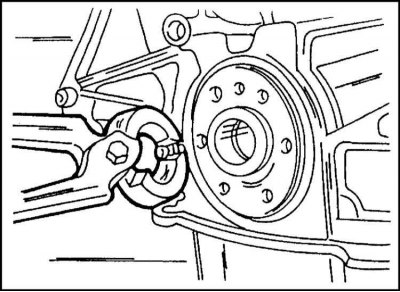
1. To remove the front oil seal, use a sharp mandrel to punch a hole in the metal ring of the oil seal, screw in a self-tapping screw and pull out the oil seal with pliers, as shown in the illustration. All seals can be removed in a similar manner.
2. To remove the rear oil seal, you need to remove the gearbox, clutch and flywheel. The seal is removed in the manner described above using a self-tapping screw (see illustration of point 1 here). Be careful not to damage the cylinder block.
Installation of seals
1. Lubricate the working edge and the outer surface of the seal with grease and carefully press the seal flush with the outer surface. You can use a piece of pipe installed on the outer perimeter of the gland and clamped on top with a washer. In this case, the seal can be pressed in using the crankshaft pulley mounting bolt.
2. Next, you need to act in accordance with the description of the oil pump installation.
3. The rear oil seal is pressed in carefully using a hammer. Be careful not to damage the working surface of the seal. Lubricate the working and outer surfaces with oil or grease. The seal is pressed in using a piece of pipe of the appropriate diameter flush with the outer plane. Other parts are installed in the reverse order of removal (flywheel, clutch, etc.)
2.4L OHC Engine
This engine has the front seal in the timing case cover and the rear seal in the rear cover.
Replacing the front oil seal
1. Disconnect the ground cable from the battery.
2. Remove the fan shroud and hang it under the impeller.
3. Remove the fan with viscous coupling. The bolt that mounts it has a left-hand thread (see chapter Cooling and heating systems).
4. Remove the generator oil pump drive V-belt as described in the relevant subsections. To loosen the belt tension, loosen the tensioner.
5. Remove the crankshaft wheel while holding the shaft from turning (put the gear on).
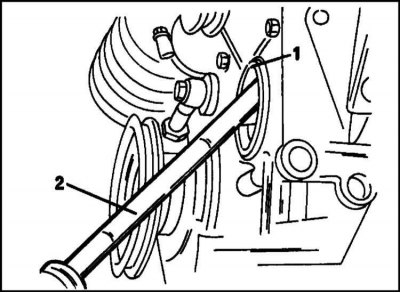
6. Remove the front oil seal (1) using a screwdriver (2) from the camshaft drive cover as shown in the illustration.
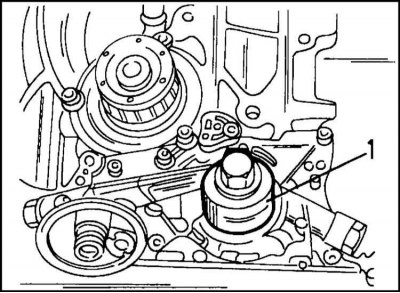
7. Lubricate the working surface of the seal with grease and press it into the cover until it stops. There is a special tool for this. You can also use a piece of pipe (1) of the appropriate diameter, a washer and a bolt, as shown in the illustration.
8. Install the crankshaft pulley and, holding the pulley from turning, tighten its mounting bolt to a torque of 120 Nm.
9. Install and tension the generator and oil pump drive V-belt.
10. Install a fan with a viscous coupling (see separate description).
11. Install the fan shroud and connect the battery.
Replacing the rear oil seal
1. Remove the gearbox (see the relevant section).
Original source on the website (www.OPELBOOK.ru)
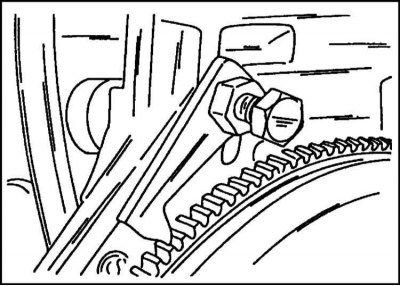
2. Mark the position of the guide bolt in the flywheel (marked with the letter "P"). Hold the flywheel from turning (see illustration.), loosen the flywheel mounting bolts. Remove the flywheel.
Warning! It can easily fall
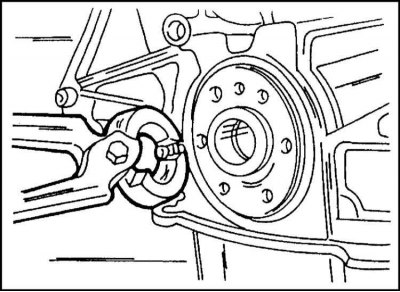
3. Punch a hole in the seal with a sharp mandrel, screw a self-tapping screw into it and pull out the seal as shown in the illustration.
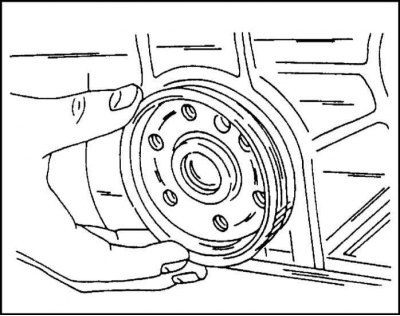
4. Apply grease to the outer and working surfaces of the seal and insert it into the hole as shown in the illustration. Press the seal with a mandrel until it stops.
5. Install and secure the flywheel, paying attention to the position of the guide bolt. Tighten the bolts evenly around the circumference to a torque of 60 Nm.
6. Install the clutch and gearbox.
Flywheel
The flywheel of the engines in question is bolted directly to the rear flange of the crankshaft.
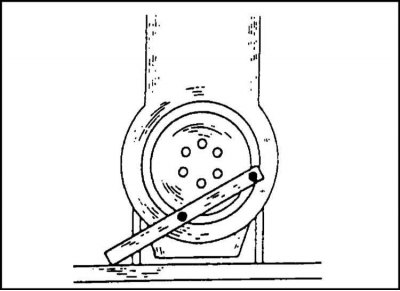
1. To remove the flywheel, lock it with a screwdriver inserted into the toothed ring or with a pawl. It is recommended to block the flywheel in the same way as described for removing the crankshaft (see illustration.). The engine must be securely fastened. Mark the flywheel position before removing.
Engine 2.4 l
This engine has a pilot bolt in the flywheel marked "P". Mark the position of the pilot bolt before removing the mounting bolts. Its marking is shown in the illustration. 2.
OHC 2.0L engine since mid-1995
A vehicle with air conditioning has a dual mass flywheel. Its removal is similar to removing a regular flywheel.
DOHC Engine
The flywheel mount is similar to the 2.0L OHC engine flywheel mount. When installing, pay attention to the installation time (see below).
OHC 2.0L engine up to mid-1995
Flywheel mounting bolts should not be reused. Tighten the new bolts to the specified torque and turn them to the required angle.
1. Lubricate the bolt threads with Loctite.
2. First tighten the bolts to 65 Nm, then tighten them further by 30°–45°. Tightening of the bolts should be done within 5 minutes (drying time of "Loctite").
2.0L engine since mid-1995
The flywheel mounting bolts are not used a second time. They are first tightened to a given torque and then tightened twice to a given angle. The tightening must be completed within 5 minutes, including the tightening.
1. Tighten the bolts evenly around the circumference to a torque of 65 Nm.
2. Pull the boots up to a 30° angle.
3. Tighten the bolts again at an angle of 15°.
2.4L OHC Engine
Screw in the fixing bolt shown in the illustration according to the marking. 10 and tighten the mounting bolts evenly around the circumference to a torque of 60 Nm.
DOHC Engine
The bolts are tightened to the specified torque and then tightened twice to the specified angle. The tightening must be completed within 5 minutes, including the tightening.
1. Tighten the bolts evenly around the circumference to a torque of 65 Nm.
2. Pull the boots up to a 30° angle.
3. Tighten the bolts again at an angle of 15°.
Note: It is best to perform the tightening using a graduated scale as shown in the illustration. 12.
OHC 2.0 engine and DOHC engine from mid-1995
These engines have a gear wheel for the engine speed sensor located under the flywheel. The wheel is removed only if the crankshaft is replaced.
1. Tighten the wheel mounting bolts to a torque of 13 Nm.
Flywheel ring gear
The ring gear for driving the engine by the starter is pressed onto the flywheel and can be replaced.
1. Removing the crown may require heating to a temperature of 70°C. In this case, it is advisable to perform the work in a car repair shop.
If the flywheel friction surface is scored, the flywheel must be replaced.
Automatic transmission drive disc
The same work is performed on the drive disk as on the flywheel. The tightening torques are the same as those specified in the last subsection. Always replace the disc mounting bolts with new ones.
Replacing the guide bearing
A guide bearing is installed at the end of the crankshaft. If the bearing is damaged, it is replaced with a new one (with manual transmission).
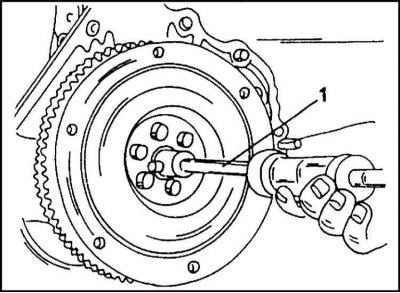
1. The bearing is removed using a puller and a hammer with a sliding striker, see illustration.
If there is damage to the guide bearing, it is also necessary to check the journal of the primary shaft of the gearbox.
The new bearing is lubricated with high-temperature grease and pressed onto the end of the crankshaft using a mandrel.
Visitor comments