


2.0L engine view from suction side
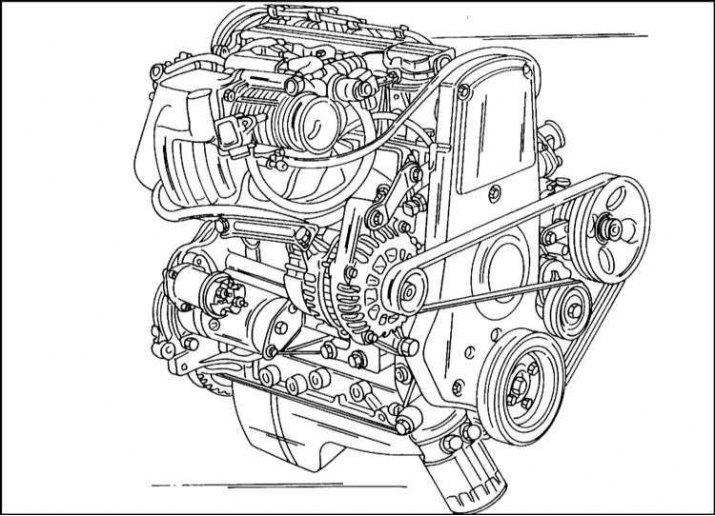
Engine type 2.4 l (C 24 NE). The engine has a chain drive of the camshaft
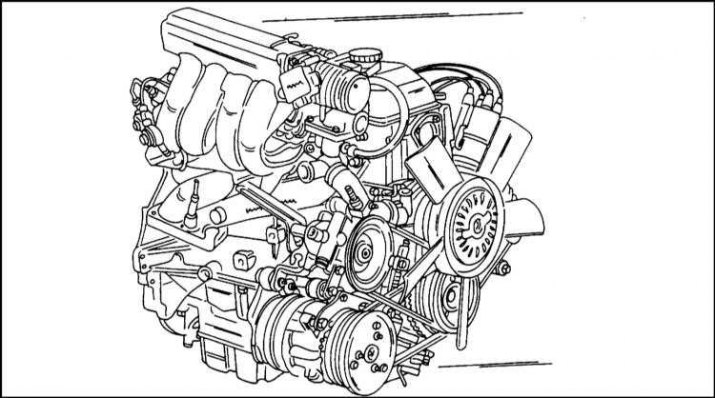
Before starting work, it is necessary to thoroughly clean all external surfaces of the engine. All openings on the engine should be covered with a clean cloth beforehand to prevent dirt or other foreign particles from getting inside
Disassembly of individual engine components is described in detail below in the subsections under the heading "Repair".
This section describes the work performed on the engine installed in the vehicle or on the engine removed. If a complete disassembly is required, the individual operations should be combined in the specified sequence.
The description implies that the cylinder block is replaced, although this is not always necessary. Links are constantly provided to sections where the work is described in more detail.
Before disassembling, all moving and sliding parts must be marked so that they can be returned to their original position if they are to be reused. This applies in particular to pistons, valves, covers and bearing shells. Engine parts should be stored so that they do not have to be moved past each other.
Do not mark bearing surfaces or sealing surfaces with any sharp objects such as scribers or impact methods. It is necessary to apply markings with paint. The best way to store the valves is by piercing them through an upside-down cardboard box. In this case, the valve number is written next to it. If the engine has a multi-valve distribution for each cylinder, then the valves belonging to one cylinder should be separated from the other valves.
Aluminum alloy parts require appropriate handling. If they require hammering to disassemble, the hammer should be rubber or leather. If the required stand is not available, then appropriate wooden stands should be used. The stands must be such that access to the top and bottom of the engine is provided. If a mounting stand is used, the exhaust manifold is disconnected from the engine and the engine is bolted to the stand.
The cylinder head, after being removed from the engine, can be secured in a vice with a metal clamp screwed to the studs of the intake manifold.
Complete disassembly of the engine is not described, as it is performed only in rare cases. A description of the removal of individual engine components is given in the relevant sections. The cylinder head can be removed without removing the engine.
The timing belt and, accordingly, the chain can be replaced without removing the engine.
The following work can be performed without removing the engine:
Engine 2.0 l (timing belt driven mechanism)
- Replacing the rear crankshaft oil seal.
- Replacing the front crankshaft oil seal (in the oil pump housing).
- Replacing the oil seal in the camshaft housing on the gearbox side.
- Replacing the oil seal in the camshaft housing on the drive side of the distribution mechanism.
- Removal and installation of the camshaft, camshaft housing, rocker arms and valve clearance compensator.
- Removal and installation the cylinder head.
- Removal and installation the oil pan.
- Removal and installation the oil pump.
- Removal and installation of the connecting rod and piston group.
- Removal and installation the flywheel.
Engine 2.4 l (chain driven distribution mechanism)
- Replacing the intake manifold and exhaust manifold gaskets.
- Replacing the rear crankshaft oil seal.
- Replacing the oil pan gasket.
- Replacing the gasket at the front of the crankshaft (timing mechanism housing).
- Removal and installation the flywheel.
- Removal and installation of the camshaft and camshaft bearings.
- Removal and installation rocker arm pins.
- Removal and installation valve stem seals.
- Removal and installation the cylinder head.
DOHC Engine
- Replacement of distribution mechanism parts (v-belt, tension roller), camshaft gears, camshaft seals, toothed belt, toothed belt guide roller.
- Removal and installation the cylinder head.
- Removal and installation the flywheel.
Only fairly large works are listed here. In addition, there are many smaller jobs that can be done without removing the engine.
The engine must be removed to perform the following procedures:
- Removal and installation of the crankshaft or replacement of crankshaft bearings (a new crankshaft installation is being carried out).
- Replacing the rear crankshaft oil seal (depending on the engine type).
Visitor comments