OpelBook.ru
Cars AvtoVAZ Cars Mitsubishi Cars BMW Cars Mercedes Cars Nissan Cars Toyota Cars Chevrolet
English Русский
Български
Беларускі
Український
Српски
Hrvatski
Română
Polski
Slovenský
Magyar
 |  Sitemap  |  Contacts  |    


Main Astra Corsa Insignia Kadett Omega Vectra Zafira Others Articles
Astra F (1991-1998, petrol) Astra G (1998-2004, petrol) Astra G (1998-2004) Astra H (2004-2009) Astra J (2009-2015, petrol)
  • Main
  • Astra
  • Astra J
  • Power unit
  • Engine repair
  • Disassembling the engine

Disassembling the engine (Opel Astra J)

            0

You will need: tools required for removing the cylinder head, as well as TORX socket heads E8, E11, E12, extension, ratchet, screwdrivers, hammer, piston pin pressing tool or suitable mandrel, pliers.

Note: If possible, work on a special rotating stand that provides access to the engine from all sides, since it is very difficult to fix the engine from moving when unscrewing fastening parts tightened with a high torque.


1. Remove the power unit from the vehicle (see Removal and installation of the power unit).

2. Remove the starter (see Removal and installation the starter).

3. Remove the generator (see Removal and installation the generator).

4. Disconnect the gearbox from the engine by unscrewing the bolts that secure it to the engine (see Removal and installation the gearbox).

5. Remove the clutch from the flywheel (see Removal and installation the clutch).

6. Remove the flywheel (see Removal, defect detection and installation of the flywheel).

7. Remove the cylinder head (see Replacing the cylinder head gasket).

8. Remove the water pump (see Replacing the water pump).

9. Remove the oil filter (see Changing engine oil and oil filter).
9. Remove the oil filter (see Changing engine oil and oil filter).


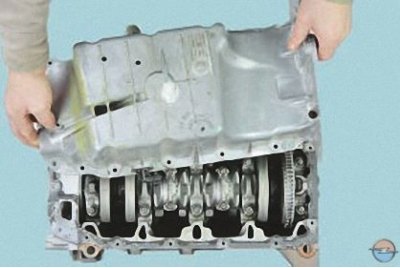
10. Remove the oil pan (see Replacing the oil pan seal).


10. Remove the oil pan (see Replacing the oil pan seal).


(Article posted on a web portal: «www.opelbook.ru»)

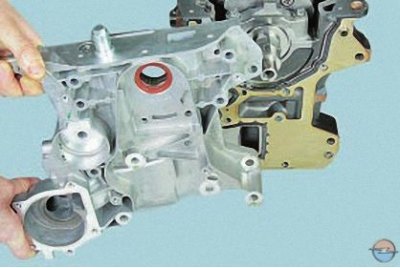
11. Remove the oil pump…

11. Remove the oil pump…


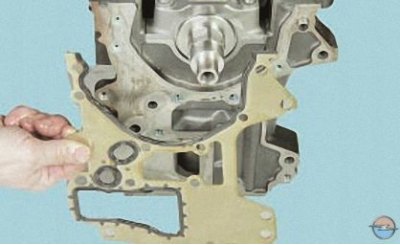
12. …and a sealing gasket installed under the flange of the oil pump housing (see Removal and installation the oil pump).

Note: When disassembling the crank mechanism and piston group, mark the pistons, connecting rods, and main and connecting rod bearing shells so that they can be installed in their original places during assembly if they are in good working order.


Note: When disassembling the crank mechanism and piston group, mark the pistons, connecting rods,…


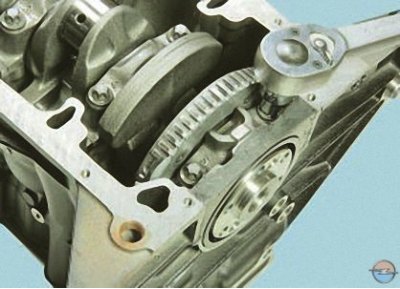
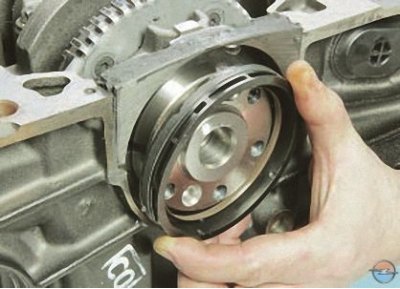
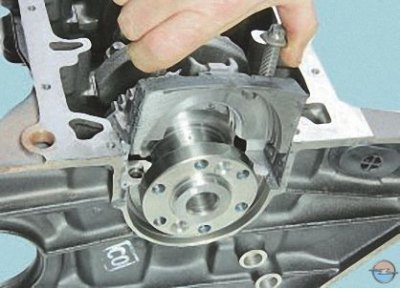
13. Remove the two bolts securing the crankshaft rear main bearing cover…


13. Remove the two bolts securing the crankshaft rear main bearing cover…


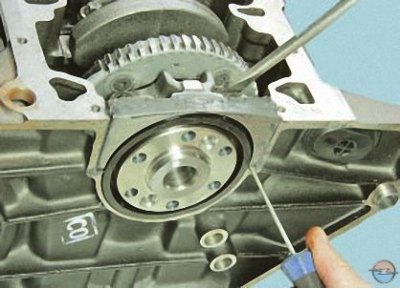
14. …slide the cover up…

14. …slide the cover up…


15. …remove the rear crankshaft oil seal from the cylinder block socket…

15. …remove the rear crankshaft oil seal from the cylinder block socket…


16. …and remove the crankshaft rear main bearing cover

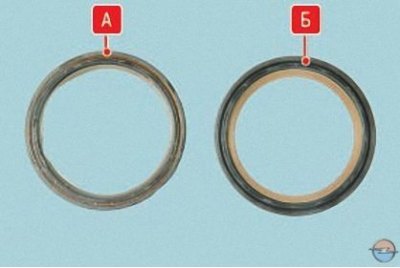
Note: Replace the rear oil seal with a new one each time it is removed.


Note: Replace the rear oil seal with a new one each time it is removed.


The photo shows the oil seal removed from the engine A and a new seal B. Diameter of the working surface of the seal A enlarged, so when reinstalled the seal will not provide a seal to the rear flange of the crankshaft.


The photo shows the oil seal removed from the engine A and a new seal B. Diameter of the working…


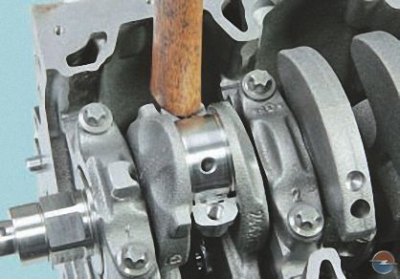
17. Unscrew the two bolts securing the connecting rod cover of the 1st cylinder, move the cover from its seat with light hammer blows through a wooden spacer..

17. Unscrew the two bolts securing the connecting rod cover of the 1st cylinder, move the cover…


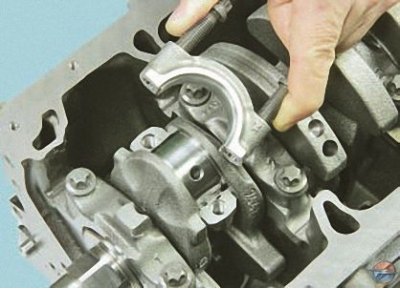
18. …and remove the cover with the insert.

Attention! The connecting rod and cover are not marked with cylinder numbers. Be sure to mark them in any way possible (for example, by kerning), so that during assembly they can be installed in their original places, since the connecting rod caps are not interchangeable (the connecting rod is machined together with the cover).


Attention! The connecting rod and cover are not marked with cylinder numbers. Be sure to mark them…


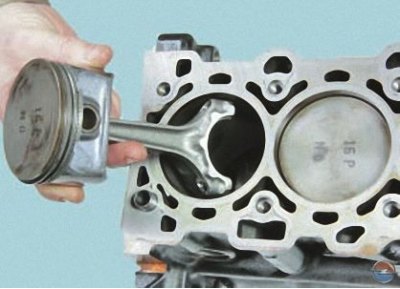
19. Press with a wooden block (with a hammer handle) on the connecting rod...


19. Press with a wooden block (with a hammer handle) on the connecting rod...


20. ...and remove the piston with the connecting rod from the cylinder towards the upper surface of the cylinder block.

21. Similarly, remove the pistons and connecting rods of the remaining cylinders, turning the crankshaft to access the connecting rod cap bolts.

Note: Turn the crankshaft with a wrench on the flat on the front end.


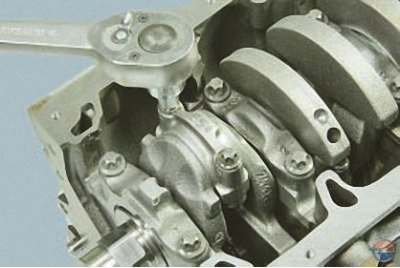
22. Remove the two bolts securing any main bearing cap. Separate the cap from its seat with light hammer blows through a wooden spacer…

22. Remove the two bolts securing any main bearing cap. Separate the cap from its seat with light…


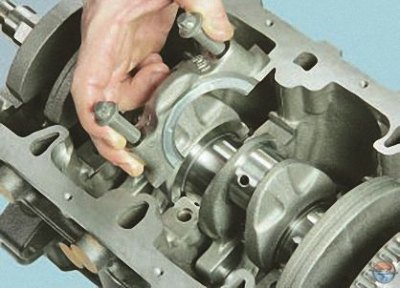
23. …and remove the cover with the lower insert.

Caution! Main bearing caps are designed for one specific cylinder block only (the covers are processed together with the block). The covers are not interchangeable with each other.
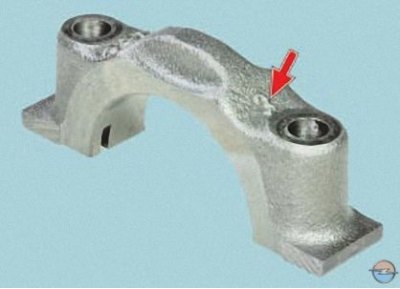

Caution! Main bearing caps are designed for one specific cylinder block only (the covers are…


The covers are numbered according to the order in which they are installed (counting from the front of the engine).


The covers are numbered according to the order in which they are installed (counting from the front…


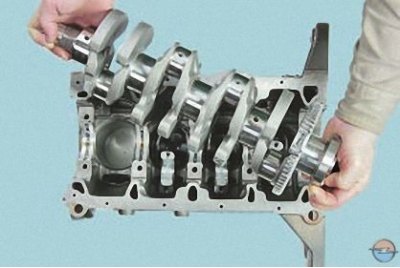
24. Unscrew the bolts, remove the remaining main bearing caps and remove the crankshaft.

24. Unscrew the bolts, remove the remaining main bearing caps and remove the crankshaft.


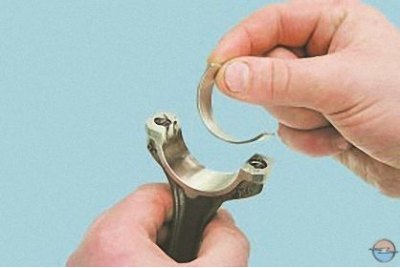
25. Remove the bearing shells from all connecting rods...

25. Remove the bearing shells from all connecting rods...


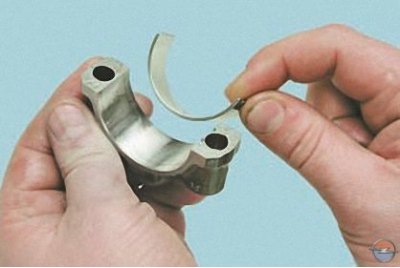
26. …and from their lids…

26. …and from their lids…


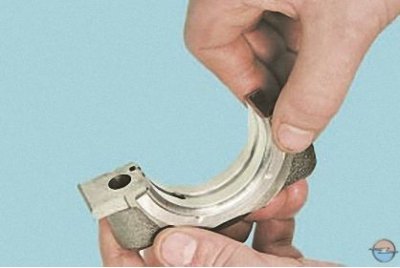
27. …from the main bearing caps…


27. …from the main bearing caps…


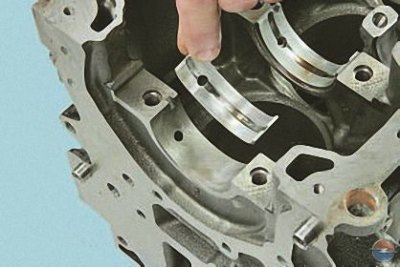
28. …and from all the beds in the cylinder block.
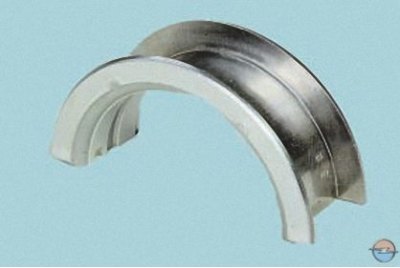
28. …and from all the beds in the cylinder block.


Note. The third main bearing cap liner is thicker, and its side ends are provided with flanges that act as thrust half rings limiting the axial movement of the crankshaft. Similar flanges are also provided on the upper liner of the third main bearing.


Note. The third main bearing cap liner is thicker, and its side ends are provided with flanges that…


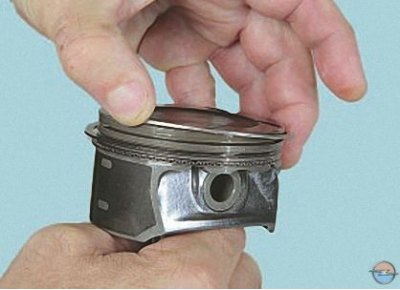
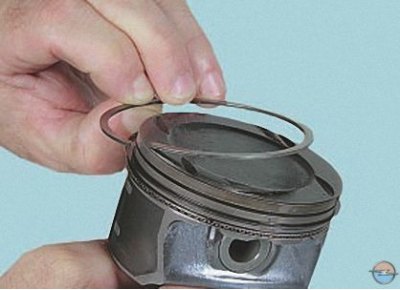
29. Release the upper compression ring…


29. Release the upper compression ring…


30. …and take it off.

30. …and take it off.


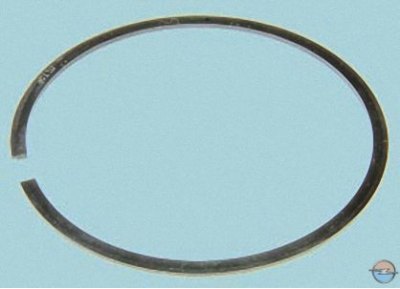
31. Remove the second (lower) compression ring in the same way.

32. Unclamp and remove the upper ring, expander and lower ring of the composite oil scraper ring
32. Unclamp and remove the upper ring, expander and lower ring of the composite oil scraper ring


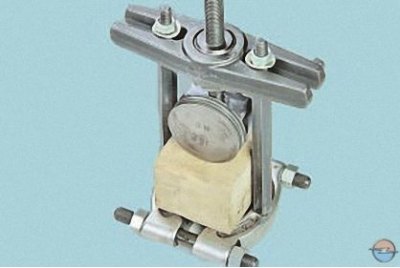
33. Using a screw or hydraulic press, press the piston pin out of the upper connecting rod head.

34. Remove the pin from the piston and remove the piston from the connecting rod.

Note: Mark the parts. If they are not damaged and show little wear, they can be used in their original locations.


This article is available at russian, bulgarian, belarusian, ukrainian, serbian, croatian, romanian, polish, slovak, hungarian
Checking the article: Trifonova Emilia

Share information:

Previous articles
Opel Astra J: Engine repair
Next articles

Removal and installation the engine
Lapping valves
Removal, inspection and installation of camshafts
General information about the cylinder head
Replacing the oil level indicator guide seal
Replacing camshaft seals
Engine parts defect detection
Engine assembly


See similar ones from other Opel car manuals:
▶ Disassembling the engine Opel Kadett E (1984-1995)
▶ Disassembling and assembling the engine — general… Opel Vectra A (1988-1995, petrol)
▶ Disassembling the engine Opel Frontera A (1991-1998, petrol)
▶ Starting the engine from an auxiliary power source Opel Corsa B (1993-2000)
▶ Engine compartment fuse box Opel Insignia A (2008-2017)
Link to this page in different formats

Visitor comments


No comments yet


How much will 30 + 28 =


Astra J (2009-2015, petrol) 
  • General information
  • Vehicle device
  • User manual
  • Faults en route
  • Maintenance
  • Power unit
  • Engine repair
  • Cooling and lubrication system
  • Engine power system
  • Exhaust system
  • Transmission
  • Clutch
  • Car gearbox
  • Drive shafts
  • Chassis
  • Front suspension
  • Rear suspension
  • Steering
  • Brake system
  • Wheels and tires
  • Body
  • Exterior
  • Interior
  • Doors and windows
  • Body Care
  • Heating and air conditioning
  • Security systems
  • Electrical equipment
  • Equipment and devices
  • Lighting and signaling
  • Power devices
  • Electrical circuits
Astra H (2004-2009) 
  • General information
  • Introduction to the guide
  • Troubleshooting
  • User manual
  • Maintenance
  • Power unit
  • Engine repair
  • Cooling and heating
  • Power and exhaust system
  • Ignition system
  • Launch and charge system
  • Transmission
  • Mechanical gearbox
  • Automatic gearbox
  • Drive shafts
  • Chassis
  • Brake system
  • Car suspension
  • Steering
  • Body
  • Interior
  • Exterior
  • Electrical equipment
  • Equipment and devices
  • Electrical circuits
Astra G (1998-2004) 
  • General information
  • Introduction to manual
  • User manual
  • Maintenance
  • Power unit
  • SOHC gasoline engines
  • DOHC gasoline engines
  • Diesel engines 1.7 and 2.0
  • Engine repair
  • Cooling system
  • Supply system
  • Injection system (gasoline)
  • Injection system (diesel)
  • Exhaust system
  • Charge and launch system
  • Ignition system (gasoline)
  • Preheat system (diesel)
  • Transmission
  • Manual gearbox
  • Automatic gearbox
  • Clutch
  • Drive shafts
  • Chassis
  • Brake system
  • Wheel suspension
  • Steering
  • Body
  • Exterior
  • Interior
  • Doors and windows
  • Ventilation and heating
  • Electrical equipment
  • Equipment and devices
  • Electrical circuits
Astra G (1998-2004, petrol) 
  • General information
  • User manual
  • Car care
  • Maintenance
  • Power unit
  • Single shaft engines
  • Twin shaft engines
  • Engine repair
  • Cooling and heating
  • Fuel and exhaust systems
  • Starting and charging system
  • Ignition system
  • Transmission
  • Clutch
  • Mechanical gearbox
  • Automatic gearbox
  • Drive shafts
  • Chassis
  • Brake system
  • Car suspension
  • Steering
  • Body
  • Interior
  • Exterior
  • Electrical equipment
  • Equipment and devices
  • Wiring diagrams Opel Astra
  • Wiring diagrams Opel Zafira
Astra F (1991-1998, petrol) 
  • General information
  • Maintenance
  • Power unit
  • Engine in car
  • Engine removed
  • Cooling system
  • Heating and ventilation
  • Fuel supply (carburetor)
  • Fuel supply (injector)
  • Emission control
  • Ignition system
  • Transmission
  • Clutch
  • Mechanical gearbox
  • Automatic gearbox
  • Drive shafts
  • Chassis
  • Brake system
  • Car suspension
  • Steering
  • Body
  • Exterior
  • Interior
  • Electrical equipment
  • Equipment and devices
  • Electrical circuits
OpelBook.ru © 2017–2026 · Mobile version · · Sitemap: EN BG BY UA RS HR RO PL SK HU · Feedback · Site search
Astra F, petrol · Astra G, petrol · Astra G · Astra H · Astra J, petrol · Corsa B · Corsa C, petrol · Corsa C · Insignia A · Kadett D · Kadett E · Omega A · Omega B · Omega B2 · Vectra A, petrol · Vectra A · Vectra B, petrol · Vectra B · Vectra C · Zafira A, petrol · Frontera A, petrol · Frontera B · Ascona C · Vivaro A ·
We want your visit to be comfortable 🤝! We use cookies 🍪 to make that happen.