
You will need: all the tools needed to remove the camshafts (see Removal, troubleshooting and installation of camshafts), as well as a screwdriver, pliers, a hammer.
1. Disconnect the wire from the terminal «minus» battery.
2. Set the piston of the 1st cylinder to the TDC position of the compression stroke (see Setting the piston of the first cylinder to the TDC position of the compression stroke).
3. Remove the timing belt (see Replacing the timing belt).
4. Remove gear pulleys of camshafts.
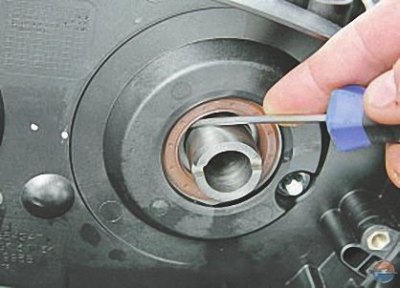
5. Using a screwdriver, remove the exhaust camshaft seal from the cylinder head socket.
6. Before installing a new oil seal, inspect its working edge. It should be smooth, without tears, dents and rubber influxes. The gland spring must be intact and unstretched. Lubricate the working edge with engine oil.
Note. To facilitate the pressing of the gland, apply a small chamfer to its seating edge with a needle file or a fine emery wheel.
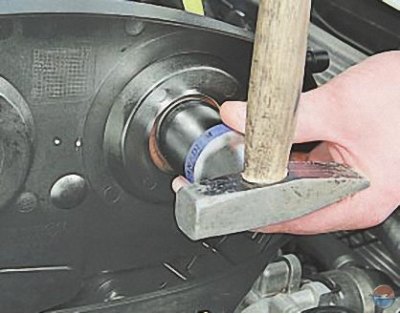
7. Install the oil seal with the working edge inside the block head socket, carefully fill the working edge onto the camshaft (e.g. wooden stick) and press it in to the stop using a suitable mandrel. As a mandrel, you can use the inner ring from a bearing of a suitable size or an old oil seal.
8. Replace the intake camshaft seal in the same way.
9. Establish all removed details and knots in an order, the return to removal.
Visitor comments