


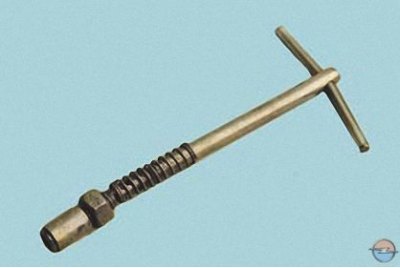
Also available for sale ready made manual valve holders.
In addition, you will need: lapping paste, kerosene, a weak spring, passing through the valve seat hole along the outer diameter.
1. Clean the valve from carbon deposits.
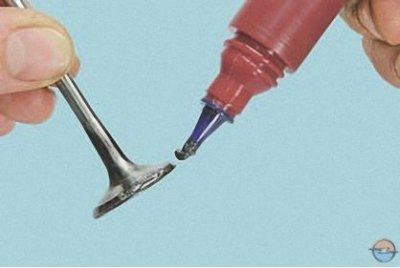
2. Apply a continuous thin layer of lapping paste to the valve chamfer.
3. Place the pre-selected spring on the valve stem and insert the valve into the guide bushing from the combustion chamber side, lubricating the valve stem with a layer of graphite grease.
Note: Graphite grease prevents the abrasive from the lapping paste from getting into the guide bushing holes and makes it easier to rotate the valve during lapping.
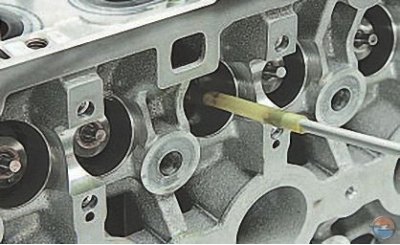
4. Place the valve lapping tool on the valve stem (or with some tension a rubber tube to connect the valve to the reversible drill).
5. Turn on the drill at minimum speed (in reverse mode) or by rotating the device (in case of manual lapping) alternately in both directions by half a turn, grind the valve, periodically pressing it against the seat, then weakening the pressing force.
Note: If you don't have any device, you can grind the valve using an eraser, pressing and turning the valve with it. Release the valve by pressing on the end of its stem with your other hand.
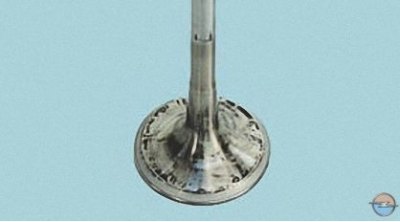
6. Grind the valve until a matte-gray continuous single-color belt appears on its chamfer, at least 1.15 mm wide for the inlet valve and 1.35 mm wide for the outlet valve, while…
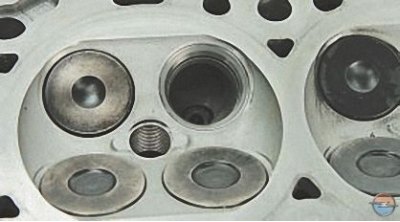
7. …after grinding, a shiny belt at least 1.5 mm wide should also appear on the valve seat.
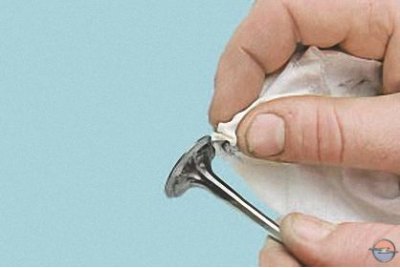
8. After grinding, carefully wipe the valve and seat with a clean cloth and rinse to remove any remaining grinding paste. Check the valve for leaks by installing it in the head with springs and crackers. Then lay the head on its side and pour kerosene into the channel that is closed by the valve. If kerosene does not leak into the combustion chamber within 3 minutes, the valve is sealed.
Visitor comments