


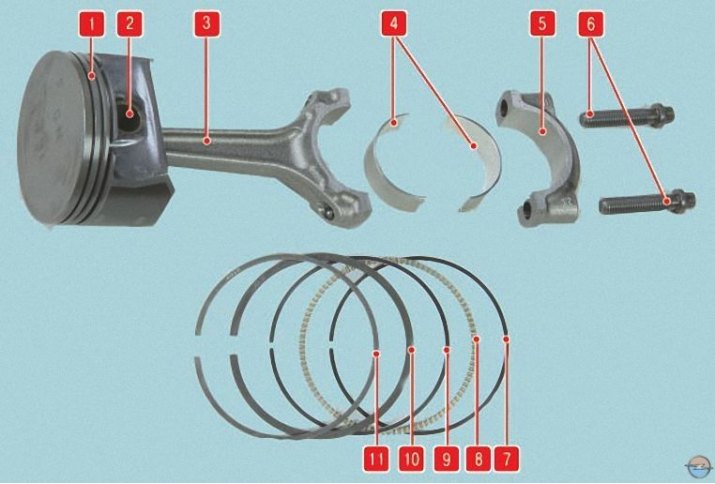
Fig. 1. Parts of the connecting rod and piston group: 1 – piston; 2 – piston pin; 3 – connecting rod; 4 – inserts; 5 – connecting rod cover; 6 – connecting rod cover mounting bolts; 7, 9 – oil scraper rings; 8 – oil scraper ring expander; 10 – lower compression ring; 11 – upper compression ring
You will need: portable lamp, set of flat feeler gauges, ruler, caliper, bore gauge, micrometer, scraper.
1. Clean the piston head from carbon deposits. If the piston has scoring, burn marks, deep scratches, cracks, replace the piston. Clean the grooves for the piston rings. It is convenient to do this with a piece of an old ring.
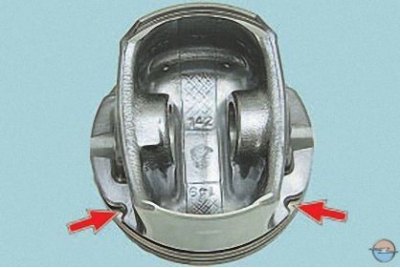
2. Use a suitable piece of wire to clean out the oil drain holes in the piston.
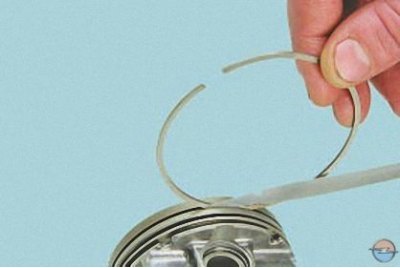
3. Check the clearances between the rings and grooves on the piston, after cleaning the rings from carbon deposits. The clearances should be as follows:
- 0.04–0.075 mm for the upper compression ring;
- 0.03-0.07 mm for the lower compression ring;
- 0.03–0.13 mm for oil scraper ring.
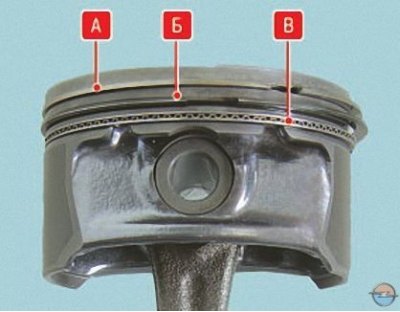
This is how the rings are arranged on the piston: A - the upper compression ring; B - lower compression ring; B - oil scraper ring.
4. The most accurate way to determine the gaps is to measure the rings and grooves on the piston. To do this, use a micrometer to measure the thickness of the rings in several places around the circumference, then use a set of feeler gauges to measure the width of the grooves in several places around the circumference. Calculate the average gap values (difference between ring thickness and groove width). If at least one of the gaps exceeds the maximum permissible value, replace the piston with rings.
5. Inspect the cylinders on both sides. Scratches, burrs and cracks are not allowed.
Note: When inspecting, we recommend illuminating the cylinder mirrors with a portable lamp, as this will make defects much more visible.
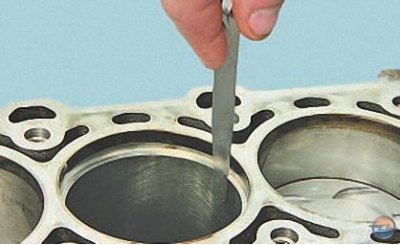
6. Measure the gaps in the ring locks by inserting the ring into a special mandrel. If there is no mandrel, insert the ring into the cylinder in which it worked (or will it work if the ring is new), push the ring into the cylinder with the piston like a mandrel so that it fits into the cylinder evenly, without distortions, and measure the gap in the ring lock with a feeler gauge.
The gaps in the ring locks should be as follows:
- 0.25–0.50 mm for upper and lower compression rings;
- 0.25–0.75 mm for oil scraper ring.
Note: To install the ring without tilting, push it deeper into the cylinder with the piston.
7. Measure the diameter of the cylinder in two mutually perpendicular planes (X - along, Y — across the cylinder block) and in three belts (A, B and IN), as shown in Fig. 2. This requires a special device - a bore gauge. The nominal dimensions of the cylinders are given in Table 1. The ovality should not exceed 0.015 mm, the taper - 0.01 mm. If the maximum wear value is greater than 0.2 mm or the ovality and taper are greater than the specified values, bore the cylinders to the nearest repair size of the pistons, leaving an allowance of 0.03 mm for the diameter for honing. Then hone the cylinders, maintaining a diameter such that when installing the piston, the calculated gap between it and the cylinder is 0.03-0.05 mm. Carry out defect detection, boring and honing of the block in workshops with special equipment.
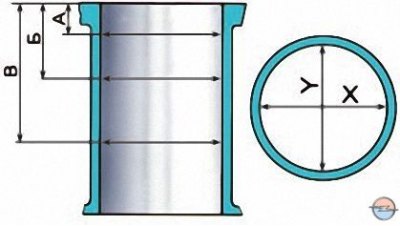
Fig. 2. Cylinder measurement diagram
Table 1. Dimensions of cylinders and pistons of the A16 XER engine
| Class | Cylinder diameter, mm | Piston diameter, mm |
| Nominal dimensions | ||
| 00 | 78,992–79,008 | 78,833–78,847 |
| 05 | 79,042–79,058 | 78,883–78,997 |
| Repair size | ||
| 00+0,5 | 79,492–75,508 | 79,433–79,447 |
8. Check the deviation from the flatness of the surface of the block joint with the cylinder head. Attach a caliper (or a ruler) to the surface:
- in the longitudinal and transverse directions;
- along the diagonals of the surface.
In each position, use a flat feeler gauge to determine the gap between the ruler and the surface. This is the deviation from flatness. If the deviation is greater than 0.1 mm, replace the unit.
9. Check the clearances between the pistons and cylinders. The clearance, determined by the difference in the measured diameters of the cylinder and piston, should be within 0.03–0.05 mm.
If the clearance does not exceed the maximum allowable, you can select pistons from the next class so that the clearance is as close to the nominal as possible. If the clearance exceeds the maximum allowable, bore the cylinders and install pistons of the repair size.
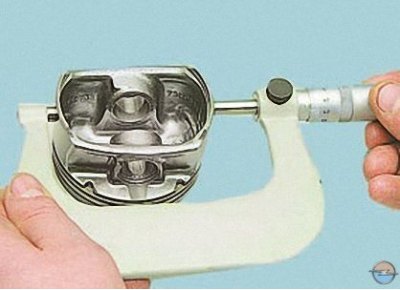
Measure the piston diameter at a distance of 19 mm from the lower edge of the piston skirt in a plane perpendicular to the piston pin.
10. When replacing parts of the connecting rod and piston group, it is necessary to select pistons for cylinders by class and one group by weight, piston pins for pistons by class and connecting rods by weight. To select pistons for cylinders, calculate the gap between them. For ease of selection of pistons for cylinders, they are divided into two classes depending on diameters (through 0.05 mm): 00, 05 (see table 1).
Spare parts include pistons of nominal size in two classes and a repair size increased by 0.5 mm.
For pistons of repair sizes, rings of repair sizes increased by 0.5 mm are supplied as spare parts.
11. Replace cracked piston pins. The pin should easily enter the piston with the force of your thumb. Insert the pin into the piston. If you feel any play when you wiggle the pin, replace the piston. When replacing the piston, match the pin to it by the gap. To do this, measure the diameters of the holes in the piston bosses…
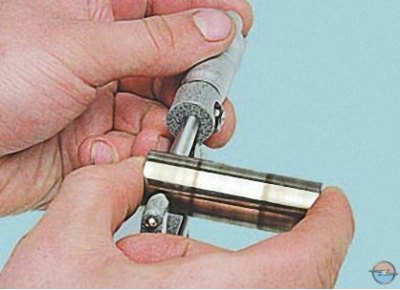
12. …and the piston pin diameter. Calculate the clearance as the difference between the diameters of the holes and the pin. The clearance between the piston pin and the holes in the piston should be 0.009–0.015 mm.
13. Replace broken rings and oil scraper ring expander.
14. Replace the connecting rods if they are deformed.
15. Replace the connecting rod if, during engine disassembly, it is found that the connecting rod bearings have turned in the connecting rod.
Attention! Connecting rods are processed together with caps, therefore they cannot be disassembled.
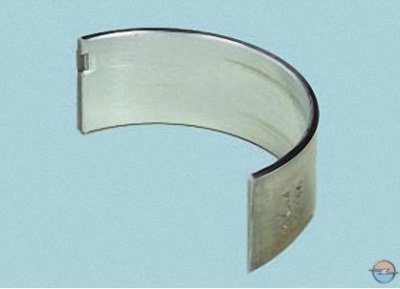
16. Inspect the bearings. If there are any scratches, scoring or delamination of the antifriction layer on their working surface, replace the bearings with new ones. All connecting rod bearings are identical and interchangeable.
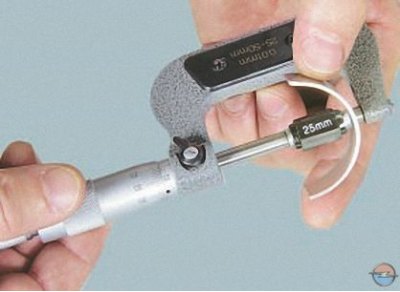
17. Measure the thickness of the connecting rod bearings with a micrometer (Table 2).
Table 2. Parameters of connecting rod bearings of the A16 XER engine
| Insert size | Thickness, mm | Color marking | Code |
| Nominal | 1,485–1,497 | – | 264 N |
| 1st repair | 1,610–1,622 | Blue | 265 A |
| 2nd repair | 1,735–1,747 | White | 266 B |
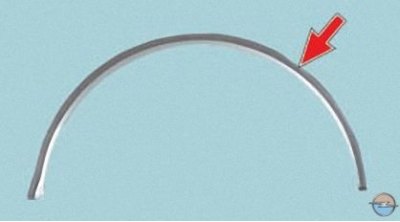
The end surface of the connecting rod bearings of repair sizes is marked with color..
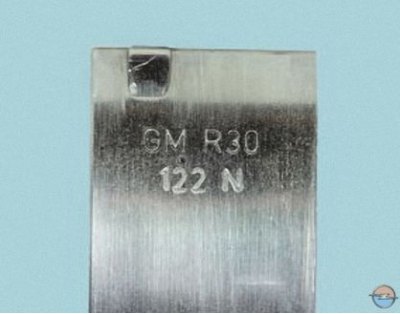
…and a code is applied to the non-working surface of all liners.
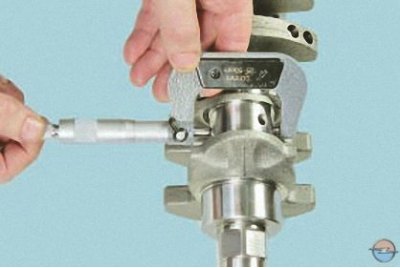
18. Use a micrometer to measure the diameter Dn of the crankshaft connecting rods.
The diameters of the crankshaft connecting rod journals are shown in Table 3.
Table 3. Diameters of connecting rod journals of crankshafts of the A16 XER engine
| Neck size | Diameter, mm | Color marking |
| Nominal | 42,971–42,987 | – |
| 1st repair | 42,721–42,737 | Blue |
| 2nd repair | 42,471–42,487 | White |
19. Install the bearing shells in the connecting rod and its cover, tighten the cover mounting bolts to a torque of 25 N·m and sequentially tighten the bolts first by 30°, and then by 15°.
20. Measure the diameter with a bore gauge Dp connecting rod bearing in three places along the width of the liner and determine the average diameter of the connecting rod bearing.
21. Calculate the connecting rod bearing clearance as the difference Dp and DnThe permissible clearance of the connecting rod bearing is 0.019–0.071 mm.
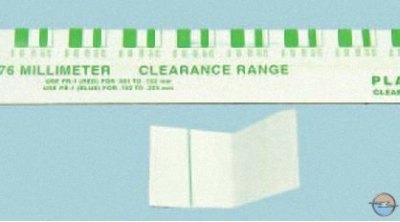
Note: The most accurate way to determine the connecting rod bearing clearance is to use a special deformable strip of Plastigage made of synthetic fiber. The Plastigage kit consists of a set of several strips and a scale.
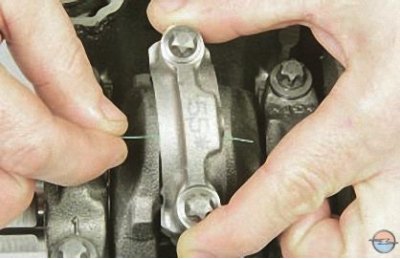
22. To measure connecting rod bearing clearance using Plastigage, place a piece of wire on the crankshaft journal, lubricate the connecting rod bearings with engine oil, and install the connecting rod on the crankshaft journal.
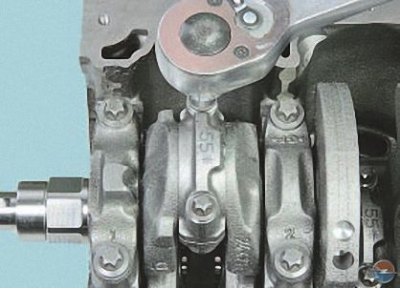
23. Tighten the cover mounting bolts to a torque of 25 N·m and sequentially tighten the bolts first by 30°, then by 15°. In this case, do not turn the connecting rod relative to the crankshaft (if measurements are taken on a removed shaft) or rotate the crankshaft (if the shaft is installed in the engine).
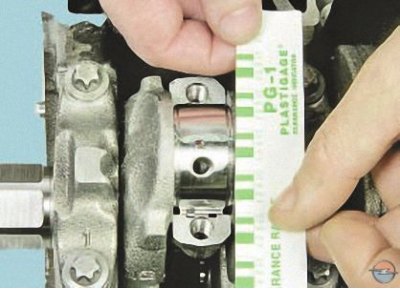
24. Remove the connecting rod cover and compare the width of the deformed wire with the scale divisions. The value of each scale division corresponds to a certain clearance in the bearing.
If the actual clearance is less than the maximum allowable, the previously installed bearings can be reused.
If the gap is greater than the maximum permissible value, the bearing shells on these journals can be replaced with new ones of the nominal thickness and the appropriate class.
If the crankshaft journals are worn and ground to the repair size, replace the bearings with repair ones (increased thickness).
The journals are ground, in addition to the presence of general wear, if they have nicks and scratches or if the ovality and taper are more than 0.005 mm.
25. Measure the thickness of the main bearings with a micrometer (Table 4).
Table 4. Parameters of the main bearings of the A16 XER engine
| Insert size | Thickness, mm | Color marking | Code |
| 1, 2, 4 and 5th bearings | |||
| Nominal | 1,987–1,993 1,993–1,999 | Brown Green | 256 N 257 N |
| 1st repair | 2,112–2,118 2,118–2,124 | Brown/blue Green/blue | 258 A 259 A |
| 2nd repair | 2,237–2,243 2,243–2,249 | Brown/white Green/white | 260 B 261 B |
| 3rd bearing | |||
| Nominal | 1,987–1,993 1,993–1,999 | Brown Green | 859 N 860 N |
| 1st repair | 2,112–2,118 2,118–2,124 | Brown/blue Green/blue | 861 A 862 A |
| 2nd repair | 2,237–2,243 2,243–2,249 | Brown/white Green/white | 863 B 864 B |
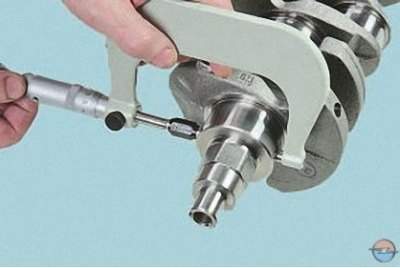
26. Measure the diameter with a micrometer Dn crankshaft main journals (Table 5). The actual clearance between the main bearing shells and the crankshaft main journals is determined using the methods described for connecting rod bearings. The permissible clearance of the crankshaft main bearing is 0.005–0.059 mm.
Table 5. Diameters of the main journals of the crankshaft of the A16 XER engine
| Neck size | Diameter, mm | Color marking |
| Nominal | 54,980–54,997 | Brown, green |
| 1st repair | 54,730–54,747 | Brown, green |
| 2nd repair | 54,482–54,495 | Brown, green |
If the actual calculated clearance is less than the maximum allowable clearance, the previously installed bearings can be reused.
If the gap is greater than the maximum permissible value, the bearing shells on these journals can be replaced with new ones of the nominal thickness and the appropriate class.
If the crankshaft journals are worn and ground to the repair size, replace the bearings with repair ones (increased thickness).
Attention! When re-grinding the connecting rod and main crankshaft necks to the repair size, it is necessary to put an appropriate brand on the first cheek of the crankshaft, for example, "W 0,25" and" K 0,25", respectively.
Visitor comments