


Contents: Removal ⬇ Installation ⬇
Note: Use new main bearing cap bolts when installing.
Removal
1. After removing the engine, proceed as follows.
2. Remove the cylinder head as described in Chapter 20.
3. Remove the oil pan, oil pump inlet pipe and oil pan deflector (where it is applied), as described in Chapter 29.
(The source is on the online website: opelbook.ru)
4. Remove the oil pump as described in Chapter 30.
5. Remove the flywheel or drive disc (depending on the model), as described in Chapters 25 and 26.
6. Remove the pistons and connecting rods as described in Chapter 32.
7. Turn the engine block upside down.
8. The main bearing caps are numbered 1 through 4: No.1 is the one closest to the toothed drive belt. Rear (at the flywheel) the cap is not marked. To ensure the correct orientation of the caps, note that the numbers are read from the coolant pump side when the engine is upside down (see illustration).
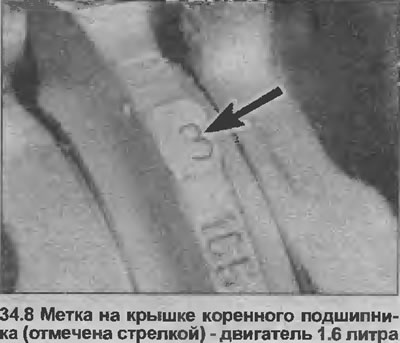
9. Loosen and remove the main bearing cap bolts, remove the caps. If the bearing shells are to be reused, tape them to the corresponding caps.
10. Note that the center bearing shell has axial pressure flanges that determine the crankshaft axial clearance.
11. Lift the crankshaft out of the crankcase (together with the ignition timing sensor wheel, if any).
12. Remove the top liners, mark their position if they are to be reused.
13. The crankshaft, bearings and sensor wheel can be examined for signs of wear and damage as described in Chapter 35, and the block and cylinder bores can be examined as described in Chapter 36.
Installation
14. Check that the crankcase and crankshaft are absolutely clean and that all oil grooves are not clogged; if possible, blow out the oil holes with compressed air and inject clean engine oil into them.
15. If the crankshaft is being replaced, transfer the ignition timing sensor wheel from the old crankshaft to the new one.
16. Wipe the bearing surfaces of the bearings in the crankcase and covers, then install the upper bearings in their places.
17. Note that the protrusion at the end of each insert must fit into the recess in the crankcase or cover (see illustration).
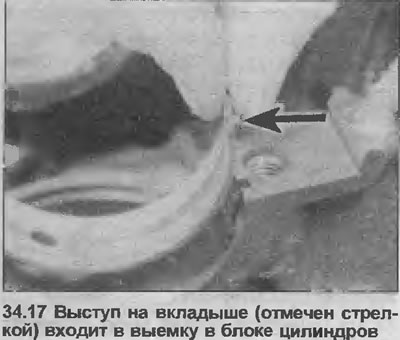
18. If new bearings are being installed, wipe off any protective grease from them.
19. Note that the center bearing shells have thrust flanges that determine the crankshaft axial clearance (see illustration). Note also that the bearings installed in the crankcase have lubrication holes, while in the covers only the center bearing has a lubrication hole.
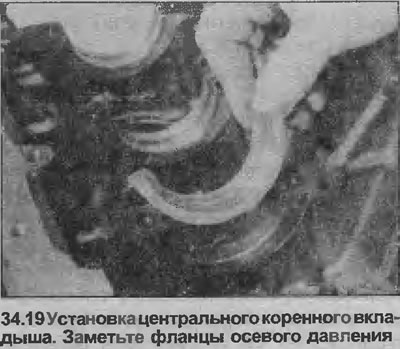
20. After installing the liners in the crankcase and covers, lubricate them with clean engine oil.
21. Fill the sealing lips of the new rear crankshaft oil seal with grease and install it on the end of the crankshaft.
22. Carefully lower the crankshaft into place in the crankcase (see illustration).
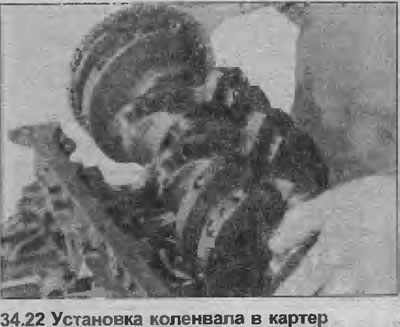
23. If necessary, seat the crankshaft by hitting the balancing bridges with a rubber hammer.
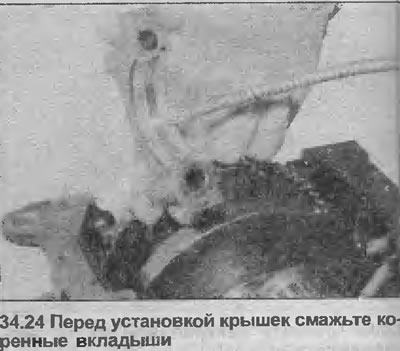
24. Lubricate the main journals and bearings (see illustration), then install main bearing caps No.2, 3 and 4, tighten the new bolts by hand as much as possible.
25. Fill the rear grooves of the rear main bearing cap with sealant (Opel #90485251, or equivalent). Coat the undersides of the bearing cap with sealant (Opel #15 04 200, or equivalent). Install the bearing cap, tightening the new bolts by hand as much as possible.
26. Install the front cover of the cardan bearing No.1, tighten the new bolts by hand as much as possible.
27. Starting from the center bearing cover and working outwards, tighten the cover mounting bolts in two stages to the specified tightening torque Specifications; that is, tighten all bolts to Stage 1 torque, then tighten all bolts to Stage 2 and Stage 3 torque.
28. When all the bolts are fully tightened, continue to apply the special compound into the side grooves of the rear main bearing cap until they are completely filled.
29. Now turn the crankshaft and check that it rotates freely, without any signs of slowing down or jamming.
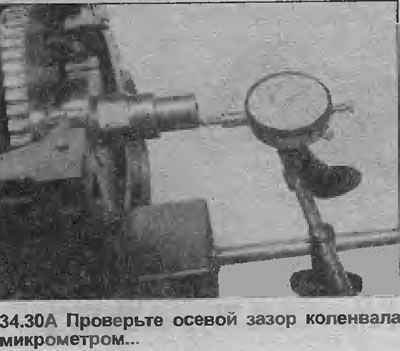
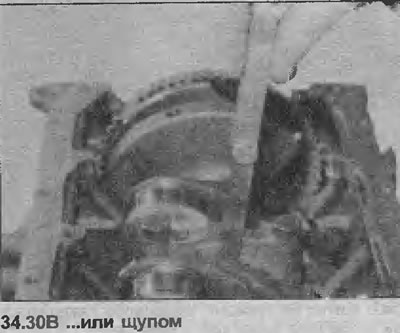
30. Check that the crankshaft axial clearance is within the limits specified in Specifications; use a micrometer for this or insert a feeler gauge between the center bearing thrust flange and the machined surface of the crankshaft (see illustrations). Before measuring, check that the crankshaft is fully moved to one end of the crankcase, creating the largest clearance. Incorrect side clearance will most likely be due to crankshaft wear or improper regrinding, provided that the correct size bearings were installed.
31. Install previously removed components, following the relevant Chapters of this Section.
Visitor comments