
OpelBook.ru
Cars AvtoVAZ Cars Mitsubishi Cars BMW Cars Mercedes Cars Nissan Cars Toyota Cars Chevrolet
English Русский
Български
Беларускі
Український
Српски
Hrvatski
Română
Polski
Slovenský
Magyar
 |  Sitemap  |  Contacts  |    


Main Astra Corsa Insignia Kadett Omega Vectra Zafira Others Articles
Astra F (1991-1998, petrol) Astra G (1998-2004, petrol) Astra G (1998-2004) Astra H (2004-2009) Astra J (2009-2015, petrol)
  • Main
  • Astra
  • Astra G
  • Power unit
  • Engine repair
  • Pistons and connecting rods — removal

Pistons and connecting rods — removal (Opel Astra G)

            0

1. On 1.4, 1.6 and 1.8 L engines, remove the cylinder head and oil pan. On 1.4 and 1.6 L engines, remove the oil deflector. On all engines, remove the oil receiver by unscrewing the bolts.

2. On 2.0L engines, remove the cylinder head and the lower section of the oil pan. Unscrew the bolts of the upper section of the oil pan, unscrew the bolts securing the oil receiver to the balance mechanism (or the frame of the main bearing caps). Move the upper section of the pan to the front of the engine, unscrew the remaining mounting bolts and remove the oil receiver. Unscrew the bolts and remove the oil deflector. Evenly and gradually unscrew the mounting bolts of the balance mechanism (or the frame of the main bearing caps) and remove these nodes.

3. Check for a rim on the top of the cylinders. The rim should be removed with a reamer or scraper without damaging the cylinder wall. The formation of a rim indicates increased wear of the cylinder.

4. Using feeler gauges, check the axial play in the connecting rods (see photo). If the clearance exceeds the norm, replace the connecting rods.
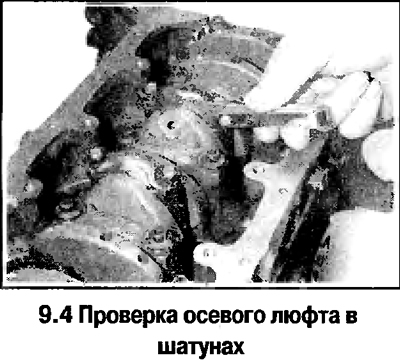
4. Using feeler gauges, check the axial play in the connecting rods (see photo). If the clearance…


5. Apply paint or punch (see photo)on the ground surface of the connecting rod and cover is the cylinder number (if the engine was disassembled, then you should find these marks). Cylinder #1 is located on the camshaft belt side.
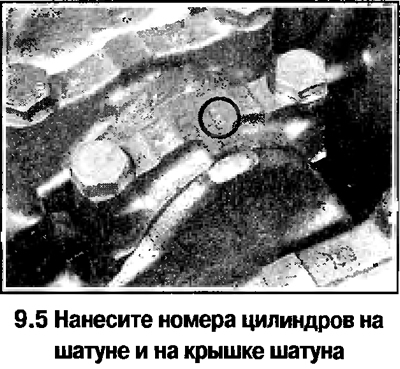


5. Apply paint or punch (see photo)on the ground surface of the connecting rod and cover is the…


5. Set pistons of cylinders 1 and 4 to the BDC position.

(Text copied from this portal: www.OPELBOOK.ru)

6. Unscrew the connecting rod cap bolts of the connecting rod of the 1st cylinder. Remove the cap and take out the lower connecting rod bearing. If the bearing is to be installed again, then glue it with adhesive tape to the removed cap.

Attention! On some engines, the split surfaces of the connecting rod caps and connecting rods are not ground, since the cap is processed together with the connecting rod both on the plane and under the diameter of the bearings, and then broken off. On these engines, measures should be taken to ensure that these surfaces are not affected during disassembly and assembly. Otherwise, premature wear of the connecting rod occurs.


7. Tape the connecting rod cap bolt threads. Use a hammer handle to push the piston into the cylinder and pull the piston out through the top of the cylinder block. Remove the upper connecting rod bearing and tape it to the removed connecting rod.

8. Place the cover on the connecting rod and secure it with nuts, without disturbing the previous order of assembly of the parts.


9. Repeat the above operations and remove the connecting rod with the piston of the 4th cylinder.

10. Similarly, remove the connecting rods with pistons from the 2nd and 3rd cylinders.


This article is available at russian, bulgarian, belarusian, ukrainian, serbian, croatian, romanian, polish, slovak, hungarian
Checking the article: Kornev Georgy

Share information:

Previous articles
Opel Astra G: Engine repair
Next articles

Cylinder head — assembly
Cylinder head and valves — cleaning and checking
Cylinder head — disassembly
Engine Overhaul — Disassembly Procedure
Power unit — dismantling and installation
Engine — removal and installation
Crankshaft — removal
Cylinder Block — Cleaning and Checking
Connecting rod and piston group — check
Crankshaft — check
Main and connecting rod bearings — inspection
Engine Overhaul — Assembly Procedure


See similar ones from other Opel car manuals:
▶ Replacing pistons with connecting rods Opel Insignia A (2008-2017)
▶ Installing pistons with connecting rods into cylinders Opel Kadett E (1984-1995)
▶ Pistons and connecting rods Opel Omega B (1993-1999)
▶ Pistons and connecting rods — removal and installation Opel Vectra A (1988-1995, petrol)
▶ Pistons and connecting rods — removal, inspection and… Opel Frontera A (1991-1998, petrol)
Link to this page in different formats

Visitor comments


No comments yet


How much will 25 + 35 =


Astra J (2009-2015, petrol) 
  • General information
  • Vehicle device
  • User manual
  • Faults en route
  • Maintenance
  • Power unit
  • Engine repair
  • Cooling and lubrication system
  • Engine power system
  • Exhaust system
  • Transmission
  • Clutch
  • Car gearbox
  • Drive shafts
  • Chassis
  • Front suspension
  • Rear suspension
  • Steering
  • Brake system
  • Wheels and tires
  • Body
  • Exterior
  • Interior
  • Doors and windows
  • Body Care
  • Heating and air conditioning
  • Security systems
  • Electrical equipment
  • Equipment and devices
  • Lighting and signaling
  • Power devices
  • Electrical circuits
Astra H (2004-2009) 
  • General information
  • Introduction to the guide
  • Troubleshooting
  • User manual
  • Maintenance
  • Power unit
  • Engine repair
  • Cooling and heating
  • Power and exhaust system
  • Ignition system
  • Launch and charge system
  • Transmission
  • Mechanical gearbox
  • Automatic gearbox
  • Drive shafts
  • Chassis
  • Brake system
  • Car suspension
  • Steering
  • Body
  • Interior
  • Exterior
  • Electrical equipment
  • Equipment and devices
  • Electrical circuits
Astra G (1998-2004) 
  • General information
  • Introduction to manual
  • User manual
  • Maintenance
  • Power unit
  • SOHC gasoline engines
  • DOHC gasoline engines
  • Diesel engines 1.7 and 2.0
  • Engine repair
  • Cooling system
  • Supply system
  • Injection system (gasoline)
  • Injection system (diesel)
  • Exhaust system
  • Charge and launch system
  • Ignition system (gasoline)
  • Preheat system (diesel)
  • Transmission
  • Manual gearbox
  • Automatic gearbox
  • Clutch
  • Drive shafts
  • Chassis
  • Brake system
  • Wheel suspension
  • Steering
  • Body
  • Exterior
  • Interior
  • Doors and windows
  • Ventilation and heating
  • Electrical equipment
  • Equipment and devices
  • Electrical circuits
Astra G (1998-2004, petrol) 
  • General information
  • User manual
  • Car care
  • Maintenance
  • Power unit
  • Single shaft engines
  • Twin shaft engines
  • Engine repair
  • Cooling and heating
  • Fuel and exhaust systems
  • Starting and charging system
  • Ignition system
  • Transmission
  • Clutch
  • Mechanical gearbox
  • Automatic gearbox
  • Drive shafts
  • Chassis
  • Brake system
  • Car suspension
  • Steering
  • Body
  • Interior
  • Exterior
  • Electrical equipment
  • Equipment and devices
  • Wiring diagrams Opel Astra
  • Wiring diagrams Opel Zafira
Astra F (1991-1998, petrol) 
  • General information
  • Maintenance
  • Power unit
  • Engine in car
  • Engine removed
  • Cooling system
  • Heating and ventilation
  • Fuel supply (carburetor)
  • Fuel supply (injector)
  • Emission control
  • Ignition system
  • Transmission
  • Clutch
  • Mechanical gearbox
  • Automatic gearbox
  • Drive shafts
  • Chassis
  • Brake system
  • Car suspension
  • Steering
  • Body
  • Exterior
  • Interior
  • Electrical equipment
  • Equipment and devices
  • Electrical circuits
OpelBook.ru © 2017–2026 · Mobile version · · Sitemap: EN BG BY UA RS HR RO PL SK HU · Feedback · Site search
Astra F, petrol · Astra G, petrol · Astra G · Astra H · Astra J, petrol · Corsa B · Corsa C, petrol · Corsa C · Insignia A · Kadett D · Kadett E · Omega A · Omega B · Omega B2 · Vectra A, petrol · Vectra A · Vectra B, petrol · Vectra B · Vectra C · Zafira A, petrol · Frontera A, petrol · Frontera B · Ascona C · Vivaro A ·
We want your visit to be comfortable 🤝! We use cookies 🍪 to make that happen.