
OpelBook.ru
Cars AvtoVAZ Cars Mitsubishi Cars BMW Cars Mercedes Cars Nissan Cars Toyota Cars Chevrolet
English Русский
Български
Беларускі
Український
Српски
Hrvatski
Română
Polski
Slovenský
Magyar
 |  Sitemap  |  Contacts  |    


Main Astra Corsa Insignia Kadett Omega Vectra Zafira Others Articles
Astra F (1991-1998, petrol) Astra G (1998-2004, petrol) Astra G (1998-2004) Astra H (2004-2009) Astra J (2009-2015, petrol)
  • Main
  • Astra
  • Astra G
  • Power unit
  • Engine repair
  • Cylinder head and valves — cleaning and checking

Cylinder head and valves — cleaning and checking (Opel Astra G)

            0

Contents: Cleaning ⬇ Examination ⬇
1. Thorough cleaning of the cylinder head and valve mechanism parts followed by inspection will allow us to assess the scope of work required to repair the valve mechanism.

Note: If the engine has been overheating frequently, the cylinder head may have become warped, carefully check for signs of head deformation.


Cleaning


2. Clean the cylinder head sealing surfaces.

3. Clean the combustion chambers, all holes and channels from carbon deposits, then wash the cylinder head with solvent.

(Text copied from an online resource: OpelBook.ru)

4. Remove heavy carbon deposits from valves.

Examination


Note: Before concluding that parts need to be reground, be sure to complete all of the inspection procedures described below.


Cylinder head

5. Carefully inspect the head for cracks, signs of coolant penetration, and other damage. If cracks are found, replace the cylinder head.

6. Check the deformation of the cylinder head split plane (see photo)If the split plane is found to be warped, the head should be replaced (not subject to polishing).
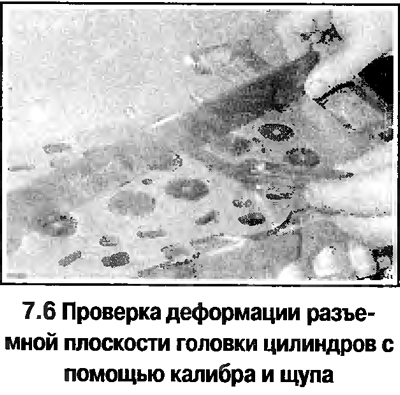
6. Check the deformation of the cylinder head split plane (see photo)If the split plane is found to…


7. Check the condition of the valve seats. In the presence of pitting (pits), cracks, traces of burnout, you will need to repair the head in the workshop of a car service station. Minor defects can be removed by lapping the valve.


8. Check the wear of the guide bushings (wear of bushings is one of the reasons for the appearance of bluish smoke from the exhaust pipe).. To do this, insert the valve into the corresponding guide bushing and rock it from side to side. A small, barely noticeable play is acceptable. If the valve play in the bushing is significant, measure the valve diameter. If the valve diameter has noticeably decreased due to wear, replace the valve. If the valve stem diameter is normal, replace the guide bushing (performed in a car service workshop). It is also recommended to check the clearance between the bushing and the valve, by the difference between the measured inner diameter of the bushing and the diameter of the valve. New bushings are pressed in after they have been deeply cooled. The amount of bushing protrusion above the cylinder head is specified in the Technical Data.

9. If the guide bushings are to be changed, the valve seats should be reground (or to over-center) only after pressing in new bushings.

Valves

10. Check the valves for cracks, burn marks, scoring and a bead formed due to wear on the rods. Check the bend. Roll the valves on a smooth hard surface. Check the wear on the end of the rod. If any signs of wear or damage are found, replace the valve.

11. If this check reveals that the valve is in satisfactory condition, then measure the valve diameter in several places (see photo). A noticeable difference in diameter indicates wear of the valve stem. If a noticeable difference in diameter is found in at least two places, replace the valve.
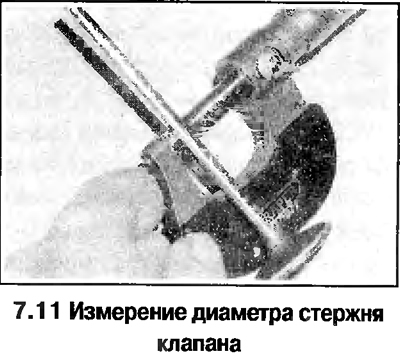


11. If this check reveals that the valve is in satisfactory condition, then measure the valve…


12. If the valves are in satisfactory condition, they should be ground to the seats. If the seats have only minor damage, or the seat has been reground, then lapping can be done with a fine-grained compound. A coarse-grained lapping compound should only be used if traces of deep wear or severe burnout of the seats are detected. In this case, the cylinder head and valves should be checked by an experienced specialist to determine whether the seats should be re-countersunk or replaced.

13. Before lapping, place the cylinder head on a flat surface with the combustion chambers facing up.

14. Apply a thin layer of lapping paste to the seat chamfer. Perform lapping by turning the device 180° in both directions and periodically lifting the valve to evenly redistribute the abrasive material (see photo).
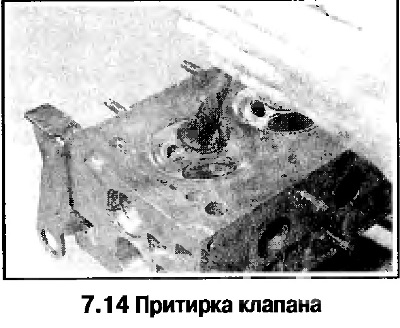
14. Apply a thin layer of lapping paste to the seat chamfer. Perform lapping by turning the device…


15. Lapping on a coarse compound ends after the formation of a monotonous matte belt on the chamfers of the valve and seat (see photo). Wipe the valve and seat from the remaining paste and continue grinding with a fine-grained compound. Grinding is considered complete when a uniform, solid, grayish belt forms on the valve and seat chamfers. Further grinding is not allowed, since excessive wear of the seat may make subsequent repairs impossible.
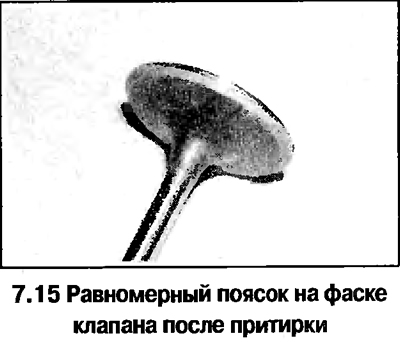


15. Lapping on a coarse compound ends after the formation of a monotonous matte belt on the…


16. After finishing grinding all valves, thoroughly wash all parts with solvent.

Valve Mechanism Parts

17. Check the springs for signs of chipping and damage. A rough check of the spring condition can be made by comparing the removed spring with a new one.

18. Check the spring deviation from the vertical using a square and compare with the standard

19. On single-shaft 1.6L engines, bearings are built into the support washers of the exhaust valve springs, ensuring the valve rotation and protecting the seat from carbon deposits. If the bearing is jammed or damaged, replace the support washer.

20. If at least one of the springs is damaged, has an increased deviation from the vertical, or has lost elasticity, then replace all the springs in the set. Keep in mind that during major repairs, it is recommended to change the valve springs regardless of their condition. The valve stem seals are changed regardless of their condition.


This article is available at russian, bulgarian, belarusian, ukrainian, serbian, croatian, romanian, polish, slovak, hungarian
Checking the article: Kornev Georgy

Share information:

Previous articles
Opel Astra G: Engine repair
Next articles

Cylinder head — disassembly
Engine Overhaul — Disassembly Procedure
Power unit — dismantling and installation
Engine — removal and installation
Engine Overhaul — General Information
Compression Test — Description and Interpretation
Cylinder head — assembly
Pistons and connecting rods — removal
Crankshaft — removal
Cylinder Block — Cleaning and Checking
Connecting rod and piston group — check
Crankshaft — check


See similar ones from other Opel car manuals:
▶ Cleaning and checking the condition of the cylinder head Opel Corsa B (1993-2000)
▶ Cleaning and checking the technical condition of the… Opel Insignia A (2008-2017)
▶ Cylinder head and valves — cleaning and inspection Opel Omega B2 (1999-2003)
▶ Checking the cylinder head Opel Kadett E (1984-1995)
▶ Checking the cylinder head and cylinder block for… Opel Vectra A (1988-1995)
Link to this page in different formats

Visitor comments


No comments yet


How much will 44 + 29 =


Astra J (2009-2015, petrol) 
  • General information
  • Vehicle device
  • User manual
  • Faults en route
  • Maintenance
  • Power unit
  • Engine repair
  • Cooling and lubrication system
  • Engine power system
  • Exhaust system
  • Transmission
  • Clutch
  • Car gearbox
  • Drive shafts
  • Chassis
  • Front suspension
  • Rear suspension
  • Steering
  • Brake system
  • Wheels and tires
  • Body
  • Exterior
  • Interior
  • Doors and windows
  • Body Care
  • Heating and air conditioning
  • Security systems
  • Electrical equipment
  • Equipment and devices
  • Lighting and signaling
  • Power devices
  • Electrical circuits
Astra H (2004-2009) 
  • General information
  • Introduction to the guide
  • Troubleshooting
  • User manual
  • Maintenance
  • Power unit
  • Engine repair
  • Cooling and heating
  • Power and exhaust system
  • Ignition system
  • Launch and charge system
  • Transmission
  • Mechanical gearbox
  • Automatic gearbox
  • Drive shafts
  • Chassis
  • Brake system
  • Car suspension
  • Steering
  • Body
  • Interior
  • Exterior
  • Electrical equipment
  • Equipment and devices
  • Electrical circuits
Astra G (1998-2004) 
  • General information
  • Introduction to manual
  • User manual
  • Maintenance
  • Power unit
  • SOHC gasoline engines
  • DOHC gasoline engines
  • Diesel engines 1.7 and 2.0
  • Engine repair
  • Cooling system
  • Supply system
  • Injection system (gasoline)
  • Injection system (diesel)
  • Exhaust system
  • Charge and launch system
  • Ignition system (gasoline)
  • Preheat system (diesel)
  • Transmission
  • Manual gearbox
  • Automatic gearbox
  • Clutch
  • Drive shafts
  • Chassis
  • Brake system
  • Wheel suspension
  • Steering
  • Body
  • Exterior
  • Interior
  • Doors and windows
  • Ventilation and heating
  • Electrical equipment
  • Equipment and devices
  • Electrical circuits
Astra G (1998-2004, petrol) 
  • General information
  • User manual
  • Car care
  • Maintenance
  • Power unit
  • Single shaft engines
  • Twin shaft engines
  • Engine repair
  • Cooling and heating
  • Fuel and exhaust systems
  • Starting and charging system
  • Ignition system
  • Transmission
  • Clutch
  • Mechanical gearbox
  • Automatic gearbox
  • Drive shafts
  • Chassis
  • Brake system
  • Car suspension
  • Steering
  • Body
  • Interior
  • Exterior
  • Electrical equipment
  • Equipment and devices
  • Wiring diagrams Opel Astra
  • Wiring diagrams Opel Zafira
Astra F (1991-1998, petrol) 
  • General information
  • Maintenance
  • Power unit
  • Engine in car
  • Engine removed
  • Cooling system
  • Heating and ventilation
  • Fuel supply (carburetor)
  • Fuel supply (injector)
  • Emission control
  • Ignition system
  • Transmission
  • Clutch
  • Mechanical gearbox
  • Automatic gearbox
  • Drive shafts
  • Chassis
  • Brake system
  • Car suspension
  • Steering
  • Body
  • Exterior
  • Interior
  • Electrical equipment
  • Equipment and devices
  • Electrical circuits
OpelBook.ru © 2017–2026 · Mobile version · · Sitemap: EN BG BY UA RS HR RO PL SK HU · Feedback · Site search
Astra F, petrol · Astra G, petrol · Astra G · Astra H · Astra J, petrol · Corsa B · Corsa C, petrol · Corsa C · Insignia A · Kadett D · Kadett E · Omega A · Omega B · Omega B2 · Vectra A, petrol · Vectra A · Vectra B, petrol · Vectra B · Vectra C · Zafira A, petrol · Frontera A, petrol · Frontera B · Ascona C · Vivaro A ·
We want your visit to be comfortable 🤝! We use cookies 🍪 to make that happen.