


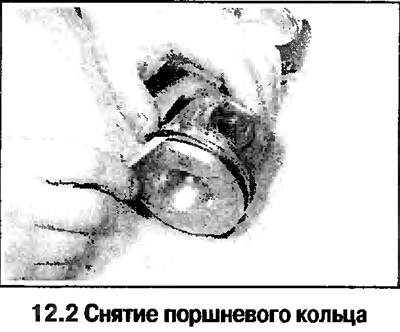
2. Carefully move the ring apart, moving it to the top of the piston. To prevent the ring from falling into an empty groove when removing it, place two or three old feeler gauges under the ring (see photo).
3. Scrape off the carbon deposits from the piston crowns. After removing the top rough layer of carbon deposits, clean the piston crowns by hand with a wire brush (or with sandpaper on a cloth backing).
4. Carefully remove carbon deposits from the piston grooves using an old broken piston ring.
5. Wash the piston assembly with the connecting rod in a solvent, dry thoroughly. Make sure that the oil drain grooves in the piston ring grooves are clean.
6. Carefully check for cracks on the piston skirt, on the piston pin bosses and in the areas between the piston ring grooves.
7. Check for chips and scoring on the friction area of the piston skirt, traces of burning along the edges of the bottom. If chips and scoring are observed, this indicates frequent overheating of the engine, one of the causes of which may be abnormal combustion of the fuel mixture. In this case, a thorough check of the fuel, lubrication and cooling systems is required. Traces of melting on the side surface of the piston indicate a breakthrough of gases from the combustion chamber. Burning of the piston bottom or burnt areas along the edges of the bottom indicate abnormal engine operation due to incorrect ignition timing (too early ignition), or as a result of detonation. If the above defects are detected, their cause must be found and eliminated, otherwise the causes of such wear may continue to manifest themselves in the future. The causes of abnormal engine operation may be air leakage on the intake manifold, incorrect ignition timing, or fuel injection system failure.
8. Piston corrosion in the form of small pits (pitting) indicates penetration into the combustion chamber (and also in the crankshaft housing) coolant. Here again, it is necessary to find the cause and eliminate it.
9. Measure the diameter of the piston skirt perpendicularly and parallel to the axis of the piston pin with a micrometer and compare the result with the standard. The piston size group is stamped on its bottom. If the piston wear exceeds the maximum permissible value, the piston must be replaced. Determine the clearance between the piston and the cylinder by subtracting the piston diameter from the cylinder diameter, measured in the same direction. If the clearance exceeds the standard, replace the piston. If the piston moves freely in the upper part of the cylinder and moves with difficulty in its lower part, the taper of the cylinder clearly exceeds the standard.
10. Carefully check the connecting rods for damage such as cracks in the heads near the piston pins and in the places where the connecting rod bearings are installed. Check if there is any deformation of the connecting rod body (twisting or bending). Damage to connecting rods is unlikely and only occurs in cases of engine seizure or severe overheating. A thorough inspection of connecting rods can only be performed at a car service center.
11. On all engines under consideration, the piston pins are inserted with tension into the connecting rod head. The pistons should be removed from the connecting rods at a car service center.
Attention! The manufacturer strongly advises against disassembling the piston-connecting rod unit. The piston is replaced together with the connecting rod.
Visitor comments