


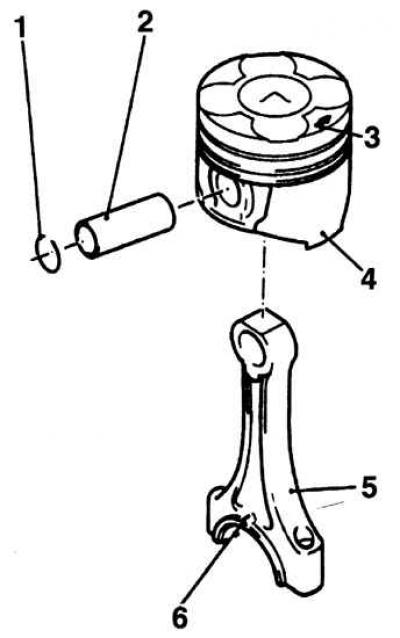
1 – retaining ring
2 – piston pin
3 – arrow on the piston head
4 – piston
5 – connecting rod
6 – Connecting rod mark Warning! New bolts and nuts must be used to secure the lower connecting rod head.
Removal
1. Remove the cylinder head, oil pan and oil pickup pipe.
2. On all models, if there is carbon deposits on the top of the cylinder, remove them with a soft scraper. The presence of a step on the top of the cylinder indicates excessive cylinder wear and the need to rebore the engine cylinder.
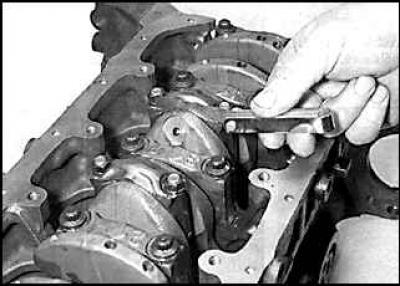
3. Check the side clearance of all connecting rod lower ends.
4. Using a hammer and center punch or paint, mark the position of the small end cap and the cylinder number.
5. Turn the crankshaft so that the pistons of the first and fourth cylinders are at the bottom dead center.
6. Unscrew the bolts securing the lower connecting rod cover of the first cylinder. Remove the lower connecting rod cover.
7. Using the handle of a hammer, push the piston up the cylinder block and remove it from the cylinder block.
8. Install the connecting rod cap onto the lower connecting rod head and screw it on with nuts, which will keep them together and prevent them from getting mixed up.
9. Remove the piston of the fourth cylinder in the same way.
10. Turn the crankshaft 180° to set the pistons of the second and third cylinders to the bottom dead center and remove the pistons in the same way.
Examination
Measuring the piston pin diameter
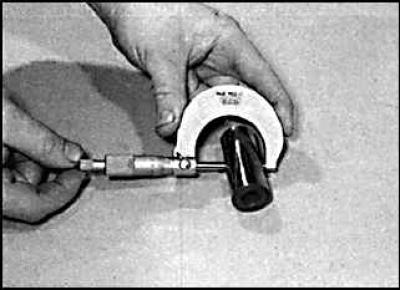
Before checking the pistons with connecting rods, remove the piston rings from the pistons and thoroughly clean the pistons.
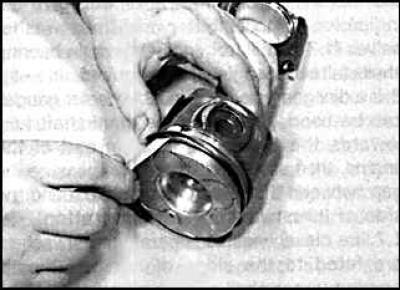
1. To remove piston rings from pistons, loosen the ring, insert two or three old feeler gauge blades evenly around the circumference under the ring and slide the ring off the piston using them.
Warning! Be careful not to scratch the piston with the ring ends. The rings are very fragile and can crack if you squeeze them too hard. The working edges of the piston rings are very sharp, so handle them very carefully to avoid cutting yourself. Keep each set of rings with the pistons for reinstallation.
2. Clean all traces of carbon from the top of the piston.
3. Remove carbon deposits from the piston ring grooves using an old piston ring.
4. After removing the deposits, clean the piston and connecting rod with a suitable solvent and wipe dry.
5. Carefully inspect each piston for cracks around the skirt and piston pin holes.
6. Check for wear on the piston skirt, bore in the piston head, and burn marks on the top of the piston.
7. Traces of pitting corrosion on the piston indicate that coolant has entered the combustion chamber. It is necessary to find the cause of the liquid entering the combustion chamber and eliminate it.
8. Measure the piston diameter.
9. Determine the piston clearance in the cylinder by subtracting the piston diameter from the cylinder diameter and dividing by two.
10. Check each connecting rod for wear, cracks, and distortion.
11. The piston pins are installed with a sliding fit and are fixed in the piston by two retaining rings. On these engines, the pistons and connecting rods can be separated as follows.
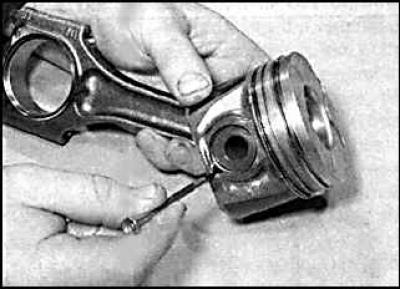
12. Using a thin screwdriver blade, remove the retaining ring from the piston and push out the piston pin by hand. When reinstalling the piston pin, use only new retaining rings.
13. Check the piston pin and big end bearing for wear.
14. Connecting rods usually do not require replacement unless the engine has seized up beforehand.
15. Assemble the piston and connecting rod so that the arrow on the piston head points in the opposite direction from the mark on the connecting rod.
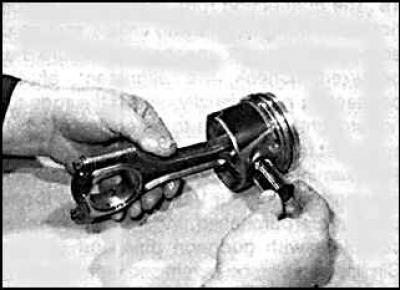
16. Lubricate the piston pin and insert it into the piston and connecting rod upper head. Check that the piston rotates easily and freely on the piston pin.
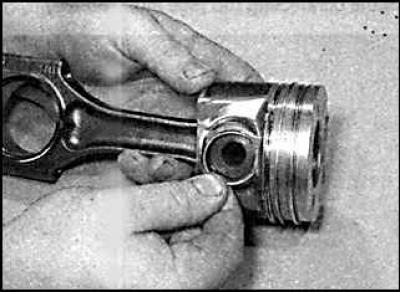
17. Secure the piston pin with new circlips. Check that each circlip is correctly positioned in the piston groove. Install the circlips with their locks facing upward.
18. The cut in the retaining ring must point upwards towards the piston.
Installing pistons with connecting rods
The engines use both standard bearing shells and oversized ones, after regrinding the crankshaft. The required size of the shell can be determined after measuring the crankshaft journal.
1. Clean the back of the connecting rod bearing and the area where it fits into the connecting rods and connecting rod caps.
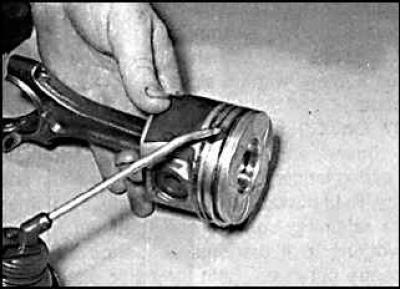
2. Lubricate the pistons and piston rings with clean engine oil and position the piston ring gaps as required.
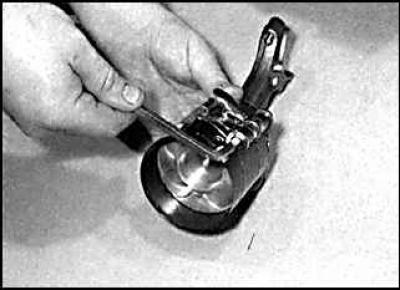
3. The installation of pistons should begin with the first cylinder. Compress the piston rings on the piston with a special device for compressing piston rings.
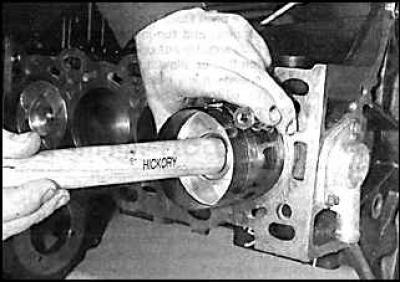
4. Insert the piston with the mandrel compressing the rings into the top of the first cylinder. The arrow on the piston head should point toward the timing chain. Using a wooden block or a hammer handle, push the piston into the cylinder.
5. Check the alignment of the lower head of the connecting rod with the crankshaft journal and, if necessary, tighten the piston with the connecting rod and install the lower head of the connecting rod with the liner on the crankshaft journal.
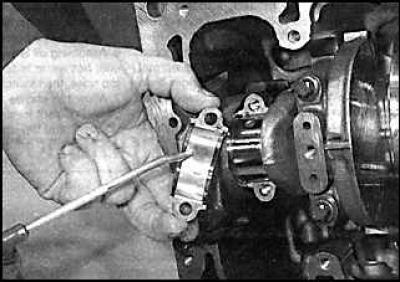
6. Install the connecting rod lower head cover with the insert. The protrusion on the connecting rod cover should be directed towards the flywheel.
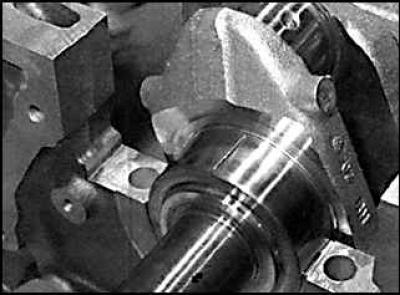
7. Tighten the mounting bolts to the required torque in several stages.
8. Install the remaining three pistons and connecting rods in the same manner.
9. Turn the crankshaft and check that it rotates easily and without binding.
10. Install the oil pickup pipe, oil pan and cylinder head.
Visitor comments